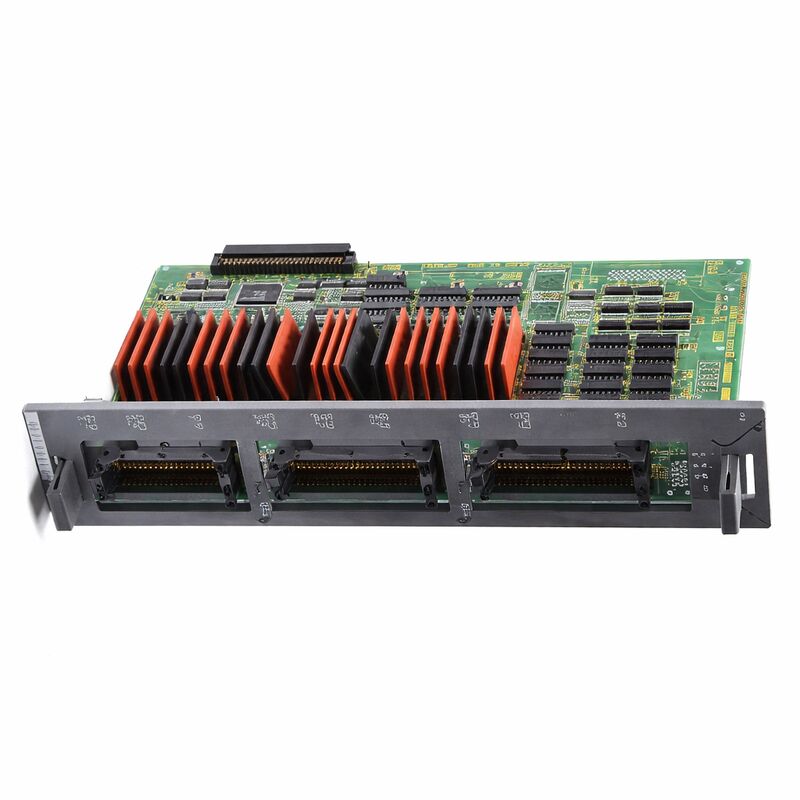
FANUC A16B-2200-0950 | Sink Type 104/80 I/O PCB with Hi-Speed Skip — Series 16-B (F16M/T), Japan Origin
Part Number: A16B-2200-0950
Manufacturer: FANUC Corporation (Japan)
Product Type: Machine I/O PCB with Hi-Speed Skip (Sink Type)
Board Series: A16B-2200
I/O Configuration: 104 Digital Inputs (DI) / 80 Digital Outputs (DO)
Output Type: Sink (NPN, current sinking)
Hi-Speed Skip: Included
Compatible Systems: FANUC Series 16-B, F16M, F16T (F16B)
Required Companion: A20B-9001-0480 (sold separately)
Status: Discontinued by Manufacturer
Overview
The A16B-2200-0950 is the machine I/O board for FANUC's Series 16-B CNC, providing 104 digital inputs and 80 digital outputs in a sink-type configuration — and critically, adding the high-speed skip function that distinguishes it from the -0955 variant with otherwise identical I/O capacity.
The inclusion of the hi-speed skip circuitry makes this the board required for Series 16-B installations where on-machine probing, tool length measurement, or skip-signal-dependent compensation cycles are part of the machining process.
Note that the A16B-2200-0950 does not include the companion module A20B-9001-0480, which is required for full functionality. This companion module must be sourced separately.
Installations that need a replacement board without sourcing a new companion module can often reuse the existing A20B-9001-0480 from the machine being repaired, provided that module is confirmed functional.
The board covers the full machine I/O range that a Series 16-B controlled machining centre requires: every limit switch, proximity sensor, door-closed confirmation, and mode-selection input feeds through its 104 input channels.
Every relay, solenoid, indicator, and auxiliary device output drives through its 80 output channels.
And for machines equipped with probing systems, the hi-speed skip inputs provide the precise, time-critical interface between the probe's trigger signal and the CNC's position latch mechanism.
Key Specifications
| Parameter |
Value |
| Part Number |
A16B-2200-0950 |
| Manufacturer |
FANUC Corporation |
| Product Type |
Machine I/O PCB (Sink, with Hi-Speed Skip) |
| Board Series |
A16B-2200 |
| Digital Inputs (DI) |
104 |
| Digital Outputs (DO) |
80 |
| Output Type |
Sink (NPN / current sinking) |
| Hi-Speed Skip |
Included |
| Required Companion |
A20B-9001-0480 (not included) |
| Field Voltage |
24V DC |
| Compatible CNC |
Series 16-B, F16M, F16T (F16B) |
| Origin |
Japan |
| Operating Temperature |
0 – 55°C |
| Status |
Discontinued by Manufacturer |
| Condition Available |
New (surplus) / Refurbished / Repaired |
What Hi-Speed Skip Does — and Why It Matters
The ordinary PMC inputs on any FANUC I/O board have a response latency determined by the I/O scan cycle time. The PMC scans its input addresses periodically — checking the state of each input during each scan pass.
There is a delay between when a field input changes state and when the PMC first reads the change.
For most machine functions, this delay is inconsequential: a door-closed switch, a tool magazine position sensor, or a cycle-start button can all tolerate the PMC scan cycle time without any visible effect on machine operation.
The hi-speed skip input is architecturally different. When a signal is received on the hi-speed skip input, the board does not wait for the PMC scan cycle. Instead, the board immediately generates a hardware interrupt to the CNC.
The CNC captures (latches) the current axis positions at that instant — before the signal's change has even been fully processed by software. The result is a position measurement that reflects where the axes were at the moment the skip signal fired, not where they were a few milliseconds later when software first read the input.
This hardware-latched position capture is essential for probing accuracy.
A touch-triggered probe moving at feed rate into a workpiece surface triggers at a specific geometric point on the surface.
The skip input captures the axis positions at that trigger moment.
The CNC uses those latched positions to determine the probe contact point's coordinates with high precision.
If the response were delayed by a full PMC scan cycle, the axis would have moved during the delay, and the captured coordinates would be systematically offset from the true contact point.
Application: Series 16-B (F16B) Machine Probing Cycles
The Series 16-B CNC — marketed under the F16M and F16T designations for machining centre and turning centre applications respectively — was widely deployed in high-precision machine tool installations of its era.
Many of these machines were equipped with on-machine measurement systems: spindle-mounted touch probes for workpiece measurement and tool setting probes for automatic tool length measurement.
These measurement systems are common in aerospace, automotive, and precision mould-and-die applications, where in-process measurement is part of the machining strategy rather than an afterthought.
The A16B-2200-0950's hi-speed skip circuitry enables these measurement cycles.
Without it, the probe would trigger but the position capture would be imprecise, rendering the measurement results unreliable.
For machines used in precision manufacturing where probing cycles are essential, a replacement board must include the hi-speed skip function.
Replacing the A16B-2200-0950 with the -0955 (which lacks hi-speed skip) would eliminate the probing capability, even if the machine's other I/O functions continued normally.
I/O Capacity and Machine Wiring Architecture
Beyond the hi-speed skip function, the A16B-2200-0950's 104/80 I/O capacity supports the full machine I/O requirements of a Series 16-B controlled machine. The 104 inputs accommodate the complete machine sensor and switch complement.
The 80 outputs cover all controlled machine actuators.
The sink-type output designation determines the wiring convention. Sink outputs pull the output terminal to 0V when active.
Field devices connect from the 24V supply rail to the output terminal, so the device drives current when the output is active.
Machine tool wiring for Series 16-B machines using the -0950 board follows this convention throughout its 80 output channels.
Every replacement board must maintain the same sink-type designation.
FAQ
Q1: The machine's probing cycles have become inaccurate. Repeated measurements of the same feature show excessive scatter. The probe and stylus hardware test as correct. Could the A16B-2200-0950 be the cause?
Increased scatter in probing measurement without hardware probe faults points to a problem with the position capture mechanism.
The hi-speed skip input must trigger a hardware-latched position capture within microseconds of the probe contact.
If the board's skip input circuit is degraded — increased response time, noise on the skip signal input, or intermittent capture failures — each measurement cycle captures positions with different latency, producing the scatter observed.
Test the skip signal response time if measurement equipment is available, or replace the board with a confirmed functional equivalent.
Q2: What happens if a replacement board without hi-speed skip (such as the -0955) is installed in a machine that requires the A16B-2200-0950?
The non-skip board will serve all 104 inputs and 80 outputs normally. Machine I/O functions — limit switches, solenoids, indicators, mode selections — will all work as before. However, the hi-speed skip input will not function.
Any G31 skip cycle or measurement macro that depends on the hi-speed skip input will produce unreliable results, as the position capture will revert to software timing with its associated latency.
For machines using probing cycles in their production process, this is an unacceptable functional loss.
Q3: The A20B-9001-0480 companion module is no longer in service but the A16B-2200-0950 board is being replaced. Must the companion module also be replaced?
If the existing A20B-9001-0480 is functional, it can typically be reused with the replacement A16B-2200-0950 board.
The companion module provides functions that support the main I/O board, and if those functions were working correctly before the board failure, the module itself is likely not at fault.
Inspect the module visually and check its connector contacts before reinstalling it with the new board.
Q4: How is the hi-speed skip input physically connected to the probe system?
The probe trigger signal from the machine's probe interface unit connects to the designated skip input terminals on the A16B-2200-0950.
The exact terminal designations are described in the Series 16-B connection manual.
The probe interface unit converts the probe's electrical contact (or optical/radio trigger) signal to the logic-level signal compatible with the skip input.
Correct shielding and routing of the skip signal cable is important — the skip input is sensitive, and noise on the signal can cause premature triggering.
Q5: The A16B-2200-0950 is discontinued. How reliable is the aftermarket supply for this specific variant?
The Series 16-B platform was widely installed in precision machining applications, and the -0950 with hi-speed skip was a common configuration choice for machines in industries where probing was standard.
The aftermarket supply chain — tested surplus boards, professionally refurbished units, and component-level repair services — remains active for this variant.
When sourcing, specifically confirm that the hi-speed skip function has been tested as part of the board's functional verification.
A board that passes general I/O testing but has a degraded skip circuit will appear functional until a probing cycle reveals the problem.


 Your message must be between 20-3,000 characters!