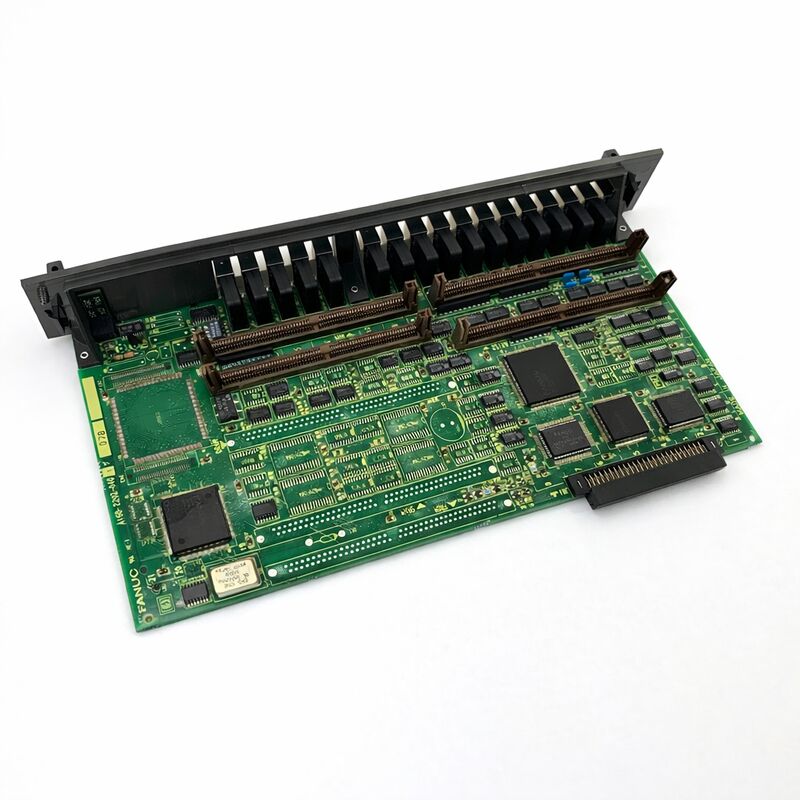
FANUC A16B-2202-0720 | Source-Type 104/80 I/O PCB with Hi-Speed Skip — Series 16 / 18, Japan Origin
Part Number: A16B-2202-0720
Manufacturer: FANUC Corporation (Japan)
Product Type: Operator Panel / Machine I/O PCB
Board Series: A16B-2202
Digital Inputs (DI): 104
Digital Outputs (DO): 80
Hi-Speed Skip: Yes (HDI)
Compatible Systems: FANUC Series 15 / 16 / 18 Model B and C
Overview
The A16B-2202-0720 is the source-type 104-input / 80-output I/O PCB with high-speed skip capability for FANUC Series 16 and 18 CNC systems.
It is the largest I/O count variant in the A16B-2202 series — providing 104 digital input channels and 80 digital output channels in a single board, along with the integrated high-speed digital input (HDI) circuitry that enables high-speed skip functions for probing and in-process gauging applications.
In FANUC CNC architecture, the I/O PCB is the point where the machine's physical field devices connect to the CNC controller. Every limit switch, proximity sensor, solenoid valve, relay coil, and panel indicator on the machine must connect to I/O hardware before the PMC ladder can read or drive it.
The A16B-2202-0720 provides the 104 + 80 channels that larger machine configurations demand — machining centres with automatic tool changers, pallet systems, and complex fixturing sequences quickly accumulate I/O requirements that smaller boards cannot accommodate.
This board mounts as a standalone I/O unit and connects to compatible main boards such as the A16B-2202-0860 and A16B-3200-0190. It is powered by dedicated power supply units in the A16B-1212 family.
Key Specifications
| Parameter |
Value |
| Part Number |
A16B-2202-0720 |
| Manufacturer |
FANUC Corporation |
| Product Type |
Source-Type I/O PCB |
| Board Series |
A16B-2202 |
| Digital Inputs |
104 channels (DI) |
| Digital Outputs |
80 channels (DO) |
| Hi-Speed Skip |
Yes — HDI (High-speed Digital Input) |
| I/O Type |
Source type (current-sinking field devices) |
| Compatible Systems |
FANUC Series 15 / 16 / 18 Model B and C |
| Compatible Main Boards |
A16B-2202-0860, A16B-3200-0190 and others |
| Compatible PSU |
A16B-1212-053x / A16B-1212-087x series |
| Origin |
Japan |
| Operating Temperature |
0 – 55°C |
| Condition Available |
New (surplus) / Refurbished / Repaired |
104 Inputs and 80 Outputs — Why Count Matters
Every machine function that the PMC controls requires at least one I/O point. A four-way hydraulic valve requires at least two outputs. A door with open and closed limit switches requires two inputs. A tool changer confirmation sensor requires one input per station in some configurations.
An automatic pallet changer adds another layer of I/O requirements on top.
Machines with 100+ I/O requirements are common. A typical horizontal machining centre with ATC and pallet changer may use 60-80 outputs and 70-90 inputs in a moderate configuration.
The A16B-2202-0720's 104 inputs and 80 outputs cover this range comfortably as a single-board solution.
The difference between the -0720 (104 DI / 80 DO with skip) and the adjacent -0721 (104 DI / 72 DO with skip) is eight output channels. For machines with heavy output requirements — large ATC systems, multiple coolant zones, hydraulic multi-zone fixtures — the eight extra outputs can be the difference between fitting the I/O on one board and needing an add-on board.
High-Speed Skip — The HDI Function
The high-speed skip input is a separate electrical circuit from the standard digital inputs. It is hardwired to bypass the PMC scan cycle delay and signal the CNC axis interpolator directly. This direct path is what makes sub-millisecond response to skip input signals possible.
In probing applications, a workpiece-measuring probe generates an electrical signal when it contacts the part surface. The CNC must capture the exact axis position at the moment of contact.
Any delay between the probe signal and the position latch — even a few milliseconds — translates to a positioning error in the measured result.
The HDI circuit on this board eliminates the PMC scan cycle delay from this path, delivering the sub-millisecond response that accurate probing requires.
The same HDI input serves in-process gauging, where a measurement head touches a machined surface to verify dimensional compliance mid-cycle. It also serves tool length measurement when a fixed probe or reference surface is used as the datum.
Without HDI — found on the -0725 and -0726 variants in the same series — skip functions can only be performed using standard digital inputs, which are subject to the PMC scan delay. For probing applications, this is unacceptable.
The presence of HDI distinguishes this board as the correct choice for probe-equipped machining centres.
Source-Type I/O Convention
Source-type I/O describes the direction of current flow in the input circuits. In source-type boards, the board supplies current to the field device. The field device — a sensor, limit switch, or button — connects the circuit path to ground (0V) when active.
This pulls the input to ground and the board detects the activation.
This convention is opposite to sink-type I/O, where the board sinks current from the field device.
The practical difference is in how field wiring is configured — source-type wiring connects the load between the board's output and ground, while sink-type connects the load between supply voltage and the board's input.
Panel wiring must match the board type. Confirm the I/O type of the existing board from its label before sourcing a replacement.
FAQ
Q1: The machining centre probe cycle produces inconsistent measurements. Dimensions measured by the probe vary more than expected. Could the A16B-2202-0720 be at fault?
Probe measurement inconsistency can come from the HDI input circuit, the probe stylus or body, or the axis deceleration parameters.
First confirm the HDI skip input is connected to the correct terminal on this board — not to a standard DI input. If the HDI connection is confirmed, check the probe's trigger signal quality with an oscilloscope: a clean, bounce-free trigger is required for consistent measurements.
If the trigger is clean and the HDI connection is correct, the board's HDI circuit should be tested by a qualified FANUC service technician.
Q2: Several machine outputs stopped working after a power surge. The remaining I/O appears normal. Could the board be partially damaged?
Yes. The DO output driver ICs on I/O boards are vulnerable to voltage transients. A power surge can damage one or more output driver sections while leaving others intact.
This produces the pattern of selective output failures while other channels continue to function.
Confirm which specific output channels have failed and check for visible component damage on the board near those output sections. Partial board failure from surge damage is a common fault mode.
Q3: The machine has a 96-input / 64-output I/O configuration. Can the A16B-2202-0720 replace the existing board?
The A16B-2202-0720 provides 104 DI and 80 DO — more than the existing configuration requires. The additional channels are simply unused. If the main board, power supply, and software are compatible with the -0720 board, it can function as a replacement with the used channels assigned to the existing signals.
Confirm the board type compatibility (source vs. sink, and main board compatibility) before proceeding. Unused channels do not cause any operational issue.
Q4: The I/O board was replaced. Some inputs are not responding correctly even though the field wiring appears correct. What should be checked?
After I/O board replacement, confirm the diagnostic screen in the CNC shows the same I/O address assignment that the ladder program expects. If the replacement board has a different I/O address configuration — set by hardware switches or parameters — the ladder reads signals from wrong addresses.
Check the board's DIP switch settings against the original board's settings before powering on.
Address configuration is a common miss during I/O board replacement.
Q5: What is the difference between the A16B-2202-0720 and A16B-2202-0725?
Both boards provide 104 DI and 80 DO. The -0720 includes the high-speed skip (HDI) circuit; the -0725 does not.
If the machine uses probing cycles that require HDI response, only the -0720 will deliver the required measurement accuracy.
If the machine does not use probing or high-speed skip, either board is functionally adequate, though the -0720 provides the capability if probing is added later.


 Your message must be between 20-3,000 characters!