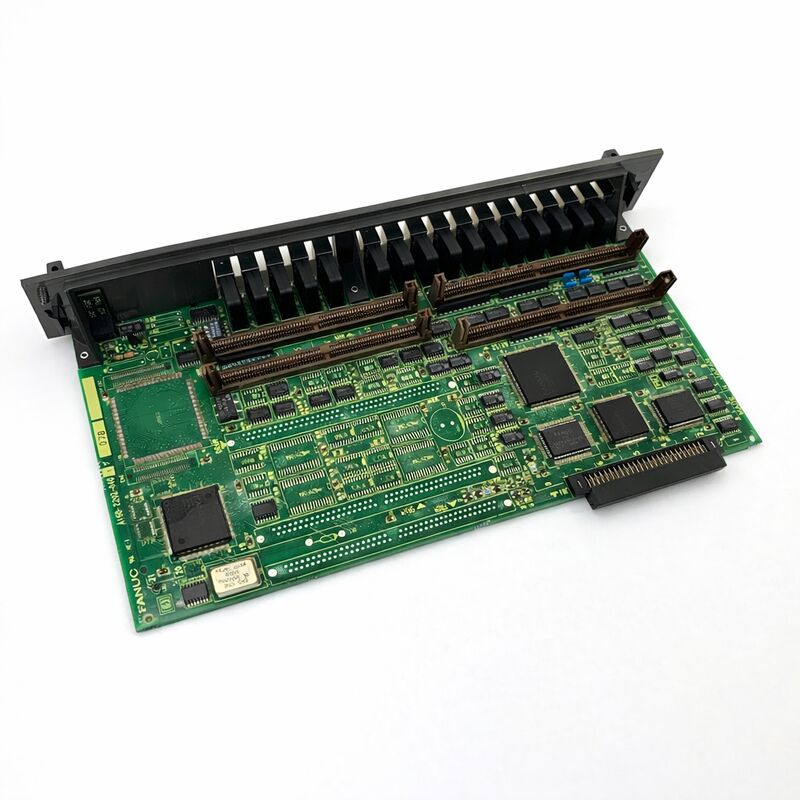
FANUC A16B-2202-0726 | F16M / F16T I/O PCB — 104DI / 72DO, Without High-Speed Skip, Series 16-A
Part Number: A16B-2202-0726
Manufacturer: FANUC Corporation (Japan)
Product Type: I/O Interface PCB (DI/DO Board)
Board Series: A16B-2202
Description: PCB — DI/DO: 104/72 Without High-Speed Skip, F16M/T
Overview
The A16B-2202-0726 is the I/O interface printed circuit board for FANUC's F16M and F16T CNC controllers — the Series 16-A machining centre and turning centre variants. It provides the discrete digital input and output interface between the CNC controller's PMC (Programmable Machine Controller) and the machine tool's field devices, carrying 104 digital inputs and 72 digital outputs through a single board.
The F16M and F16T controllers — successors to the earlier 16-A generation — were among the first FANUC CNC platforms to offer a genuinely high-capability control solution for production machining at competitive prices.
They ran the standard FANUC programming environment, supported the Alpha drive system, and offered the kind of machining performance that precision parts manufacturing required.
The I/O board is the component that connects all of this controller intelligence to the physical machine: the tool-change mechanism, coolant system, axis limit switches, door interlocks, hydraulics, and all the discrete control elements that make a machining centre a complete production system.
The "W/O High-Speed Skip" designation is an important identifier.
The high-speed skip function allows the CNC to detect a high-speed skip signal from an in-process gauging probe or touch sensor and immediately record the current axis position without the latency of the standard I/O scan.
The A16B-2202-0726 does not include this circuit — it is the version for machines that do not require in-process gauging or high-speed measurement applications. Its companion with the skip function is the A16B-2202-0725 (which carries the same 104DI/72DO count with the skip input added).
Key Specifications
| Parameter |
Value |
| Part Number |
A16B-2202-0726 |
| Manufacturer |
FANUC Corporation |
| Product Type |
I/O Interface PCB |
| Board Series |
A16B-2202 |
| Compatible Systems |
Series 16-A — F16M, F16T |
| Digital Inputs |
104 |
| Digital Outputs |
72 |
| High-Speed Skip |
Not included |
| I/O Type |
Sink type (NPN sink input/output) |
| Signal Voltage |
24V DC |
| Origin |
Japan |
| Operating Temperature |
0 – 55°C |
| Status |
Discontinued by Manufacturer |
104DI / 72DO — The I/O Point Capacity
A machining centre controlled by the F16M generates a lot of I/O traffic. The tool magazine's pocket confirm inputs, the automatic tool changer's sequence status signals, the coolant system's flow and level switches, the pallet system's position confirms, the chip conveyor's fault inputs, the hydraulic pressure sensors, the door interlocked safety inputs — and on the output side, solenoid commands for all the pneumatic and hydraulic functions, coolant valve signals, indicator lights, and cycle start outputs.
A full-featured machining centre can easily use 60–80 input and 40–50 output points.
The A16B-2202-0726's 104/72 capacity gives the machine builder headroom for a complete machine with room for options.
The 72 outputs drive the machine's 24V DC relay coils, solenoid valves, and indicator circuits directly.
Each output circuit has a defined current rating — typically around 200mA per point — that matches standard industrial relay coil and solenoid specifications.
Exceeding this rating damages the output transistors. Correctly sized output fusing and correctly specified loads are important aspects of the machine's electrical design.
High-Speed Skip — What This Board Lacks and When It Matters
The high-speed skip function is relevant to machines equipped with in-process measurement probes — a Renishaw or Heidenhain probe that measures the machined part while it is still on the machine, without removing it.
When the probe contacts the workpiece, it generates a skip signal. The CNC must record the exact axis position at the moment of contact, with microsecond precision, regardless of where the PLC scan cycle is at that moment.
Standard I/O — like the A16B-2202-0726 — processes inputs on the PMC scan cycle.
The scan cycle introduces latency. For a probe measuring a feature at slow feed rates, this latency might be acceptable.
For high-accuracy in-process gauging at the feed rates typically used in production, the latency of standard I/O scan is too large, and the high-speed skip circuit is required.
If a machine with the A16B-2202-0726 needs in-process gauging added later, the I/O board must be swapped to the A16B-2202-0725 to get the high-speed skip input.
This is a hardware change, not a parameter change.
Sourcing and Replacement Considerations
The A16B-2202-0726 is discontinued. When the original board fails, the replacement comes from the aftermarket supply chain. Both the 0726 (without skip) and the 0725 (with skip) are known quantities with established service histories. Suppliers often stock both variants.
The replacement procedure is straightforward: physical board swap, confirmation of all connector seating, and functional verification through the CNC's I/O diagnostic screen.
There are no parameters specific to the I/O board that need to be configured — the PMC's I/O address assignments for this board are stored in the CNC's PMC parameters and survive the board swap unchanged.
FAQ
Q1: Several output points on the A16B-2202-0726 have stopped working. The PMC output commands are confirmed correct. Is the board failed?
Multiple dead output points with correct PMC commands are consistent with output transistor failure — typically caused by overcurrent from a short circuit or inductive kickback on a connected load.
Check whether the failed outputs are on the same connector or share a common ground return.
If output fuses are fitted for the failed point group, check them first. If fuses are intact and the outputs remain dead, the output driver section of the board has failed and board replacement is required.
Q2: The CNC shows I/O communication alarms involving the A16B-2202-0726. The board connector has been reseated. What else should be checked?
After connector reseating, check the 24V DC supply voltage to the I/O board. An under-voltage condition causes communication alarms that mimic board failure.
Measure the supply at the board's 24V input terminals — not at the supply source — to detect voltage drops in the supply wiring.
Also check the I/O bus cable between the I/O board and the CNC's main board for any damage or loose contacts.
Q3: The machine needs in-process gauging capability added. Can the A16B-2202-0726 support a probing system?
The A16B-2202-0726 does not have the high-speed skip input circuit required for precision in-process gauging. Standard I/O input latency is too high for accurate probe position capture. To add in-process gauging, the I/O board must be replaced with the A16B-2202-0725 (which has the high-speed skip input).
The machine's PMC program also needs updating to handle the probe logic, and the CNC parameters for the skip function need configuration.
Q4: Some inputs on the A16B-2202-0726 are intermittently reading incorrect states. The wiring to the affected inputs has been checked and is correct. Is the board failing?
Intermittent input misreads with confirmed correct wiring point to input filter capacitor degradation on the aging board.
The input filter capacitors smooth the 24V input signals before they reach the optical isolators.
As the capacitors age, their filtering effectiveness decreases, allowing noise transients to produce false input readings.
This symptom is temperature-dependent — it typically worsens as the board warms up in operation. Board replacement or capacitor-level refurbishment resolves this.
Q5: A replacement A16B-2202-0726 from a different machine of the same Series 16-A model is available. Can it be used directly?
An A16B-2202-0726 from an identical controller platform is directly interchangeable — the board is a standard item with no machine-specific configuration stored on it.
The PMC's I/O address mapping for this board is stored in the CNC's PMC parameters, not on the board itself.
After installing the replacement board, the I/O points should function without any parameter changes.
Verify through the CNC's I/O diagnostic screen after installation to confirm all expected inputs and outputs are responding correctly.


 Your message must be between 20-3,000 characters!