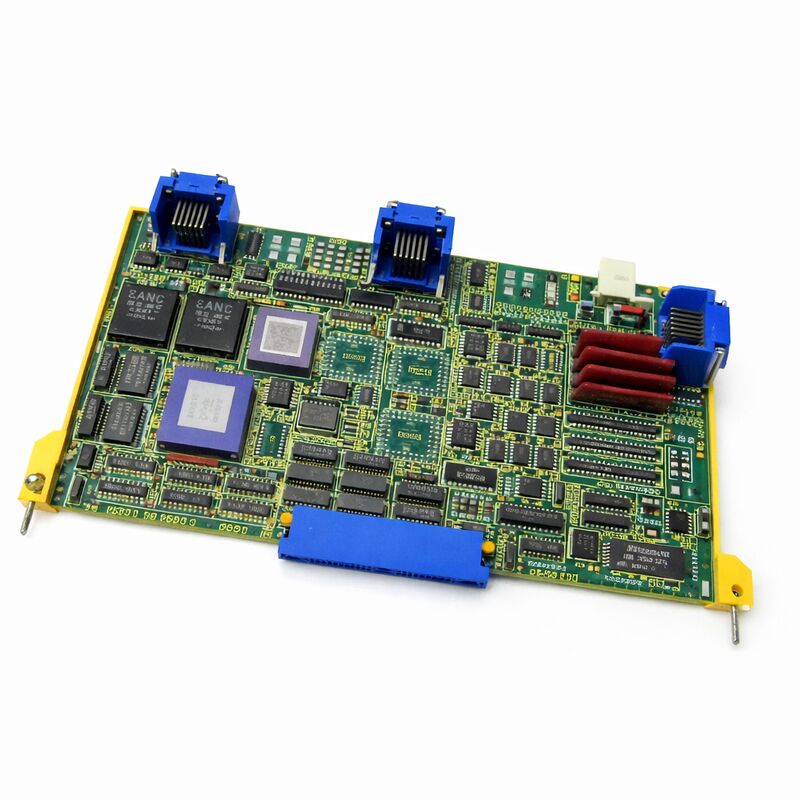
FANUC A16B-2203-0021 | A16B-2203 Series Control PCB Module — FANUC CNC Systems, Japan Origin
Part Number: A16B-2203-0021
Manufacturer: FANUC Corporation (Japan)
Product Type: Control PCB Module
Board Series: A16B-2203
Application: FANUC CNC controller and automation systems
Overview
The A16B-2203-0021 is a printed circuit board from FANUC's A16B-2203 series — a family of CNC control PCBs that spans servo drive circuit boards, axis control and expansion modules, spindle amplifier interface boards, graphics processors, and system function boards across FANUC's CNC and automation controller range.
This series represents the generation of boards associated with FANUC's mid-generation CNC platforms, providing the specific functional capabilities that the A16B-2203 family was designed to deliver in the controller configurations it supports.
The A16B-2203 series distinguishes itself from the A16B-2200, A16B-2201, and A16B-2202 series through its functional position in the FANUC board architecture.
While earlier series numbers in the A16B-22xx family covered I/O, memory, axis control, and system logic for the early-to-mid generation controllers, the A16B-2203 series encompasses more advanced functional boards including high-performance servo interface cards, spindle drive control PCBs, and expansion option boards for controllers requiring capabilities beyond the base hardware set.
The A16B-2203-0021 fills its specific functional role within this series. Each board in the A16B-2203 family has a defined purpose in the controller architecture it serves.
The -0021 is one such board, providing its specific capability to the FANUC CNC system it is installed in.
Key Specifications
| Parameter |
Value |
| Part Number |
A16B-2203-0021 |
| Manufacturer |
FANUC Corporation |
| Product Type |
Control PCB Module |
| Board Series |
A16B-2203 |
| Application |
FANUC CNC controller systems |
| Origin |
Japan |
| Operating Temperature |
0 – 55°C |
| Storage Temperature |
−20 – 60°C |
| Humidity |
75% RH max (non-condensing) |
| Condition Available |
New (surplus) / Refurbished / Repaired |
The A16B-2203 Family — Advanced CNC Board Functions
The A16B-2203 series was produced alongside FANUC's Series 16, 18, 21, and related CNC platforms.
Within this family, different variants serve the specific hardware requirements of drives, motion expansion, spindle control, and system functions that these controllers demanded.
Some members of the A16B-2203 family serve as servo drive circuit boards fitted directly into the servo amplifier units — cards that run the current control algorithms, process encoder feedback, and manage the power stage gate drivers.
Others function as axis expansion option boards that add controlled axes to a controller without requiring a separate sub-CPU. Still others provide specialised graphics control, communication interfaces, or monitoring functions.
The breadth of the series reflects FANUC's modular engineering approach: one family prefix, many specific functions, each optimised for its role.
The A16B-2203-0021 contributes its specific function to this ecosystem.
Its installation in the controller configuration it serves is what enables the capability it provides.
Working with Legacy FANUC A16B-2203 Boards
The A16B-2203 series boards are legacy components by current standards. FANUC has completed the production cycle for these boards following the transition to later controller generations.
The machines that contain them are not legacy in the pejorative sense — many represent high-value manufacturing assets that their owners intend to maintain in production for years ahead. The electronics are what require attention, not the machine itself.
Maintaining these machines depends on access to the specific boards they contain.
The aftermarket supply chain for A16B-2203 series boards includes tested surplus units from decommissioned controllers, professionally refurbished boards with component-level restoration and functional testing, and repair services that address specific component failures at board level.
This supply chain operates effectively for boards of this generation.
When sourcing a replacement A16B-2203-0021, confirm the exact part number from the installed board's label.
The A16B-2203 series contains many variants, and part numbers that differ by a single digit can serve completely different functions in the controller.
Physical similarity between boards does not indicate functional compatibility.
Maintenance and Fault Diagnosis
A16B-2203 series board faults produce alarms in the functional area the board serves. Identifying the precise alarm code from the CNC's alarm display is the first step in any diagnosis.
FANUC alarm codes in these systems map to specific functional areas — servo communication alarms, axis control errors, spindle interface faults, and I/O communication errors each have distinct alarm code ranges.
Before concluding a board has failed, the connector associated with the board should be inspected and reseated.
A significant number of apparent board failures are in fact connector failures — oxidised contacts, partially disengaged connectors, or connector pins that have bent during a previous service operation.
These are far more common than actual PCB component failures and can often be resolved without board replacement.
When the board is confirmed as the fault source, replacement with a tested equivalent board and functional verification are the appropriate steps.
Functional verification — confirming the controller operates correctly through the range of functions that board enables — should be performed before returning the machine to production.
FAQ
Q1: The CNC alarm code points to the functional area served by the A16B-2203-0021. Before ordering a replacement, what diagnostic steps confirm the board is the fault?
First reseat the board and clean its connector contacts. Retest. If the alarm persists, and if a confirmed-good board of the same part number is available for a substitution test, install it temporarily to confirm whether the alarm clears.
This swap test definitively isolates the fault to the board versus the surrounding circuitry.
If a swap-test board is unavailable, proceed with connector confirmation, then measure any test point voltages documented in the controller's maintenance manual before ordering a replacement.
Q2: A tested replacement A16B-2203-0021 was installed and the original alarm cleared, but a new, different alarm appeared. What should be investigated?
A new alarm after board replacement that clears the original alarm is often a secondary condition that the original fault was masking.
The new alarm is now the active fault. Investigate it using the same diagnostic approach — alarm code, alarm code documentation, and functional check of the area the new alarm points to.
It is also possible that the replacement board has a slightly different hardware revision whose interface requires a parameter adjustment; review the controller's hardware change documentation if available.
Q3: The board appears physically undamaged. Is it worth sending for professional assessment before deciding on replacement versus repair?
Physical inspection identifies obvious damage but misses most failure modes — capacitor degradation, transistor drift, and IC parametric failures produce no visible signs.
For a board that is scarce or expensive, professional assessment before disposal is economically rational.
A qualified FANUC PCB repair service can test the board under realistic electrical conditions and identify whether the fault is a repairable component failure.
A repaired board with a repair service warranty is often the most cost-effective resolution for scarce A16B-2203 variants.
Q4: How should a spare A16B-2203-0021 board be stored to maintain its functionality over an extended period?
Store in original anti-static packaging or equivalent. Maintain stable room temperature and low humidity. Avoid temperature cycling — the expansion and contraction stresses solder joints over time. Inspect connector contacts annually for oxidation.
Label clearly with part number and storage date. For boards with any battery-backed components, check and replace the battery before it falls below the retention threshold.
A well-stored board can remain functional for many years as a maintenance spare.
Q5: The machine is approaching the end of its planned production life. Is it still worth maintaining this board versus considering a CNC upgrade?
The economics depend on the machine's remaining production value, the cost of the board replacement versus a CNC upgrade, and how many other legacy boards in the controller may need attention in coming years.
A CNC upgrade replaces the entire controller with a modern platform, eliminating the legacy board availability concern but requiring investment in commissioning, parameter re-entry, and operator retraining.
For a machine with substantial remaining productive life, the board replacement is usually the economical choice.
For a machine near end-of-life, the upgrade investment may deliver better long-term value.


 Your message must be between 20-3,000 characters!