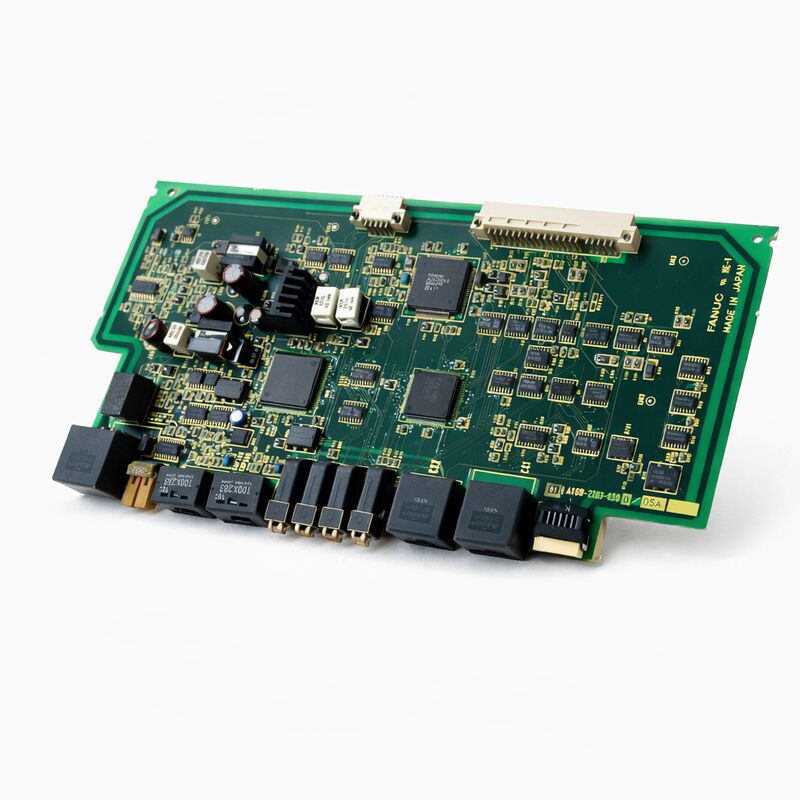
FANUC A16B-2203-0300 | Alpha Series SVM1-240 Servo Amplifier Wiring Board — For A06B-6096-H107, A16B-2203 High-Current Single-Axis Power Board, Japan Origin
Overview
The FANUC A16B-2203-0300 is the power wiring board for the Alpha series SVM1-240 — the 240A peak current single-axis servo amplifier in FANUC's A06B-6096 Alpha series.
At 240 amperes peak, the SVM1-240 is among the highest-current single-axis servo drives in the Alpha generation, designed for servo motors that must produce very high torque — large-frame axes on heavy machining centres, gantry heads, large rotary tables, and other high-force applications where smaller servo motors simply cannot deliver the required torque.
The A16B-2203 board family as a whole covers the wiring boards for a wide range of Alpha series servo amplifier modules.
The family spans from small-current boards for compact servo axes up to the high-current boards like the A16B-2203-0300 for the 240A configuration.
Each board in the family is sized and rated for the specific current range of its associated amplifier module — the current sensing resistors, the gate drive circuits, the bus current paths, and the thermal design all scale with the rated current.
The A06B-6096 Alpha series amplifier generation occupies a specific place in FANUC's servo drive history — it is the Alpha (non-i) generation, which predates the Alpha i (A06B-6114, -6124, -6127 series).
The A06B-6096 served as the high-performance servo amplifier for FANUC CNC generations that included Series 16B/C, 18B/C, 21B, 15B, and the early i-series, during a period when FANUC was transitioning from Type A/B analogue interfaces to the FSSB (Fibre-optic Serial Servo Bus) digital interface.
The SVM1-240, with its FSSB interface, represents the higher-current end of the Alpha series range.
Key Specifications
| Parameter |
Value |
| Compatible Amplifier |
A06B-6096-H107 (SVM1-240) |
| Peak Current Rating |
240A |
| Function |
Wiring board (power circuit board) |
| Control Board Partner |
A20B-1006-0485 |
| Interface |
FSSB (Fibre-optic Serial Servo Bus) |
| Series |
A16B-2203 |
| Status |
Available — refurbished, tested |
| Origin |
Japan |
Wiring Board Function in the SVM1-240 Architecture
Inside the A06B-6096-H107 SVM1-240 module, the A16B-2203-0300 wiring board handles all the functions that involve large currents, high voltages, and the physical connection between the drive's electronics and the motor and power supply:
DC bus connection: The shared DC bus from the PSM (Power Supply Module) delivers rectified 300V DC to the SVM1 modules.
The wiring board terminates this bus connection, distributing the DC bus voltage to the IGBT transistor bridge that switches motor current.
At 240A peak rating, the bus current paths on this board must carry substantial instantaneous currents — the copper traces and bus bar connections are sized accordingly.
IGBT gate drive: The IGBT transistors in the SVM1-240's power section are the actual switches that control motor current.
The wiring board carries the gate drive circuitry — isolated gate driver ICs that receive low-level gate command signals from the control board and translate them into the high-voltage, high-current gate pulses needed to reliably switch large IGBTs.
The isolation between the control board's low-voltage signals and the high-voltage gate drive circuits is essential for safe operation.
Current sensing: The wiring board contains the current sensing elements (typically shunt resistors or Hall-effect sensors) that measure the actual motor phase currents.
These measurements feed back to the control board's servo algorithm, which uses them to close the current control loop.
At 240A peak, current sensing accuracy is critical — errors in current feedback translate directly to torque control errors and can compromise the servo loop's stability.
Motor output terminals: The motor phase connections (U, V, W) terminate on the wiring board.
These terminals are sized for the full rated current and include the necessary isolation from the logic circuits and chassis.
High-Current Alpha Series Drives — Maintenance Priorities
The SVM1-240 drives large-axis servo motors — motors that are physically heavy, thermally demanding, and mechanically coupled to large machine structures. Maintaining these drives requires attention to factors that matter more at high current than at low current.
Thermal management: High-current operation generates substantial heat in the IGBT modules.
The SVM1-240 relies on a heatsink and in many installations a forced-air cooling fan. The cooling fan's continued operation is critical — a failed fan allows heat to build up, accelerating IGBT and capacitor aging and eventually causing thermal shutdown.
Periodic fan inspection and replacement (typically recommended every 3–5 years depending on operating hours) is standard maintenance for the SVM1-240 and related high-current drives.
Capacitor aging: The DC bus capacitors in the SVM1-240's power supply section — and the filter capacitors on the wiring board itself — age over time. Aged capacitors show increased ESR (equivalent series resistance), which reduces their ability to smooth the DC bus voltage under rapid current changes.
The symptom in operation is increased DC bus ripple, which can trigger overvoltage alarms during high-torque transients.
Capacitor replacement as part of a planned overhaul is the standard approach for drives that have been in service for 10+ years.
Connection inspection: At 240A peak, poor connections produce localized heating that can cause carbonisation, oxidation, and eventually thermal failure of connection points. Periodic inspection and retorquing of bus bar connections and motor phase terminals is important maintenance practice.
FAQ
Q1: The SVM1-240 trips an IPM alarm during heavy acceleration. Does this indicate the A16B-2203-0300 wiring board has failed?
An IPM (Intelligent Power Module) alarm during heavy acceleration can originate from several causes.
First, check whether the alarm is overcurrent or overtemperature — the alarm code distinguishes between these.
Overcurrent during acceleration suggests the commanded acceleration exceeds the motor and drive's rated limits, or the motor has a winding problem producing excessive current draw. Overtemperature during acceleration suggests inadequate cooling.
True IPM failure (blown transistor module) presents as an immediate alarm even at light load.
The wiring board is suspect primarily when the IPM alarm occurs at loads well below the rated capability and other causes have been eliminated.
Q2: Can the A16B-2203-0300 be used with the SVM1-360 (A06B-6096-H108)?
No. The A16B-2203-0300 is the wiring board for the SVM1-240 (A06B-6096-H107). The SVM1-360 uses a different wiring board, the A16B-2203-0301.
These boards differ in their IGBT configuration, current sensing calibration, and thermal design.
Using the -0300 board in a -0301 application (or vice versa) would result in incorrect current sensing, wrong current limits, and potentially unsafe operation.
Always match the wiring board to the specific amplifier module designation.
Q3: The control board (A20B-1006-0485) in the SVM1-240 is fine, but the wiring board has failed. Can the wiring board alone be replaced?
Yes, provided the amplifier module can be disassembled to access the wiring board separately.
FANUC Alpha series SVM modules are designed to allow the control board and wiring board to be serviced independently — the two boards connect through known connectors and are physically separable.
The wiring board replacement requires working on the power section (which retains stored energy in the DC bus capacitors even after power-off — always verify the DC bus is fully discharged before touching any components on the wiring board).
Engage FANUC-trained service personnel for this procedure if in-house capability is not established.
Q4: After replacing the A16B-2203-0300 wiring board, the axis runs but torque seems reduced. What should be checked?
Reduced torque after wiring board replacement is typically a current sensing issue — the current sensing elements on the replacement board may have slightly different calibration than the original.
The servo control algorithm uses the current feedback to close its torque control loop, and if the feedback is reading higher than actual current (a common direction for calibration error), the algorithm limits the current prematurely to avoid apparent overcurrent.
Check the current sensing calibration parameter in the CNC for this axis, and if necessary, perform the current loop calibration procedure described in the Alpha series maintenance manual.
Q5: The SVM1-240 has been in service for 15 years. Should the wiring board be proactively replaced even if no alarm has occurred?
Proactive replacement of 15-year-old drive boards is justified for critical production axes where unplanned downtime is expensive.
At that age, the electrolytic capacitors on the wiring board are likely degraded — their capacity has reduced and their ESR has increased from thermal cycling.
Rather than waiting for a failure, a planned overhaul during a scheduled maintenance window — replacing both the wiring board and capacitors, cleaning the heatsink, replacing the cooling fan, and inspecting all connections — returns the drive to near-new reliability.
Specialist FANUC repair centres offer wiring board overhaul services that include capacitor replacement, a cost-effective alternative to full board replacement.


 Your message must be between 20-3,000 characters!