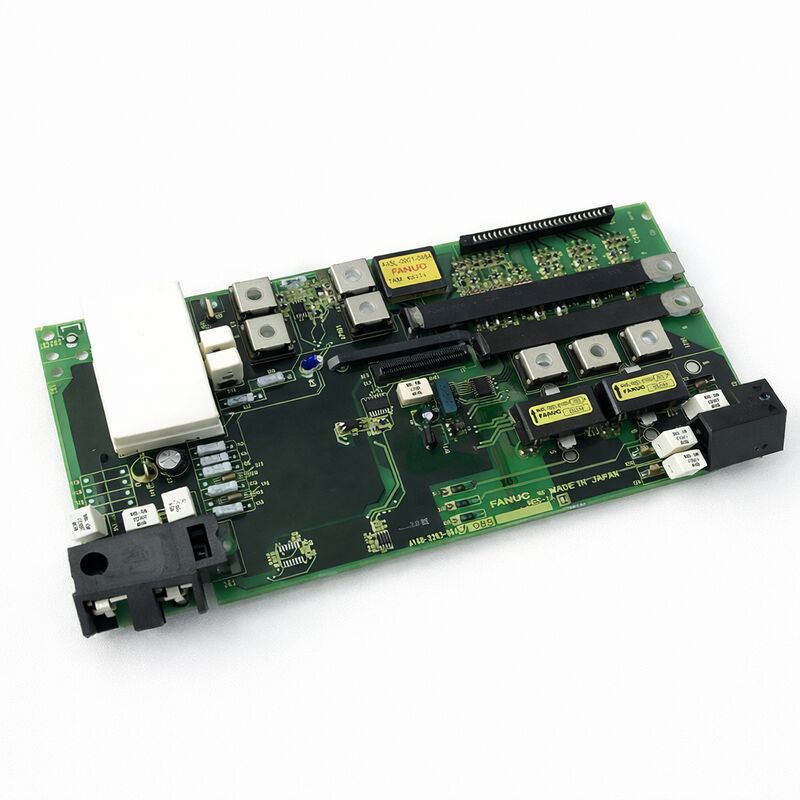
FANUC A16B-2203-0640 | Alpha i Power Supply Wiring PCB — PSMi 5.5 kW, 200 VAC, Power Regenerative, Japan Origin
Part Number: A16B-2203-0640
Manufacturer: FANUC Corporation (Japan)
Product Type: Power Supply Wiring PCB (Printed Circuit Board)
Series: Alpha i (αi)
Overview
The A16B-2203-0640 is the power wiring PCB fitted inside FANUC's Alpha i power supply modules rated at 5.5 kW with 200 VAC three-phase input.
This board handles the internal power routing, signal conditioning, and control interface functions within the PSMi (Power Supply Module i) housing.
It is a component-level spare for the PSMi unit — not a standalone device, but an internal PCB that can be replaced during servicing without replacing the entire power supply module assembly.
FANUC's Alpha i power supply modules are the active-front-end DC bus supply units in Alpha i drive systems.
They rectify the incoming three-phase AC supply, maintain the shared DC bus voltage, and actively return regenerated braking energy from decelerating servo axes back to the AC supply. The wiring PCB is the interface layer between the high-voltage power section of the module and its control electronics.
It carries the signal paths, protection circuits, and auxiliary power distribution that the module depends on to operate.
This board is found in several FANUC PSMi unit variants in the 200 VAC input class, including the A06B-6110-H006, A06B-6115-H006, and A06B-6140-H006.
Each of these is a 5.5 kW, 200 VAC, power-regenerative power supply module in the FANUC Alpha i drive family.
Key Specifications
| Parameter |
Value |
| Part Number |
A16B-2203-0640 |
| Manufacturer |
FANUC Corporation |
| Product Type |
Power Supply Wiring PCB |
| Board Series |
A16B-2203 |
| Drive Series |
FANUC Alpha i (αi) |
| Host Module Input |
200 VAC, 3-Phase |
| Host Module Rating |
5.5 kW |
| Host Module Type |
Power Regenerative (PSMi) |
| Compatible Units |
A06B-6110-H006, A06B-6115-H006, A06B-6140-H006 |
| Regeneration Method |
Active return to AC supply |
| Cooling |
Fan-cooled module (fans replaceable without disassembly) |
| CNC Communication |
Fibre optic link |
| Origin |
Japan |
| Operating Temperature |
0 – 55°C |
| Storage Temperature |
−20 – 60°C |
| Humidity |
75% RH max (non-condensing) |
| Condition Available |
New / Refurbished / Repaired |
The Alpha i PSMi — System Role
In a FANUC Alpha i drive system, the PSMi is the sole connection point to the main AC power supply. All servo and spindle amplifier modules in the cabinet draw their DC bus power from the PSMi.
The PSMi rectifies the three-phase input to a regulated DC bus — typically around 283 to 339 VDC for 200 VAC input class modules — and maintains that bus for the connected amplifiers.
The 5.5 kW rating of the A06B-6110-H006 family places these modules at the smaller end of the Alpha i PSMi range.
They are appropriate for drive systems with limited total motor load — single-axis or light two-axis configurations, or machines with motors that do not demand simultaneous heavy acceleration. Larger machines use higher-rated PSMi units with different wiring PCBs.
The A16B-2203-0640 is the internal PCB that enables the PSMi to perform these functions.
Remove this board and the PSMi cannot operate. Replace a faulty one and the PSMi returns to service — at a fraction of the cost and lead time of sourcing a complete replacement module.
Power Regeneration — Active Energy Return
Power regeneration is a defining characteristic of the Alpha i PSMi. When a servo axis decelerates, the motor acts as a generator.
The kinetic energy of the machine's moving parts and the motor rotor converts to electrical energy. In a resistive braking system, this energy dissipates as heat in a discharge resistor.
In the PSMi, an active front-end circuit on the power section captures this energy and feeds it back onto the AC supply grid.
This regenerative function reduces energy consumption in machines with frequent acceleration and deceleration cycles.
It also eliminates the thermal load of resistive braking, which reduces cabinet temperature and the thermal stress on other components.
The A16B-2203-0640 wiring PCB supports this regenerative function as part of the PSMi's overall circuit architecture.
It provides the interface paths between the active front-end stage and the module's control circuitry.
Fibre Optic Communication and Serviceability
FANUC's Alpha i drive system uses fibre optic cables for communication between the PSMi and the amplifier modules.
Fibre optic links eliminate ground loop issues, provide noise immunity in the electrically harsh environment of a drive cabinet, and allow long cable runs without signal degradation.
The A16B-2203-0640 interfaces with this communication architecture as part of the PSMi's internal design.
One notable serviceability feature of the Alpha i PSMi family: the cooling fans can be replaced without disassembling the module.
Fan failure is a common field failure mode in drive cabinet components.
A replaceable fan that can be swapped during scheduled maintenance — without disturbing the power connections or removing the module from the cabinet — significantly simplifies thermal maintenance on these units.
Component-Level Service Path
Replacing the A16B-2203-0640 wiring PCB is a component-level repair. This means opening the PSMi housing and working inside the module — a procedure that requires proper precautions, appropriate tools, and familiarity with FANUC drive hardware.
The main power bus must be fully discharged before opening the module.
DC bus voltage remains present for several minutes after power-off as the bus capacitors discharge.
This repair path is justified when the PSMi module's power section and external hardware are in good condition, and the fault is isolated to the wiring PCB specifically. Faults commonly associated with the wiring PCB include control signal failures, protection circuit faults, and auxiliary power distribution failures.
Confirm the fault is in this board before proceeding — a full PSMi module exchange may be the appropriate path when the fault is in the high-voltage power section rather than the wiring board.
FAQ
Q1: The PSMi shows an LED alarm but no drive system faults are present. Could the A16B-2203-0640 be the cause?
PSMi LED alarms without downstream amplifier faults often point to the power supply module's internal circuitry rather than the drive system.
The wiring PCB handles control signals and protection circuits — faults in these paths produce PSMi-level alarms without necessarily tripping the amplifier modules.
Check the alarm LED pattern against the Alpha i maintenance manual to identify the fault category before determining whether the wiring board is the affected component.
Q2: Is it safe to open the PSMi housing to replace the A16B-2203-0640 immediately after power-off?
No. The DC bus capacitors inside the PSMi retain charge for several minutes after power-off.
Wait until the DC bus voltage has discharged to a safe level — confirmed by measuring across the DC bus terminals with an appropriately rated voltmeter — before opening the module or handling internal components.
Do not rely on elapsed time alone; always measure.
Q3: The A16B-2203-0640 is installed in which specific PSMi unit variants?
This wiring PCB is fitted in the FANUC Alpha i PSMi 5.5 kW, 200 VAC power supply modules: A06B-6110-H006, A06B-6115-H006, and A06B-6140-H006.
Always confirm the specific unit specification against the module label before sourcing replacement PCBs.
Q4: Can the A16B-2203-0640 be repaired rather than replaced?
Component-level repair is sometimes viable for wiring PCBs, depending on the fault. Damaged passive components, failed protection devices, and corroded connector contacts are potentially repairable.
Faults involving proprietary FANUC ICs or damaged PCB traces may not be.
A board with fire or arcing damage from a power fault should be replaced rather than repaired — the substrate integrity cannot be assumed after such events.
Q5: After replacing the wiring PCB, does the PSMi require any parameter setup or initialisation?
The PSMi wiring PCB does not carry controller parameters in the same way a CNC memory module does.
After installation, confirm the module powers up cleanly with no LED alarms and that the DC bus voltage reaches its normal regulated level when the drive system is energised.
Verify correct CNC-to-drive communication via the fibre optic link. No software loading procedure equivalent to a FROM module reload is required.


 Your message must be between 20-3,000 characters!