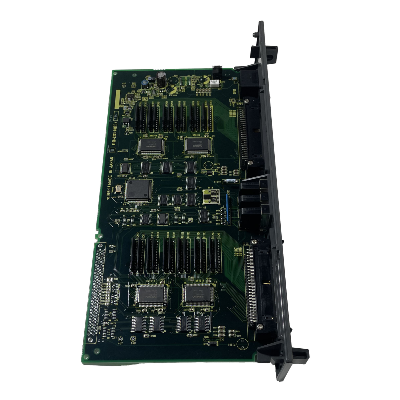
A16B-2203-0695 | FANUC αis Dual-Axis 20/20 Servo Wiring Board — A06B-6114 & A06B-6117 / FSSB / 200–230VAC / Power-Control Interconnect
Dual-Axis 20/20 — Each Channel at 20A
The 20/20 designation identifies both axes this wiring board serves:
- Axis 1: 20A peak servo output capacity
- Axis 2: 20A peak servo output capacity
This symmetric 20/20 configuration serves machine tools where both controlled axes have similar torque requirements — a standard 2-axis configuration like the X and Z axes of a turning centre, or the X and Y axes of a compact machining centre, where both axes use the same αi motor tier.
The 20A rating per channel covers FANUC αi series servo motors in the 20A class — typically motors in the αiS 4/4000 through αiS 8/3000 performance tier, suitable for medium-inertia axis applications at moderate to high feedrates.
Key Specifications
| Parameter |
Value |
| Axes |
2 (dual-axis) |
| Current per Channel |
20A peak |
| Input Voltage |
200–230VAC |
| Host Modules |
A06B-6114 & A06B-6117 |
| Interface (via host) |
Fibre-optic FSSB |
| Mounting |
Internal board-to-board |
| Cooling |
Shared forced-air |
| Role |
Power/control interconnect |
Power/Control Interconnect — What This Board Actually Does
"Power/control interconnect" is the confirmed role of A16B-2203-0695 within its host module. This means the board performs two parallel functions:
Power path: Routes the DC bus supply and three-phase motor output currents for both axes. The wiring board's high-current copper conductors carry the full 20A per channel between the DC bus connection, the IGBT output stage, and the motor cable connector.
Control path: Provides the board-to-board electrical connections between the host module's control electronics and the power stage hardware — gate drive signals from the control PCB route through the wiring board to the IGBT devices; current sensor feedback routes from the wiring board back to the control PCB.
Application Scenarios
Dual-axis 20/20 module board fault: A FANUC αis dual-axis servo module develops faults affecting both 20A axes simultaneously — consistent with a shared wiring board failure rather than individual axis control board faults. The A16B-2203-0695 is replaced, restoring power and control paths for both channels.
Cross-generation module sparing: A CNC service workshop maintains one A16B-2203-0695 wiring board to cover both A06B-6114-frame and A06B-6117-frame dual-axis modules in their service fleet.
FAQ
Q1: Is the A16B-2203-0695 the complete dual-axis module, or just the internal wiring board?
The A16B-2203-0695 is the internal wiring board inside the dual-axis host module. The complete servo amplifier module — ordered as A06B-6114-Hxxx or A06B-6117-Hxxx — also contains a control PCB and the IGBT power devices. The A16B-2203-0695 is a board-level replacement component, not the complete module.
Q2: The spec says "replacement approach: swapped with full amp" — does this mean board replacement is not typical?
"Swapped with full amp" indicates the standard service approach is replacing the complete host amplifier module rather than isolating to the wiring board. Board-level replacement of A16B-2203-0695 requires specialist access to the module's internals — not a standard field operation. For most sites, complete module exchange is faster. For repair workshops with access to FANUC drive internals, the A16B-2203-0695 board provides the cost-effective alternative.
Q3: Does A16B-2203-0695 affect servo parameters when replaced?
No. Servo parameters for both axes reside in the CNC's main parameter memory, not in the wiring board. After fitting the replacement and restoring the module to service, the CNC applies the existing axis parameters through the FSSB fibre optic link.
Q4: What αi motor models are compatible with the 20A channels of this module?
The 20A per channel rating is matched to FANUC αi series servo motors in the 20A class — αiS 4/4000, αiS 8/3000, and comparable motor ratings from the αi servo motor range. Higher-rated motors (40A, 80A) require higher-current module configurations and wiring boards.
Q5: What does "shared forced-air path" mean for this module's cooling?
The dual-axis module uses a common forced-air cooling channel for both axis power stages. A single fan draws air through the module and cools both the A16B-2203-0695 wiring board's high-current components and the control PCB simultaneously. If the module's cooling fan fails, both axes are equally at risk from thermal overload — fan failure is therefore a critical maintenance item for dual-axis modules using shared cooling.


 Your message must be between 20-3,000 characters!