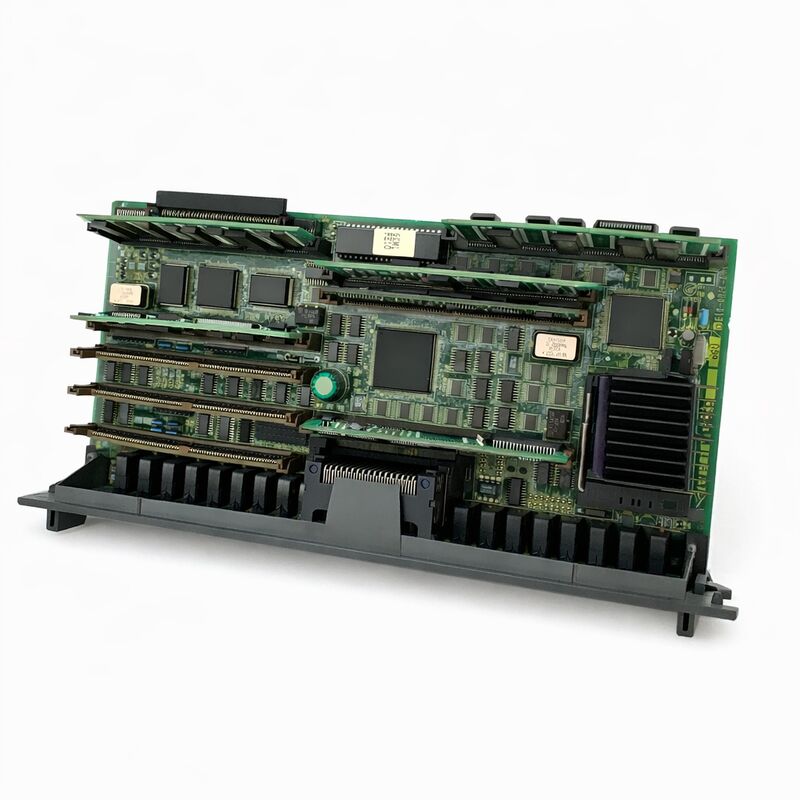
FANUC A16B-3200-0190 | Main CPU Board — FANUC Series 16-C, 6-Axis, 16-MC / 16-TC / 160-MC / 18-TC, 9 DIMM Module Slots, Japan Origin
Overview
The FANUC A16B-3200-0190 is the main CPU board — the master PCB — of the FANUC Series 16 Model C CNC.
The "16C" designation identifies the final model in the FANUC Series 16 lineage: the 16A and 16B preceded it, and the 16i followed, but the 16C was the production-mature version of the Series 16 architecture that appeared in the largest number of installed machine tools during the late 1990s.
Machine tools built around this control generation — primarily CNC lathes with C-axis and live tooling, machining centres with full 5-axis capability, and cylindrical grinders with complex contour grinding profiles — were the precision manufacturing workhorses of automotive, aerospace, and precision component manufacturers globally.
The A16B-3200-0190 is recognisable from earlier A16B-3200 series boards (such as the -0090 for Series 16B) by its 9 DIMM-style module slots versus fewer slots in the earlier generation.
These nine slots accommodate the complete module set required for advanced Series 16C CNC functionality: the main RAM module, the FROM module (system software and option registration), the spindle module (analogue or serial), the servo module (for axis control), the PMC module (ladder logic processor), the CRTC module (display controller), and any HSSB communication module if a PC-connected Open CNC configuration is used.
Some slots may be empty in a minimum-configuration machine; others carry the board to its full capability ceiling.
The board's 6-axis capability is a headline specification — it means the A16B-3200-0190 can simultaneously coordinate the motion of up to six CNC-controlled servo axes, which covers the needs of the large majority of 4-axis lathes (X, Z, C, Y), 5-axis machining centres (X, Y, Z, A, B), and 6-axis systems (X, Y, Z plus three rotary axes).
This axis count is determined by the combination of the board's hardware capabilities and the servo module installed — but the A16B-3200-0190's design accommodates the full range of OPTION PCB expansion boards and RISC processors that FANUC offered for the Series 16C, including sub-CPU boards for additional path control and high-speed interpolation processing.
Key Specifications
| Parameter |
Value |
| CNC Series |
16C (16-MC, 16-TC, 160-MC, 18-TC) |
| Max Axes |
6 |
| Module Slots |
9 DIMM-style slots |
| Spindle |
Single and twin spindle support |
| Supply Condition |
Board only — no SMD modules |
| Weight |
Approx. 1 kg |
| Status |
Discontinued by manufacturer |
| Origin |
Japan |
The Nine DIMM Slots — What Goes Where
The nine plug-in module slots on the A16B-3200-0190 are not interchangeable — each slot is assigned to a specific module type, and installing a module in the wrong slot at best produces a startup alarm (because the module's function does not match what the slot is configured to receive) and at worst causes a short circuit if the connector pinouts are mismatched.
The slot assignments are documented in the Series 16C connection manual (FANUC B-61393E or equivalent), which should be on hand for any board replacement.
The modules that typically populate a fully-configured A16B-3200-0190 in a Series 16-MC machining centre installation:
DRAM module: Volatile working memory for the CNC processor — typical capacity 3.5MB or 2.5MB depending on the installed module variant. Cleared at every power cycle; loss of DRAM causes the CNC to fail to initialise.
SRAM module: Battery-backed non-volatile memory for machine parameters, part programmes, PMC data, tool offset tables, and work coordinate offsets — the most critical data store in the machine.
The battery backup maintains this data through power cycles; battery depletion causes data loss and is the most common maintenance event on 16C systems.
FROM module: Flash ROM carrying the CNC system software, servo parameters, and option registration data.
The FROM defines the CNC's software version and which options (graphic display, DNC2, multiple path control, etc.) are activated. Different machines built with the same hardware may have different option registration in their FROM depending on what the machine tool builder purchased.
Spindle module: Interface between the CNC CPU and the spindle drive amplifier — either analogue (±10V velocity command, for older analogue spindle drives) or serial (for the FANUC serial spindle amplifier systems used from the mid-1990s onwards).
The spindle module type must match the spindle drive system installed on the machine.
Servo module: Interface between the CNC CPU and the FSSB (FANUC Serial Servo Bus) or analogue servo amplifiers for axis control. This module handles the real-time servo loop data exchange between the CNC's processor and the servo amplifiers.
PMC module: Dedicated processor for executing the machine's PMC ladder logic — the machine-specific PLC programme written by the machine tool builder that manages all machine functions (ATC, coolant, chip conveyor, axis interlocks, M-code execution).
The PMC module runs its own processor independently of the main CNC CPU.
CRT/Graphics module (CRTC): Interface between the CNC CPU and the operator panel display, managing the video signal generation for the CNC's LCD or CRT screen.
Replacing the A16B-3200-0190 — What Must Be Done
A main CPU board replacement is the highest-stakes maintenance procedure in a FANUC CNC system. Every aspect of the machine's configuration passes through this board, and restoring that configuration after board replacement requires careful preparation and execution.
Before the old board is removed: back up all CNC parameters to memory card, USB, or RS-232 (depending on what interface is available). Back up all part programmes. Back up the PMC ladder programme.
Note the FROM module part number and software version. Note which SRAM module is installed and verify its battery is healthy.
During the board swap: the SRAM module from the original board should be transferred to the replacement board — this preserves all parameter, programme, and PMC data in a single step. The FROM module from the original board should also be transferred (preserving the software version and option registration).
If the modules transfer successfully, the board should boot with the full original configuration without any parameter reload.
If the SRAM data was lost (battery failure on the original board, or SRAM module replaced): all parameters must be reloaded from the backup.
The machine must then be re-homed, tool offsets re-entered, and production programmes verified before the machine returns to production.
FAQ
Q1: The A16B-3200-0190 is supplied without modules. Does this mean a completely blank board cannot boot at all?
Correct. Without a minimum module set — at least a FROM module (to provide the system software) and a DRAM module (to provide working memory) — the board cannot execute any code and will remain in a power-on state with LEDs lit but no display or further function.
The FROM module is the first requirement; without it, the processor has no operating system to load.
In practice, replacement boards are always supplied with the intent that the user's original FROM, SRAM, and other modules will be transferred from the failed board to the replacement.
Q2: The Series 16C is discontinued. Is it still realistic to maintain these machines, and is the A16B-3200-0190 available?
Yes on both counts. The Series 16C was installed in very large numbers through the 1990s and the installed base remains substantial. FANUC spare parts — including A16B-3200-0190 boards — circulate through the specialist refurbishment and surplus market in meaningful quantities.
Reputable FANUC repair centres carry refurbished and tested A16B-3200-0190 boards that have been fully overhauled (common component replacement plus functional verification on a 16C test rig) and backed by a 6–12 month warranty.
Given that the alternative to maintaining a 16C machine is often a complete machine replacement at many times the cost of a board repair or replacement, the refurbishment economics are very favourable.
Q3: Can the A16B-3200-0190 (16C) be replaced with the A16B-3200-0190 from another 16C machine of a different builder?
The bare board is the same hardware, but the installed module set — and particularly the FROM module — is specific to the machine tool builder's software version and option set, and the SRAM contains data specific to that machine's configuration.
Transferring a complete module set from one machine to another with different mechanical configuration would result in incorrect axis parameters, wrong spindle configuration, and potentially a PMC ladder that does not match the machine's I/O wiring.
The safe approach is to transfer only the modules from the original failed machine to the replacement board, restoring the original machine's configuration on the new hardware.
Q4: What is the significance of the RISC processor option for the A16B-3200-0190?
The A16B-3200-0190 can accommodate an optional RISC processor add-on board that dramatically accelerates complex interpolation calculations — particularly relevant for 5-axis simultaneous machining, high-speed contour cutting, and NURBS spline interpolation.
Machines purchased with this option have the RISC processor board fitted; machines without it rely solely on the main CPU's processor for all calculations, limiting the achievable speed for complex toolpaths.
The RISC processor is a separate sub-board, not a plug-in DIMM module, and must be sourced and fitted separately if the original machine was equipped with this option.
Q5: The CNC boots normally but axes drift slowly when in position. Is this a main board fault?
Slow axis drift during hold is typically a servo parameter issue rather than a main board hardware fault — specifically, it is most often caused by incorrect velocity loop gain, incorrect position loop gain, or a mismatch between the servo motor's encoder resolution and the CNC parameter settings.
Before concluding the main board has a fault, verify that all servo parameters were correctly restored after any recent board replacement or parameter reset.
If the drift appeared suddenly without any maintenance activity, check the servo amplifier for any alarm codes — a failing velocity loop component in the servo amplifier can also cause drift that appears to be in the CNC but is actually in the drive.


 Your message must be between 20-3,000 characters!