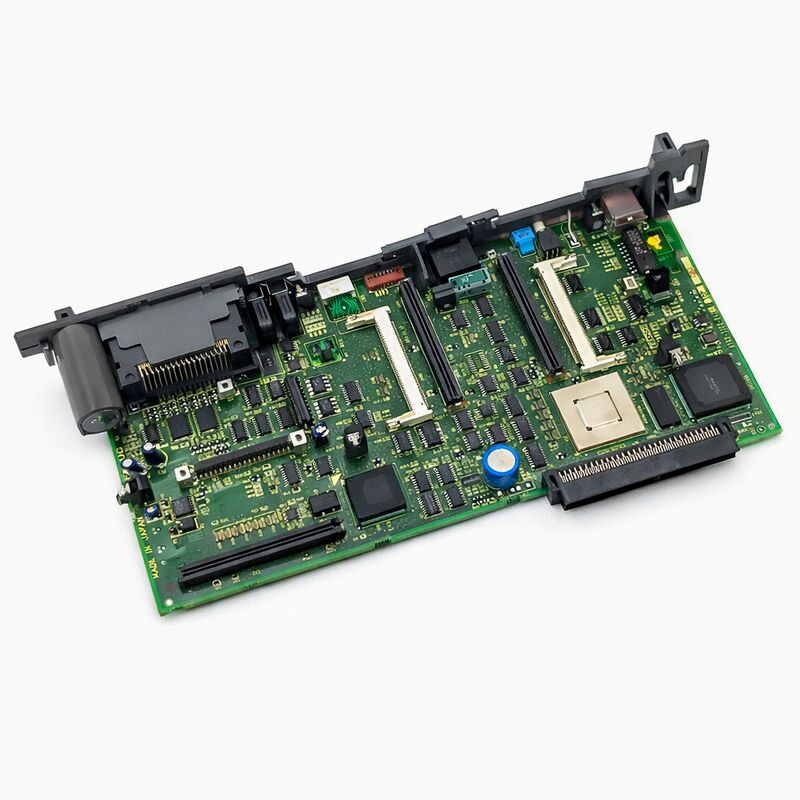
FANUC A16B-3200-0429 | Series 18i / 180i Model B Standalone Main CPU PCB — i-B Control, Japan Origin
Part Number: A16B-3200-0429
Manufacturer: FANUC Corporation (Japan)
Product Type: Standalone Main CPU PCB
Board Series: A16B-3200
Description: i-B Stand Alone Control Main CPU PCB — PCB Main CPU (#18i/180i Model B)
Overview
The A16B-3200-0429 is the standalone main CPU PCB for FANUC's Series 18i and 180i Model B CNC controllers. It is the board at the centre of the i-B controller — the single PCB that carries the main processor, the FSSB (Fiber-optic Servo Serial Bus) controller for servo drive communication, and the graphics processor for the operator display, all integrated on one board with plug-in FROM, SRAM, and DRAM memory modules.
The 18i-B and 180i-B were among the most widely deployed high-performance CNC platforms of their generation.
The 18i-B served machining centres and turning centres requiring more axis capability and faster processing than the 21i offered, while the 180i-B extended the same architecture into large-format machining centres and multi-spindle applications.
Both platforms depended on this main CPU board for every control function — program interpolation, PMC ladder execution, servo command generation, spindle control, and operator interface management all originate here.
The "standalone" designation distinguishes this board from the LCD-mounted version of the same generation. In the standalone configuration, the CPU board is installed in its own rack, separate from the display unit.
A cable connects the standalone board to the display assembly. This separation provides maintenance flexibility: the CPU board and display unit can be serviced independently, and the same CPU board type serves installations with different display configurations.
Key Specifications
| Parameter |
Value |
| Part Number |
A16B-3200-0429 |
| Manufacturer |
FANUC Corporation |
| Product Type |
Standalone Main CPU PCB |
| Board Series |
A16B-3200 |
| Compatible Systems |
Series 18i-B, 18i-MB/TB, 180i-B, 180i-MB/TB |
| Architecture |
Standalone (separate unit from display) |
| Servo Interface |
FSSB (Fiber-optic Servo Serial Bus) |
| Memory Modules |
FROM, SRAM, DRAM (plug-in type) |
| Origin |
Japan |
| Operating Temperature |
0 – 55°C |
| Storage Temperature |
−20 – 70°C |
| Humidity |
Non-condensing, 20–80% RH |
| Status |
Discontinued by Manufacturer |
| Post-Installation |
Full parameter and program reload required |
18i-B / 180i-B Platform — The Controller Context
The Series 18i-B represents the second generation of FANUC's i-series CNC. The original i-A generation established the FSSB architecture and the i-series operating software.
The B generation refined the platform — faster CPU processing, expanded memory capacity, enhanced high-speed machining functions, and improved nano-interpolation for precision contouring work.
For the machine tools that used the 18i-B, the improvements over the A generation were concrete and measurable. Cycle times on complex contoured parts shortened because the controller could process more program blocks per second.
Contouring accuracy improved because the higher processing rate reduced the interpolation error on circular and spiral tool paths.
The 18i-B became the controller of choice for high-end machining centres in the automotive, aerospace, and die-mould sectors where these performance differences directly affected part quality and production rate.
The A16B-3200-0429 is what delivered this performance. All the computational work of the 18i-B — the servo control algorithms, the PMC logic, the interpolation — runs on this board. When the board functions correctly, none of this is visible.
The machine runs, the parts are accurate, and production continues. When the board fails, it all stops.
FSSB Interface — Integrated Servo Communication
The A16B-3200-0429 includes the FSSB controller that manages servo communication between the CNC and the servo amplifier modules. FSSB (Fiber-optic Servo Serial Bus) transmits position commands and receives encoder feedback over optical fiber — a digital, noise-immune communication method that replaced the analogue PWM interfaces of earlier FANUC CNC generations.
Having the FSSB controller integrated into the main CPU board means that the servo communication and the CNC interpolation are tightly coupled on the same board. The servo update cycle is synchronised directly to the CNC processing cycle.
This tight integration is part of what gives the 18i-B its servo performance characteristics.
When the A16B-3200-0429 fails, FSSB communication alarms often appear on all axes simultaneously — because the FSSB controller for all connected servo amplifiers resides on this single board.
This pattern, where all axes lose FSSB communication at once rather than one axis at a time, is one of the indicators that the fault is in the main CPU board rather than in an individual servo amplifier or fiber cable.
Post-Installation Data Restoration
Replacing the A16B-3200-0429 requires a complete data restoration procedure. The new board's memory modules start in a factory-default state. The CNC operating software in the FROM is correct, but every machine-specific parameter in the SRAM is blank.
The parameters that must be restored cover all aspects of the machine's configuration — axis movement limits, servo gain settings, spindle parameters, PMC timer and counter preset values, pitch error compensation tables, tool offset registers, and the complete PMC ladder program.
Without this data, the controller either refuses to start or operates in a way that does not match the machine it controls.
A complete system backup before board replacement is therefore essential. FANUC 18i-B controllers support comprehensive backup through the CNC boot menu and through the data I/O functions.
For machines without a current backup, attempting board replacement before creating one is a significant risk. Restoring parameters from documentation, without a backup, is a lengthy and error-prone process that typically requires FANUC engineering support.
FAQ
Q1: All servo axes simultaneously show FSSB communication alarms. The fiber cables and servo amplifiers have been checked and are undamaged. Is the A16B-3200-0429 the fault?
Simultaneous FSSB alarms on all axes with confirmed good cables and amplifiers strongly implicate the FSSB controller on the main CPU board. All axis FSSB channels share the FSSB controller on the A16B-3200-0429.
A fault in this common circuitry affects all channels at once. Reseat the board's backplane connectors and check the FSSB module's seating on the board.
If the alarms persist, board replacement is the appropriate action.
Q2: The 18i-B controller fails to complete its startup sequence and displays a system alarm. The alarm code indicates a FROM read error. Is the main CPU board failed?
A FROM read error points to the FROM module — the plug-in flash memory card that holds the CNC operating software — rather than necessarily the main CPU board itself.
The FROM module is a separate component that inserts into a socket on the A16B-3200-0429.
First, remove and reseat the FROM module. If the error persists with the module correctly seated, the FROM module itself may be faulty.
Only if a new FROM module does not resolve the error should the main CPU board be suspected.
Q3: The machine builder requires a specific CNC software version. A refurbished A16B-3200-0429 is available but its FROM version is unknown. How should this be handled?
The FROM version determines the CNC software features, parameter ranges, and PMC compatibility. Before installing a refurbished board, identify the FROM version on the board by reading its label or checking the CNC's system information screen during startup.
If the FROM version does not match the machine's requirement, a FROM module with the correct version should be sourced and installed.
The main CPU board's other components are version-independent; only the FROM content needs to match the machine's software requirement.
Q4: After installing a replacement A16B-3200-0429 and restoring all parameters, certain axis servo parameters produce servo alarms during operation. What should be investigated?
Servo alarm after parameter restore with a new board typically means some servo parameter values are incorrect.
The most common cause is that the servo software version on the new board's FROM differs from the original, and some parameter numbers or ranges have changed between versions.
Review the alarm code, identify the specific servo parameter associated with it, and verify that parameter's value against the machine builder's documentation or the original board's backup.
Adjusting the affected parameters to values appropriate for the installed servo software version usually resolves this.
Q5: The 18i-B machine is 15 years old and the A16B-3200-0429 is discontinued. Is a CNC replacement (retrofit) a better option than a PCB replacement?
The economics depend on the machine's remaining productive value and the scope of any other aging components. A main CPU board replacement is targeted and cost-effective if the rest of the controller — the servo amplifiers, PSU, I/O units — is in good condition.
A full CNC retrofit replaces the entire controller with a modern equivalent, eliminating the legacy board availability concern but requiring investment in commissioning, parameter re-entry, and potentially updated servo amplifier hardware.
For a mechanically sound 15-year-old machine with good business justification for continued production, board replacement is usually the better first choice.
The retrofit option makes more sense when multiple controller components are aging simultaneously.


 Your message must be between 20-3,000 characters!