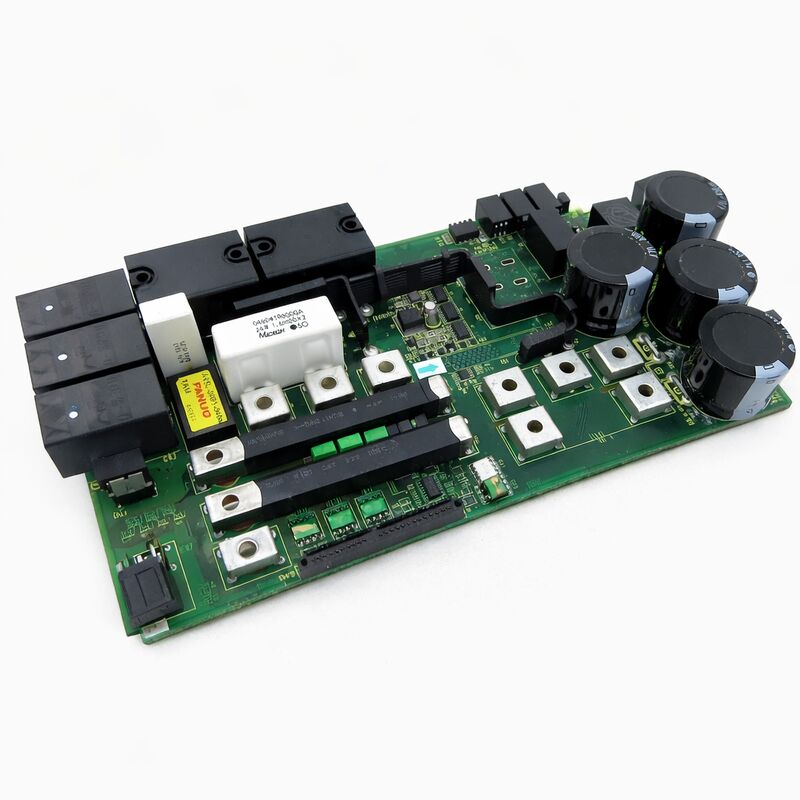
FANUC A16B-3200-0521 | i-A Standalone Control Main CPU PCB — FANUC CNC Systems, Japan Origin
Part Number: A16B-3200-0521
Manufacturer: FANUC Corporation (Japan)
Product Type: Standalone Control Main CPU PCB
Board Series: A16B-3200
Description: i-A Stand Alone Control Main CPU PCB
Application: FANUC i-A series CNC controller systems
Note: Programming required — all parameters and programs must be reloaded after installation
Overview
The A16B-3200-0521 is the standalone main CPU PCB for FANUC's i-A series CNC controllers. The "Stand Alone Control" designation identifies this as the independent main processor board — the version that handles all CNC control processing on a single, self-contained board without requiring a separate sub-CPU or secondary processing board to complete its functions.
Everything the controller needs to run its core processes — interpolation, PMC execution, servo communication, memory management, and operator interface control — originates from this board.
Within FANUC's A16B-3200 series, the i-A designation places this board in the first generation of FANUC's i-series CNC platforms.
The i-series represented a significant advance over the preceding B-series — faster processors, higher precision, expanded axis counts, more program storage, and the introduction of FSSB (Fiber-optic Servo Serial Bus) as the standard servo communication interface.
The A16B-3200-0521 is the main CPU board that realised these capabilities in the standalone controller configuration.
The "standalone" board design is one of two architectural approaches in the i-series: standalone (where the main CPU board is a complete, independent unit) and LCD-mounted (where the CPU and display are integrated).
The standalone version allows the main CPU board to be replaced independently of the display unit, and allows the same CPU board to be used with different display configurations.
This flexibility is one of the reasons the standalone board was the preferred choice for larger and more complex machine tool installations.
Key Specifications
| Parameter |
Value |
| Part Number |
A16B-3200-0521 |
| Manufacturer |
FANUC Corporation |
| Product Type |
Standalone Main CPU PCB |
| Board Series |
A16B-3200 |
| Description |
i-A Stand Alone Control Main CPU |
| Application |
FANUC i-A series CNC controllers |
| Origin |
Japan |
| Operating Temperature |
0 – 55°C |
| Storage Temperature |
−20 – 70°C |
| Humidity |
Non-condensing, 20–80% RH |
| Post-Installation Requirement |
Full parameter and program reload |
| Condition Available |
New (surplus) / Refurbished |
i-A Generation CNC — The Platform Context
The i-A generation FANUC CNCs were deployed widely across the machine tool industry from the late 1990s through the mid-2000s.
This generation powered a large population of machining centres, turning centres, grinders, and multi-axis production machines that remain in productive service today.
The i-A main CPU board is the controller's core — without it functioning correctly, the machine does not operate.
The standalone configuration used in the A16B-3200-0521 places the main CPU board in the controller rack, connected to the F-BUS backplane.
The backplane distributes power and communication to all boards in the rack — servo interface cards, memory modules, PMC boards, I/O cards, and graphics modules all plug into this shared bus. The A16B-3200-0521 is the master on this bus.
It initialises the bus at power-on, determines what boards are present, and allocates communication bandwidth among them.
FSSB connects the main CPU board's servo processing to the servo amplifier modules through fiber-optic cable.
This high-speed optical interface provides the servo position commands and receives the motor encoder feedback at the high update rates that precise multi-axis machining demands.
The A16B-3200-0521 contains the FSSB interface circuitry that makes this high-speed servo communication possible.
Standalone vs LCD-Mounted Architecture
The standalone board and the LCD-mounted board serve the same i-A CNC platforms but differ in their physical integration with the display.
An LCD-mounted main CPU board sits behind the display panel, directly connected to the display electronics.
The display and CPU are essentially one assembly. If either component fails, the entire assembly may need attention.
The A16B-3200-0521 standalone board sits in the controller rack, separate from the display.
A separate display interface board and cable connect the CPU's display output to the panel.
This physical separation has maintenance advantages — a display fault does not implicate the CPU board, and a CPU board fault does not require display disassembly.
For machine installations where the controller rack is located away from the machine operator position — panel-mounted installations in separate electrical cabinets, or machines with remote CNC units — the standalone architecture's flexibility in physical arrangement is particularly useful.
Post-Installation Data Restoration
The most important operational fact about the A16B-3200-0521 is the programming requirement after replacement. When the board is installed new or refurbished, its FROM contains the CNC operating software for the i-A series — but the FROM is at its factory default state.
The machine-specific configuration has not been loaded.
Every machine that runs this board has a unique set of parameters: axis movement limits, servo gain settings, spindle configuration, PMC timer and counter values, pitch error compensation tables, and the full set of functional parameters that make the controller match the machine it controls.
All of these reside in the SRAM on the board, backed by a battery. When a new board is installed, the SRAM starts blank.
This makes the backup situation before board replacement critically important.
Before removing the original board, a complete backup through the CNC's data I/O function must capture CNC parameters, PMC parameters, the PMC ladder program, pitch error compensation, and all stored part programs.
With this backup, data restoration after installation is a defined, systematic procedure.
Without it, reconstructing the machine's parameter set from documentation is a lengthy and error-prone process.
FAQ
Q1: The i-A CNC shows a system alarm at power-on that refers to a ROM or FROM error. Is the A16B-3200-0521 the cause?
A FROM error alarm at startup indicates a failure in reading the FROM module that contains the CNC operating software.
The FROM module is a plug-in component on the A16B-3200-0521. Before concluding the main board has failed, check whether the FROM module is correctly seated in its socket.
A partially seated FROM module produces FROM read errors that appear identical to a board failure.
Reseat the FROM module and retry. If the error persists with the module correctly seated, the FROM module itself may be faulty — FROM modules can be replaced independently of the main CPU board.
Q2: After a machine has been in storage for 18 months, the i-A controller fails to retain its parameters through power cycles. Is this the board?
Parameter retention failure after extended storage is almost always a battery exhaustion problem, not a board failure.
The SRAM battery on the A16B-3200-0521 has a finite service life.
After 18 months without the machine being powered, the battery may have discharged below the SRAM retention threshold.
Replace the battery, then restore parameters from backup.
The board itself is not at fault unless the problem persists after battery replacement and parameter restore.
Q3: The CNC is running correctly but occasionally displays a communication error between the CPU and the operator panel, then recovers. What does this suggest about the A16B-3200-0521?
Intermittent CPU-to-panel communication errors that self-recover suggest a connector or cable issue between the standalone CPU board and the operator panel interface, rather than a failing CPU board.
Inspect the cable and connectors in the display communication path. Clean the connector contacts.
Check that all connectors are fully seated and that no pins have been damaged.
Intermittent errors that could be caused by a connection issue should not be attributed to the board until connection paths are confirmed good.
Q4: A replacement A16B-3200-0521 is described as "refurbished." What does a proper refurbishment of a main CPU board involve?
A proper main CPU board refurbishment addresses the components most likely to fail over service life: replacement of the SRAM backup battery with a new cell of correct specification; inspection of all electrolytic capacitors on the board for degradation; cleaning of connector contacts; and functional testing in a complete i-A CNC system including boot sequence verification, parameter load and retention, and servo communication via FSSB.
A refurbished board should come with a documented warranty that covers the board's functionality for a defined period.
Q5: Multiple boards in the i-A controller are from the same production period. Is it worth proactively replacing the A16B-3200-0521 before it fails, given its age?
Proactive replacement is a reasonable strategy if the machine is production-critical and board failure would cause significant downtime.
However, the A16B-3200-0521's main CPU is a relatively robust solid-state component — the most common failure modes (battery exhaustion, capacitor degradation) are serviceable without full board replacement.
Annual battery replacement and periodic visual inspection of the board's capacitors can extend service life significantly.
A tested spare A16B-3200-0521 held on-site provides insurance against failure without the disruption of a planned proactive replacement.


 Your message must be between 20-3,000 characters!