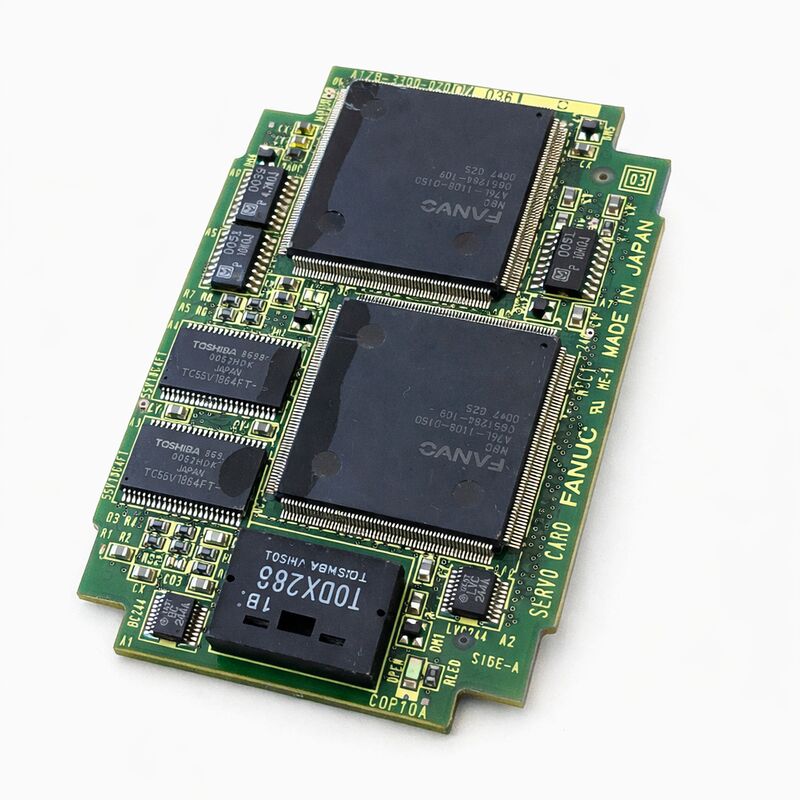
FANUC A17B-3300-0103 | 6-Axis i Series Servo Module — FSSB, CNC and Robot, Japan Origin
Part Number: A17B-3300-0103
Manufacturer: FANUC Corporation (Japan)
Product Type: Servo Control Module PCB
Board Series: A17B-3300
Axis Count: 6
Interface: FSSB (Fiber-optic Servo Serial Bus)
Compatible Systems: FANUC i Series CNC (16i / 18i / 21i) and R-J3 / R-J3iB Robot Controllers
Overview
The A17B-3300-0103 is a 6-axis servo control module from FANUC's A17B-3300 series — the plug-in PCB that manages digital servo communication for up to six axes in FANUC's i-series CNC and robot control platforms.
This small modular board plugs directly into the main CPU board of the controller, forming the vital link between the CNC's motion planning software and the servo amplifiers that physically drive each axis motor.
The A17B-3300 series represents the servo module generation associated with FANUC's i-series controllers — the generation that brought FSSB (Fiber-optic Servo Serial Bus) into widespread use across both CNC machine tools and industrial robots. This board carries that FSSB interface.
It replaces the earlier analog and short-wire digital servo connections of older FANUC generations with a high-speed optical serial link that is immune to the electrical noise generated by the high-current servo drive circuits operating nearby.
In CNC applications — turning centres (16i-TA, 18i-TA), machining centres (16i-MA, 18i-MA), and 21i-based machines — this module handles the servo control for the machine's primary axes.
In robot applications, specifically R-J3 and R-J3iB controllers running i-series A generation software, this module controls all six robot joint axes simultaneously.
The same board serves both application types because both use the same FSSB servo bus architecture.
Key Specifications
| Parameter |
Value |
| Part Number |
A17B-3300-0103 |
| Manufacturer |
FANUC Corporation |
| Product Type |
Servo Control Module PCB |
| Board Series |
A17B-3300 |
| Axis Count |
6 |
| Servo Interface |
FSSB (Fiber-optic Servo Serial Bus) |
| Compatible CNC |
Series 16i / 18i / 21i (Model A) |
| Compatible Robot |
FANUC R-J3 / R-J3iB controllers |
| Installation |
Plug-in module on main CPU board |
| Origin |
Japan |
| Operating Temperature |
0 – 55°C |
| Storage Temperature |
−20 – 60°C |
| Condition Available |
New (surplus) / Refurbished / Repaired |
FSSB — Fiber-Optic Servo Serial Bus
The FSSB is the backbone of servo communication in FANUC's i-series architecture. Each FSSB link is a point-to-point optical fiber connection that carries all servo command and feedback data for the axes connected to it.
The servo module generates the digital command stream — position targets, velocity profiles, torque limits — and sends them down the fiber at high speed. The servo amplifiers receive these commands, execute them on the motor, and return encoder position data on the same fiber link.
The optical nature of FSSB is what sets it apart from earlier wire-based servo interfaces.
The fiber carries light, not electrical current. Electromagnetic interference — from the motor cables, from other drives, from switching power supplies — cannot induce noise into an optical signal. The position data that comes back from the encoders is exactly what the encoder produced.
The command data that reaches the amplifiers is exactly what the servo module sent.
For a 6-axis machining centre or a 6-joint industrial robot, the practical consequence is higher positioning accuracy at high feed rates, tighter multi-axis synchronization, and immunity to the interference that is unavoidable in the cabinet environment of a fully loaded machine.
CNC vs. Robot Application
The A17B-3300-0103 serves in both CNC machine tool and industrial robot applications. The hardware is identical. The software context differs.
In a CNC machining centre or turning centre, the six axes are typically the machine's primary linear axes (X, Y, Z) plus rotary axes (A, B, C) or a second independent spindle.
The servo module sends position commands synchronized to the CNC's interpolation output, which is calculating the tool path at each interpolation cycle.
In a FANUC R-J3 or R-J3iB robot controller, the six axes are the six joints of the robot arm — from the base rotation (J1) through to the wrist (J6).
The robot's motion planner calculates joint angles continuously as it moves the robot through programmed paths, and the servo module translates those joint angle targets into position commands on the FSSB.
The hardware compatibility between these two very different applications reflects FANUC's design philosophy of using common servo platform components across its product range. It also means that a tested A17B-3300-0103 board from a retired robot controller can be a valid replacement in a CNC system, and vice versa, provided the FSSB servo bus is the same generation.
Installation — Plug-In Module Architecture
The A17B-3300-0103 is a plug-in module. It fits horizontally into a socket on the main CPU board of the controller — alongside other plug-in modules such as the CPU processor card, the DRAM card, the FROM/SRAM memory card, and any graphics modules.
The complete set of plug-in modules determines the controller's full capability.
When supplied as a spare, this board typically ships without any additional SMD sub-modules. The fiber-optic connectors are on the board.
The FSSB optical cables attach directly to the board's optical connectors after installation.
Confirm that the fiber connections are clean and fully engaged after installation — dirty or incompletely engaged optical connectors are a common cause of FSSB communication errors after any board swap.
FAQ
Q1: The CNC shows an FSSB servo alarm on all axes simultaneously. Could the A17B-3300-0103 be at fault?
A simultaneous alarm on all FSSB-connected axes points to the servo module itself rather than any individual axis.
If each axis had an independent fault, you'd expect staggered or selective alarms. With all FSSB axes alarming together, the common element — the servo module — is the first suspect.
Before replacing the board, check the optical fiber connections at both the servo module end and the first amplifier in the FSSB chain for any contamination or incomplete engagement.
Q2: After the servo module was replaced, one axis shows a communication error but the others are fine. The fiber connections appear good. What might be wrong?
A single-axis FSSB alarm after a good board swap usually indicates a problem in the fiber path for that specific axis — either a damaged fiber cable, a contaminated connector on that axis's amplifier, or an amplifier fault on that axis.
The servo module communicates with all axes through the same FSSB chain; a fault isolated to one axis is downstream of the module.
Inspect the fiber segment between the module output and the affected amplifier's optical input.
Q3: Can this servo module from a retired robot controller be used in a machining centre?
Yes, provided the FSSB generation is compatible. The A17B-3300-0103 uses the same FSSB architecture in both robot and CNC applications.
Confirm the specific board part number matches exactly — within the A17B-3300 series, different suffixes have different servo axis counts and different firmware compatibility.
If the part number matches and the controller's system software revision supports the -0103 variant, the board from a robot can serve in a CNC machine.
Q4: The servo module was removed to inspect the CPU area of the controller. How should it be handled and stored?
Handle by the edges. Use anti-static wrist strap and mat.
The optical connectors on the board should be capped if the board will be stored for any time — optical connector contamination is a known fault source and any dust or fingerprint inside the optical connector can degrade the FSSB communication quality.
Store in anti-static packaging. Keep at stable room temperature.
Q5: The controller shows a servo module alarm at power-on before any FSSB communication starts. The board appears visually undamaged. What could cause this?
A power-on alarm before FSSB communication starts indicates the board's self-test has failed.
The servo module performs internal diagnostics at power-on.
A failed DSP, damaged gate array, or corrupted firmware produces an immediate alarm before any external communication is attempted.
This type of fault is confirmed by the fact that the alarm appears even with all FSSB fibers disconnected. Board replacement is the correct path.


 Your message must be between 20-3,000 characters!