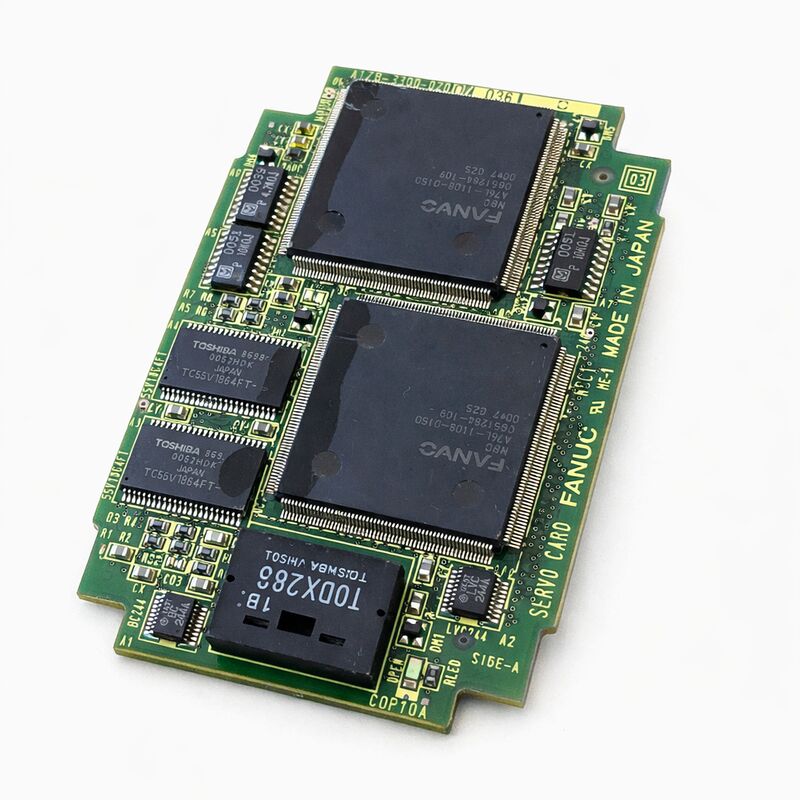
FANUC A17B-3300-0200 | 8-Axis Hi-Speed i Series Servo Module — Series 16i / 18i / 21i CNC, Japan Origin
Part Number: A17B-3300-0200
Manufacturer: FANUC Corporation (Japan)
Product Type: 8-Axis Hi-Speed Servo Module PCB
Board Series: A17B-3300
Description: 8 AXIS HI-SPEED i SERIES SERVO MODULE
Compatible Systems: FANUC Series 16i, 18i, 21i CNC controls
Application: Multi-axis servo control via FSSB interface
Overview
The A17B-3300-0200 is the 8-axis hi-speed servo module for FANUC's i-series CNC controllers — specifically the Series 16i, 18i, and 21i platforms.
It is the plug-in servo interface PCB that sits on the controller's main CPU board and manages high-speed serial communication with the servo amplifier modules through FANUC's FSSB (Fiber-optic Servo Serial Bus) interface.
Up to 8 servo axes receive their position and velocity commands through this board, and their encoder feedback returns through it as well.
The A17B-3300 series represents the servo interface module generation developed for the i-series CNC platforms — FANUC's highly successful family of controllers that powered a broad range of machining centres, turning centres, and multi-axis production machines from the late 1990s through the 2000s. Within this series, different board variants provided different axis counts and performance levels.
The A17B-3300-0200 provides 8 axes at the hi-speed specification — the higher performance tier designed for machines requiring faster servo update rates for demanding high-accuracy or high-speed machining applications.
This board is found in assemblies alongside the main CPU board (such as A16B-3200-0330) and the PMC module (such as A20B-3300-0085) that together form the complete CNC controller intelligence.
These components work as a coordinated set — the CPU board handles overall processing, the PMC board executes machine ladder logic, and the A17B-3300-0200 manages the real-time servo communication that keeps the axes moving with precision.
Key Specifications
| Parameter |
Value |
| Part Number |
A17B-3300-0200 |
| Manufacturer |
FANUC Corporation |
| Product Type |
8-Axis Hi-Speed Servo Module PCB |
| Board Series |
A17B-3300 |
| Axis Count |
8 |
| Speed |
Hi-Speed |
| Series |
i Series |
| Interface |
FSSB (Fiber-optic Servo Serial Bus) |
| Compatible Systems |
Series 16i, 18i, 21i |
| Origin |
Japan |
| Operating Temperature |
0 – 55°C |
| Storage Temperature |
−20 – 70°C |
| Humidity |
Non-condensing, 20–80% RH |
| Condition Available |
New (surplus) / Refurbished |
FSSB Interface — High-Speed Optical Servo Communication
FSSB is the communication backbone between the i-series CNC controller and its servo amplifier modules. It replaced the earlier PWM-based servo interface of the pre-i-series CNC generation with a high-speed optical serial bus — a fundamentally different architecture that sent position commands and received feedback as serial data packets over fiber-optic cables rather than as analog or parallel digital signals.
The advantages of FSSB over its predecessors are substantial. Optical fiber is immune to electromagnetic interference — the machine cabinet's motor cables, relay coils, and power switches cannot induce noise into an optical signal path.
The serial protocol concentrates all axis data into a single high-speed bus rather than requiring separate signal wires for each axis, simplifying cabling especially on high-axis-count machines.
And the digital nature of the communication makes the servo update more deterministic — each axis's command arrives at precisely the right time in the servo cycle.
The A17B-3300-0200 is the controller-side terminus of the FSSB.
It contains the FSSB communication logic that formats the position commands from the controller's interpolation into FSSB data packets, transmits them over the optical link to the servo amplifier modules, and receives the amplifier feedback data.
The controller's servo software never deals with FSSB communication directly — the A17B-3300-0200 handles that layer entirely.
Hi-Speed Specification — What It Means in Practice
The "hi-speed" designation in the A17B-3300-0200's description refers to the servo update rate. Standard-speed servo modules update the position command to each axis at a rate determined by the base CNC interpolation cycle.
Hi-speed modules update at a higher rate — the servo position command is refreshed more frequently per second.
For most machining applications, the difference is imperceptible — the servo can follow the commanded trajectory accurately at either update rate.
But for applications involving high-speed contouring, high-accuracy small-form-factor parts, or multi-axis simultaneous machining where axis synchronisation is critical, the higher update rate provides tighter synchronisation between axes and lower residual following error in dynamic conditions.
Machines specified with hi-speed servo from the original installation require the hi-speed servo module for correct operation.
The controller's software expects the higher update cycle and the servo performance parameters (gains, feedforward values) are tuned to the hi-speed loop. Installing a standard-speed board in a machine configured for hi-speed would produce incorrect servo behaviour.
A17B-3300 Series in the i-Series Architecture
The A17B-3300 series covers the servo interface module family for the i-series CNC generation. Different members of the family provide different axis counts — the -0100 and -0101 provided 8 axes, the -0200 also provides 8 axes at hi-speed specification, the -0201 provided 6 axes at hi-speed, and further variants covered other combinations.
The correct board for a specific machine depends on the number of controlled axes and the speed specification, both of which are recorded in the machine's hardware configuration documentation.
Because these boards are plug-in modules on the main CPU board, a board fault produces servo communication alarms for all axes served by the board simultaneously.
A fault that affects only some axes is more likely in the servo amplifiers or feedback cables for those specific axes rather than in the A17B-3300-0200.
FAQ
Q1: All 8 axes on the machine show FSSB communication alarms at power-on. The servo amplifiers and optical fiber cables have been inspected and appear undamaged. Could this be the A17B-3300-0200?
Simultaneous FSSB alarms on all axes with confirmed good amplifiers and fiber cables points to the servo module board as the common failure point. All 8 axis channels share the A17B-3300-0200's FSSB communication logic.
A fault in this shared circuitry affects all channels equally. Reseat the board on the main CPU board and inspect the board's connector contacts.
If reseating does not clear the alarms, board replacement is the appropriate next step.
Q2: Only 3 of the 8 axes show FSSB alarms. The other 5 are normal. Is this the A17B-3300-0200 or the servo amplifiers?
Partial-axis FSSB alarms where some axes are normal and others are not typically indicate faults in the affected axes' servo amplifier units or fiber-optic cables rather than the servo module board.
The board processes all 8 axes through shared logic — a board fault typically affects all axes. Inspect the fiber-optic connectors and cables for the 3 affected axes.
Check the servo amplifier alarm codes for those axes specifically.
Q3: The A17B-3300-0200 is described as a hi-speed board. Can it be replaced with the standard-speed variant if the hi-speed version is not available?
This substitution is not recommended without verifying compatibility. The CNC controller's servo software configuration and the servo parameter tuning may be specific to hi-speed operation.
Installing a standard-speed board in a hi-speed-configured system could produce servo performance degradation, incorrect following errors, or system alarms.
Confirm the controller's servo software configuration before attempting any cross-speed substitution.
Q4: After replacing the A17B-3300-0200, servo performance appears normal but one axis occasionally shows a brief position error spike during rapid moves. The amplifier and motor are confirmed good. What should be investigated?
Occasional position error spikes on rapid moves after a board replacement may indicate a marginal optical fiber connection at the new board's FSSB port.
The fiber connector must be fully and cleanly seated.
Even a small amount of contamination on the fiber-optic face or a connector that is not fully engaged can cause occasional data errors on the FSSB that appear as brief position disturbances. Clean the fiber connector faces and ensure full engagement before investigating further.
Q5: The A17B-3300-0200 is associated with the 16i, 18i, and 21i series. Does it also work in 0i-series controllers?
The 0i-series controllers use a different physical and electrical architecture from the 16i/18i/21i family. The servo module board format, bus interface, and electrical specifications are different.
The A17B-3300-0200 is designed for the 16i/18i/21i platform architecture and is not compatible with 0i-series controllers, which use their own servo module board specifications.


 Your message must be between 20-3,000 characters!