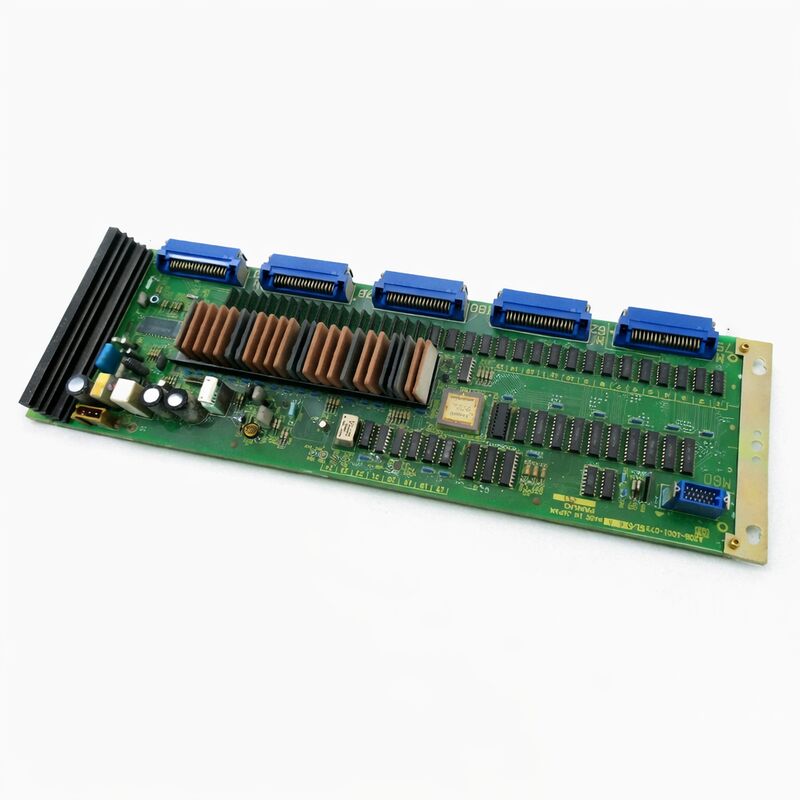
FANUC A20B-1001-0730 104/72 I/O PCB for CNC Control
The FANUC A20B-1001-0730 is an I/O-side control board used where a machine requires a defined digital input and output structure inside the CNC cabinet.
This model is widely identified as a 104/72 I/O PCB, also described as I/O B1 and associated with PMC-M I/O handling.
In practical use, it belongs to the machine-signal interface layer rather than the CPU, display, or servo section.
What makes this board useful is its clear signal profile. The 104/72 designation gives it a specific role in systems that need that exact I/O count, and some control references also place it in larger FANUC 0M or 0T configurations as an additional I/O board.
That makes it a sensible choice for board-for-board replacement when the existing control already uses the same I/O layout.
Key Product Data
| Item |
Details |
| Brand |
FANUC |
| Part Number |
A20B-1001-0730 |
| Model Number |
A20B10010730 |
| Product Series |
A20B-1001 |
| Board Type |
I/O PCB |
| I/O Format |
104/72 |
| Board Reference |
I/O B1 |
| Related Control Context |
0A Control B1 / 0-C / larger 0M or 0T configurations |
| Functional Area |
Machine I/O and PMC-side signal handling |
Application Scenarios
A20B-1001-0730 is typically used in CNC systems that need a dedicated 104-input / 72-output I/O structure for control and machine-side signal exchange.
It is suitable for cabinet-level I/O repair, replacement of a failed I/O board in FANUC 0-series controls, and restoration work where the original signal count and interface layout need to remain unchanged.
It also fits machines where the installed control already uses this board as an added I/O layer in larger 0M or 0T setups.
In those situations, the board is not being used as a generic spare PCB, but as a defined signal interface board that needs to match the existing control architecture closely.
Why Choose This Product
This model is a strong fit when the machine already depends on a 104/72 I/O board and the replacement needs to preserve the original signal structure.
The board is easier to match accurately than a general CNC PCB because its role is tied to a specific I/O capacity and a specific place in the control layout.
FAQ
Q1. What type of board is the A20B-1001-0730?
It is a 104/72 I/O PCB, also referred to as I/O B1. It belongs to the machine I/O section of the CNC and is associated with PMC-side signal handling rather than CPU or servo control.
Q2. What does this board do in the system?
Its role is to manage digital machine-side input and output signals. In practical control architecture, it acts as the I/O interface layer between the control and connected field signals.
Q3. What should be checked when selecting A20B-1001-0730?
The key checks are the exact part number, the 104/72 I/O format, and whether the installed control already uses this board family in the same position. If the control is part of a larger 0M or 0T setup, the existing cabinet layout should also be checked before replacement.
Q4. How should the “104/72” specification be understood?
It defines the board’s I/O capacity. This is one of the most important matching points because boards in the same family can still differ in signal count and application role.
The replacement should match the installed I/O structure, not just the series family.
Q5. How should faults be diagnosed before replacing this board?
Start by separating field wiring faults from board-level I/O faults. If multiple inputs or outputs fail in a pattern tied to the board’s I/O scope, and the external wiring and terminal-side devices are stable, the I/O board becomes a more likely failure point.


 Your message must be between 20-3,000 characters!