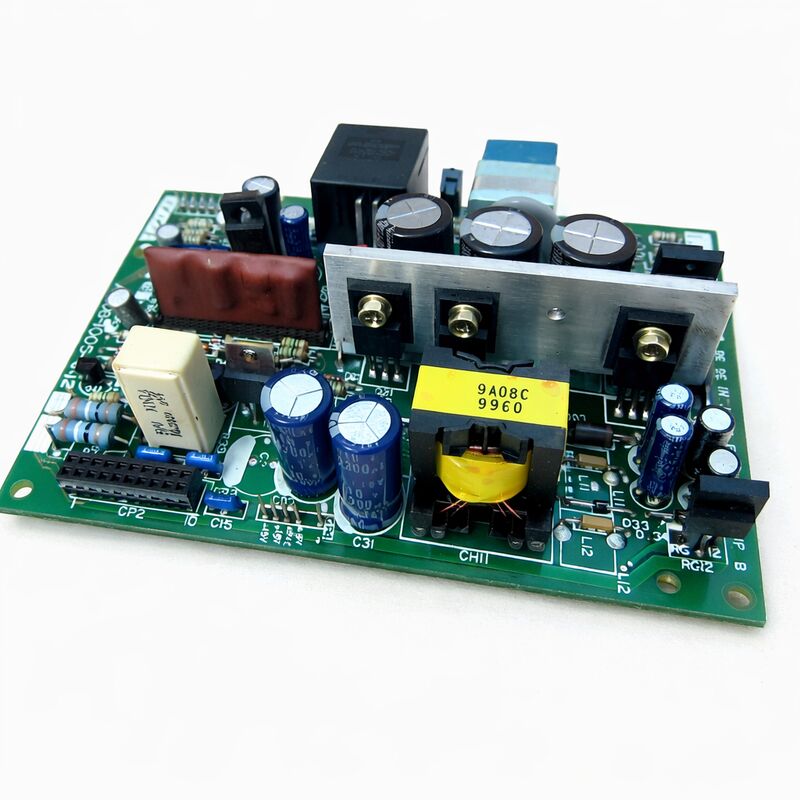
FANUC A20B-1005-0420 | Power Supply PCB — For Series 16B / 18B / 21B / 210B CNC Controllers, 24VDC Input, Type C (16B/18B) / Type B (21B/210B), Japan Origin
Overview
The FANUC A20B-1005-0420 is the power supply PCB for FANUC's Series 16B/18B/21B generation CNC controllers — the "B-series" generation that bridges the earlier analogue A-series controls and the subsequent i-series digital controls, and which represents the period during the 1990s when FANUC CNC was the dominant choice in global machine tool manufacturing.
The 24VDC input design of the A20B-1005-0420 is worth understanding, because it represents a deliberate architectural shift from the PSU approach used in earlier FANUC controller generations.
Earlier FANUC power supply designs (such as those in the Series 16A and 15A controllers) accepted AC mains input directly and included their own rectification and power factor correction stages on the PSU board.
The B-series approach moved this primary power stage off the CNC controller's PSU board and onto a separate, external 24VDC power supply — typically a dedicated switch-mode power supply mounted elsewhere in the machine's electrical cabinet.
The reasons for this architectural change are practical. By separating the primary power conversion from the CNC controller's internal PSU board, FANUC simplified the CNC board — the A20B-1005-0420 only needs to handle DC-to-DC conversion from the supplied 24V to the lower regulated voltages required by the CNC's logic and analogue circuits.
The board is smaller, generates less heat, and is more reliable as a result.
The 24VDC supply feeding the board is typically isolated from the machine's other 24VDC circuits (sensors, solenoids, contactors) to prevent machine I/O switching transients from coupling into the CNC's internal power supply.
Key Specifications
| Parameter |
Value |
| Input Voltage |
24VDC |
| Type C Designation |
For 16B, 18B (FS-18TB, FS-18GB) |
| Type B Designation |
For 21B, 210B (FS-21TB, FS-21MB) |
| Mounting |
Piggyback on I/O PSU board |
| Output Rails |
+5V, ±15V, and auxiliary rails |
| Series |
A20B-1005 |
| Origin |
Japan |
The B-Series Power Architecture — How the A20B-1005-0420 Fits
In the FANUC Series 18B and 21B controller rack, the power supply assembly consists of two layers. The lower layer is the I/O PSU board — a larger board that handles the interface between the 24VDC input, the CNC's internal power bus, and the machine's I/O circuits (input modules, output modules, relay interface).
The upper layer, mounted directly on top of the I/O PSU board in a piggyback arrangement, is the A20B-1005-0420 — the board that generates the precision-regulated DC rails required by the CNC's logic, memory, servo interface, and display electronics.
This two-layer arrangement allows the boards to be separated during fault-finding. If the CNC's operator panel lights and I/O are functional (indicating the I/O PSU board is delivering 24V to the machine interface circuits) but the CNC's CPU and memory modules are not initialising (indicating a failure in the logic supply rails), the fault is localised to the upper A20B-1005-0420 board.
Conversely, if both the machine I/O and the CNC logic fail simultaneously, the fault may be in the 24VDC supply feeding the entire assembly.
The -0420 variant (Type C for 16B/18B, Type B large capacity for 21B) is the heavier-duty of the two common variants — it delivers more current capacity than its sibling, the -0421 (which is the small capacity Type B for 21B, and Type C for 18C/16C).
Machines with more I/O, larger servo systems, or higher power display units require the higher-capacity -0420 variant.
Substituting the lower-capacity -0421 in a machine requiring the -0420 may result in supply rail sag under full load — a common cause of intermittent alarms that are difficult to trace without measuring supply voltages under operational load.
Power Supply Failure — Symptoms in the 16B/18B/21B Context
Power supply failures in the B-series CNC generation present with characteristic patterns that experienced maintenance engineers recognise:
The CNC appears dead: No display, no fan response from the CNC cooling fan, no LED activity on any board.
This points to a complete power supply failure — check the 24VDC supply at the input terminal first, then check for blown fuses on the PSU boards, then suspect the A20B-1005-0420 itself.
CNC partially initialises then stops: The CNC starts to boot — LEDs briefly light on the main board, the display shows a startup screen, then stops and shows a system alarm.
This suggests a power supply that can source light-load current (during startup with most modules not yet active) but cannot maintain stable voltage under full load.
Measure the +5V supply rail under full system load — a rail that sags below 4.75V with all modules active but reads 5.05V with the CNC in its early boot phase confirms a supply with insufficient current capability.
Intermittent system alarms correlated with ambient temperature: The CNC runs correctly when cold but generates random alarms (memory parity errors, system alarms) after 30–60 minutes of operation.
This is the classic electrolytic capacitor aging symptom — capacitors perform better cold and exhibit increased ESR when heated, causing the supply rail to develop increased ripple at operating temperature that upsets the memory and logic circuits.
Alarm 910 (SRAM parity error) not caused by battery failure: If the SRAM battery is confirmed good but alarm 910 appears intermittently, a supply voltage ripple problem is the next suspect — CMOS SRAM circuits are sensitive to supply voltage ripple, and a PSU with degraded capacitors can produce enough ripple to cause parity errors without the supply voltage leaving its nominal tolerance band.
Preventive Maintenance and Exchange Options
The A20B-1005-0420 is among the more frequently serviced boards in the FANUC B-series maintenance ecosystem, precisely because of its role delivering power to every other board in the system — any degradation in its performance affects the entire controller.
Specialist FANUC service centres typically include full capacitor replacement as standard practice during PSU overhaul, regardless of the stated fault.
This preventive approach makes sense economically: capacitor replacement adds minimal cost to a repair, but eliminates the most common future failure mode before it returns the machine to the workshop.
Exchange services (shipping a refurbished tested unit in exchange for the faulty board, often with a warranty of 6–12 months) are the most practical route for minimising machine downtime.
Having a spare A20B-1005-0420 held on site is standard practice in facilities with multiple machines fitted with Series 18B or 21B controls — the part is common enough that the investment is easily justified against the daily production loss of an unplanned machine stoppage.
FAQ
Q1: The A20B-1005-0420 is described as a "large capacity" variant. What specifically is larger compared to the -0421?
The -0420 delivers higher total output current across its regulated rails than the -0421. In FANUC's power supply architecture for the B-series, the same form factor board serves different controller configurations by providing different current ratings.
Controllers with more I/O modules, higher-power servo amplifier connections, or larger display units draw more current from the PSU; they require the -0420 (large capacity).
Simpler controllers with fewer modules draw less current and use the -0421 (small capacity).
The part numbers in the original machine configuration documentation confirm which variant is correct for the specific machine.
Q2: Can the 24VDC supply voltage tolerance affect the A20B-1005-0420's operation?
Yes. The 24VDC input to the A20B-1005-0420 should remain within the board's specified input tolerance — typically 24VDC ±10% (21.6V to 26.4V). Supply voltages below the minimum cause the internal DC-DC converters to operate outside their regulation range, reducing output rail stability.
Voltages significantly above the maximum risk damaging the board's input protection and switching components.
The 24VDC supply should be measured at the PSU board's input terminals (not at the power supply unit itself, to account for cable voltage drop) and confirmed within specification before concluding the PSU board has failed.
Q3: After replacing the A20B-1005-0420, the CNC shows alarm 910 (SRAM parity error). Is this the replacement board's fault?
Alarm 910 immediately after a PSU board replacement suggests a supply voltage issue rather than a board fault — the new board may have slightly different output characteristics that expose an SRAM battery issue that the original board was masking, or the replacement board may have a marginal output that causes SRAM voltage sensitivity issues.
Check the SRAM battery voltage first.
Then measure the +5V and ±15V rails with the system fully loaded. If all voltages are within specification and the battery is good, reload CNC parameters from backup — the SRAM data may have been corrupted during the replacement procedure (particularly if the machine was powered down during a SRAM module installation step).
Q4: Is the A20B-1005-0420 compatible with FANUC Series 20 controllers as well as 21B?
The Series 21B and Series 20 are different hardware generations with different rack architectures.
The A20B-1005-0420 was specifically designed for the Series 21B (and its related variants 210-B). The Series 20 uses a different PSU assembly.
Confirm the specific CNC system variant — Series 20 vs Series 21 — against the original hardware documentation before ordering a PSU replacement, as the two systems are not interchangeable at the PSU level.
Q5: What fuses on the A20B-1005-0420 should be checked before concluding the board has failed?
The A20B-1005-0420 typically includes one or more board-mounted fuses protecting the input 24VDC line and, in some configurations, individual output rails.
These fuses are accessible with the board removed from the rack.
A blown input fuse presents identically to a complete board failure — no output voltages, no LED activity — but is resolved by replacing the fuse (and identifying what caused the overcurrent event that blew it).
Check all board-mounted fuses visually and with a continuity tester before concluding the board's power conversion circuitry has failed.
A fuse that blows again immediately after replacement indicates a genuine overcurrent fault downstream that must be resolved before the PSU can operate safely.


 Your message must be between 20-3,000 characters!