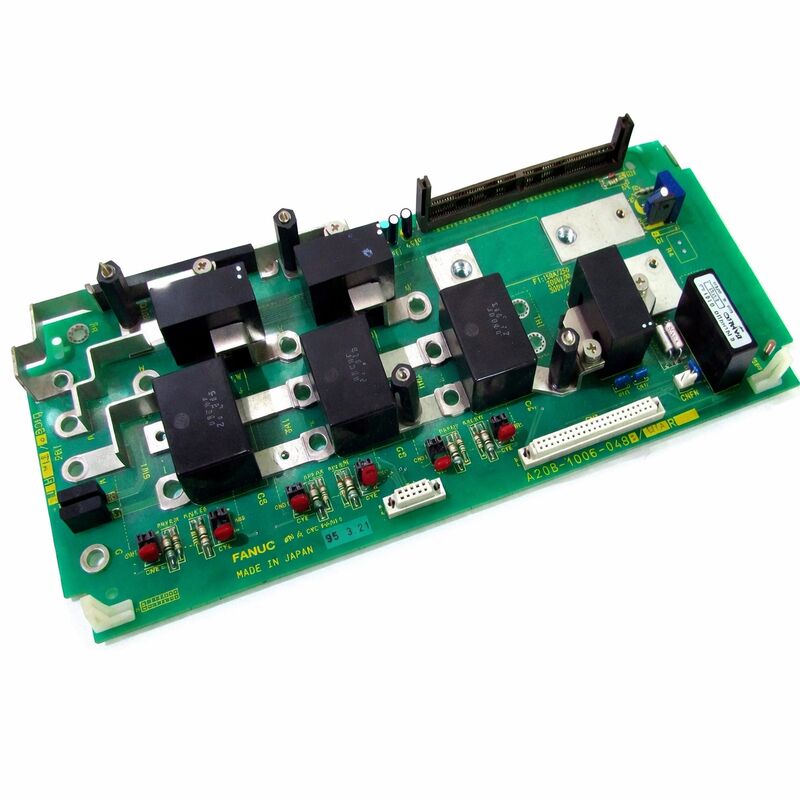
FANUC A20B-1006-0471 | Alpha Servo Power Supply PCB — PSM-15 and Above, Discontinued
Part Number: A20B-1006-0471
Manufacturer: FANUC Corporation (Japan)
Product Type: Servo Power Supply PCB (PSM Control Board)
Compatible Units: FANUC Alpha Series PSM-15 and above (including PSM-26)
Status: Discontinued by Manufacturer
Overview
The A20B-1006-0471 is the control circuit board for FANUC's Alpha series servo Power Supply Module (PSM). The PSM is the unit that supplies regulated DC bus power to the servo and spindle amplifier modules (SVM and SPM) in FANUC Alpha amplifier systems.
The A20B-1006-0471 is not the PSM itself — it is the replaceable PCB that handles the PSM's control electronics: rectifier gate control, DC bus voltage regulation, precharge sequencing, regenerative discharge management, and the communication interface with the CNC.
FANUC's Alpha amplifier system — the series that includes the SVM servo modules and SPM spindle modules alongside this PSM — was used extensively with Series 15, 16, 18, and 21 CNC controllers during the period when machining centres and turning centres were making the transition from older servo technologies to fully digital drives.
This PSM board powered Alpha systems in a large installed base of machines that remain in production today.
This board is discontinued.
FANUC no longer manufactures new units. Replacement supply comes from tested surplus stock and refurbished units.
For any Alpha PSM system that has sustained control board damage — from power transients, component aging, or environmental contamination — this board is the field-replaceable solution that restores PSM functionality without replacing the complete power module.
Key Specifications
| Parameter |
Value |
| Part Number |
A20B-1006-0471 |
| Manufacturer |
FANUC Corporation |
| Product Type |
Servo Power Supply PCB (PSM Control Board) |
| Compatible Units |
FANUC Alpha PSM-15 and above, including PSM-26 |
| Drive Family |
FANUC Alpha Series (SVM / SPM amplifier systems) |
| PSM Function |
DC bus supply for SVM servo and SPM spindle modules |
| Production Status |
Discontinued by Manufacturer |
| Origin |
Japan |
| Fuses |
Two fuses on board (FU1: 5A, FU2: 2A) — ratings marked on board |
| Condition Available |
New (surplus) / Refurbished / Repaired |
What the PSM Does — DC Bus for the Alpha Drive System
The FANUC Alpha amplifier architecture uses a shared DC bus. All the SVM servo modules and SPM spindle module in one cabinet draw their motor drive power from this common DC rail. The PSM is the component that creates and maintains this DC bus.
At the input side, the PSM connects to the three-phase AC supply. Its rectifier converts this AC to DC.
The resulting DC voltage — nominally around 300-320V DC for a 200VAC-input system — is the shared bus that feeds all connected modules. As the servo motors accelerate, they draw current from this bus. As they decelerate, they regenerate current back onto the bus. The PSM manages both conditions.
The control board — the A20B-1006-0471 — is the intelligence that makes this process work. It monitors the DC bus voltage continuously.
It controls the precharge circuit that limits inrush current when the system powers on. It activates and releases the main contactor in the correct sequence.
It monitors for fault conditions — overvoltage, undervoltage, overcurrent — and responds by issuing alarms to the CNC or shutting down the bus.
Regenerative Energy Management
Alpha PSM units with regenerative capability return braking energy to the AC supply rather than dissipating it in resistors. When the servo motors decelerate under the CNC's control, they generate electricity.
This energy flows back onto the DC bus. The PSM's control board regulates the energy return to the AC line, keeping the bus voltage within limits and feeding the excess back to the supply.
The control board contains the logic that determines when to return energy, at what rate, and when to activate the regenerative discharge function instead.
These decisions happen in real time during machine operation.
A fault in the control board's regulation logic — damaged measurement circuits, failed gate drivers, or corrupted parameter storage — can cause the DC bus to exceed its voltage limits, triggering overvoltage faults or, in severe cases, damaging the bus capacitors or connected amplifier modules.
Fuse Locations and Board Maintenance
The A20B-1006-0471 carries two fuses. FU1 is rated 5A (marking in red). FU2 is rated 2A.
Their ratings are indicated directly on the board. FANUC's maintenance documentation specifies that the fuse ratings must be confirmed before replacement — using incorrect fuse ratings can cause subsequent damage.
When a PSM fails, the fuses should be inspected before assuming the PCB itself has failed.
A blown fuse is a direct symptom — and a blown fuse means a fault event occurred that drove excess current through the protected circuit. Replacing the fuse without identifying the cause of the overcurrent event will likely result in the replacement fuse blowing immediately.
If the fuses are intact and the PSM still faults, the control board's active components — the gate drive ICs, measurement circuits, or communication interface — are the fault location. This requires board replacement.
FAQ
Q1: The PSM shows a low DC link voltage alarm. The AC input voltage is correct. Is the control board the fault?
Low DC link voltage with correct AC input can be caused by a damaged rectifier in the power stage, a faulty precharge circuit, or a control board fault that is not correctly activating the main contactor.
Check the main contactor inside the PSM — if it is not closing, the DC bus cannot charge to full voltage.
If the contactor closes correctly and the voltage is still low, the rectifier diodes should be tested. If both are confirmed good, the control board's voltage regulation circuit may be at fault.
Q2: The PSM fuses blew after a power surge. Should the A20B-1006-0471 board be replaced along with the fuses?
After a surge, inspect the control board for visible damage — burnt components, damaged gate driver ICs, discolored areas — before concluding it needs replacement. Fuses may blow to protect the board, in which case the board itself may be undamaged.
Replace fuses with correct ratings, power on with caution, and monitor the PSM's behavior. If fuses blow again or fault alarms persist, the board requires more detailed inspection or replacement.
Q3: The PSM works correctly but occasionally drops the DC bus during heavy acceleration. Is this a control board issue?
Occasional DC bus dropout during heavy acceleration is more typically a capacity issue — the PSM's power rating may be marginal for the total motor load, or the AC supply impedance is too high — than a control board fault.
Check the total motor load against the PSM's rated output. If the PSM is appropriately sized, check the AC supply voltage under load. If the supply voltage droops significantly during peak demand, the PSM sees low input voltage and may drop its bus regulation.
The control board monitors this and responds correctly to a genuine supply fault.
Q4: How should the A20B-1006-0471 be stored as a spare?
Store in anti-static packaging at stable room temperature. Keep away from moisture, temperature extremes, and direct sunlight.
The board's gate driver and analog measurement ICs are sensitive to electrostatic discharge. Handle with anti-static precautions.
In storage, the board retains its condition indefinitely under correct conditions. Before installation after extended storage, inspect the connector contacts and the fuse condition — a fuse that has corroded slightly may have increased resistance that causes problems under load.
Q5: Can the A20B-1006-0471 be used in any Alpha PSM unit, or only specific models?
This board is matched to specific PSM current ratings. The FANUC Alpha technical documentation lists the A20B-1006-0471 as compatible with PSM-15 through PSM-26 models in the Alpha series.
Larger PSM models (PSM-37 and above) use different board variants (A20B-1006-0472, A20B-1007-0650) with different power rating specifications.
Always confirm the specific PSM model number from the unit label and cross-reference against the board compatibility list before installing this board.


 Your message must be between 20-3,000 characters!