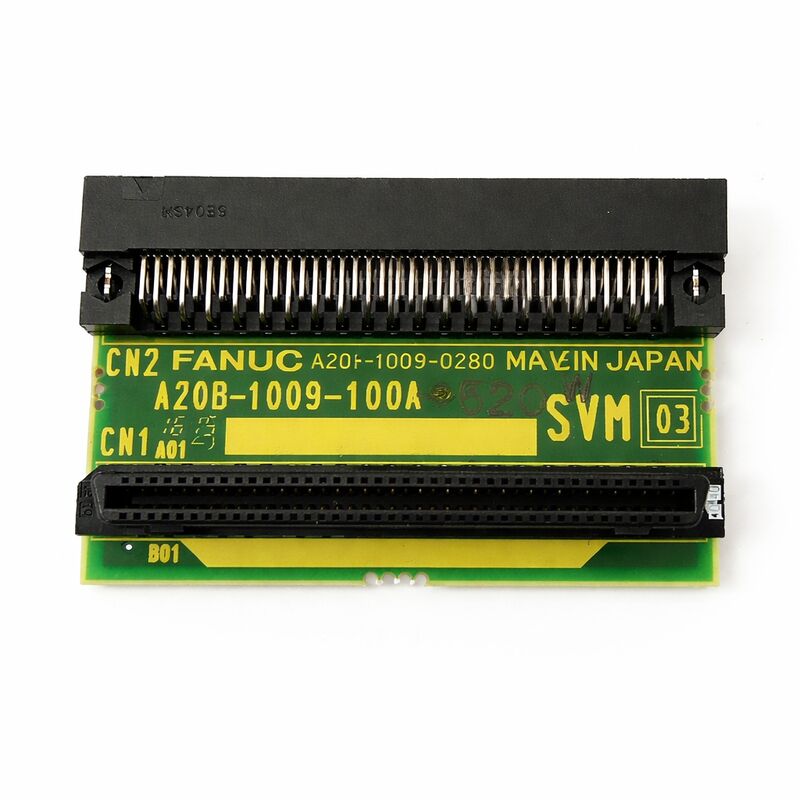
FANUC A20B-1008-0290 | Interface and Safety PCB — A20B-1008 Series, FANUC CNC and Robot, Japan Origin
Part Number: A20B-1008-0290
Manufacturer: FANUC Corporation (Japan)
Product Type: Interface / Safety PCB
Board Series: A20B-1008
Application: FANUC CNC and robot controller interface and safety circuits
Overview
The A20B-1008-0290 is a printed circuit board from FANUC's A20B-1008 series — a family of boards used in FANUC CNC and robot controllers for interface and safety circuit functions.
The A20B-1008 series spans several board variants covering emergency stop (E-Stop) unit PCBs, EMG (emergency) input modules, safety relay interface boards, and related controller input circuit boards that manage the electrical interface between the machine's safety hardware and the CNC or robot controller's internal logic.
Safety circuit boards in FANUC's architecture occupy a specific and critical position.
The machine tool or robot system's physical safety hardware — emergency stop buttons, safety gate interlock switches, external enabling circuits — generates electrical signals that must reach the controller's safety logic reliably and without distortion.
The A20B-1008 series boards serve as the conditioned electrical interface for these signals: receiving them from the field wiring, filtering and debouncing them, providing the isolation that keeps field-side noise away from controller logic, and presenting clean digital states to the PMC or robot controller's safety monitoring circuits.
The A20B-1008-0290 represents a specific variant within this safety and interface board family.
Its exact function within the A20B-1008 series is defined by its position in the machine's controller wiring.
The board is manufactured in Japan and built to FANUC's production standards for use in the industrial environments where CNC machine tools and robots operate continuously.
Key Specifications
| Parameter |
Value |
| Part Number |
A20B-1008-0290 |
| Manufacturer |
FANUC Corporation |
| Product Type |
Interface / Safety PCB |
| Board Series |
A20B-1008 |
| Application |
FANUC CNC and robot controller safety and interface |
| Input Voltage |
24V DC (typical field-side) |
| Origin |
Japan |
| Operating Temperature |
0 – 55°C |
| Storage Temperature |
−20 – 60°C |
| Humidity |
75% RH max (non-condensing) |
| Condition Available |
New (surplus) / Refurbished / Repaired |
Safety Input Processing in FANUC Systems
The 24V DC safety circuit is the standard for machine tool and robot safety inputs. Emergency stop buttons, safety gate switches, safety mats, light curtain output contacts, and robot teach pendant enable switches all produce 24V DC signal states.
A signal at 24V indicates a closed contact — the safety device is in its normal, unactivated state. A signal at 0V, or an open circuit, indicates the device has been activated — a button pressed, a gate opened, a mat contacted.
The safety input board's job is to read these states reliably. Field wiring for safety circuits runs through machine cabinets alongside motor power cables, servo feedback cables, and other conductors that generate electromagnetic interference.
Without proper input conditioning, this interference can appear as false input transitions — the controller sees an emergency stop that didn't happen, or (far more dangerously) fails to see one that did.
The A20B-1008 series boards address this through their input circuit design.
Optical isolation separates the field-side circuits from the controller logic side. The opto-isolator's LED is driven by the 24V field signal; the phototransistor on the logic side is completely electrically isolated from the field wiring.
Noise on the field side cannot directly couple into the controller logic side through this barrier.
Input debounce circuits eliminate false transitions from contact bounce. When an emergency stop button is pressed, its contacts do not transition cleanly from closed to open — they bounce, alternating between contact states dozens of times in the first few milliseconds.
Without debounce, this produces a rapid series of signal transitions that the controller logic might interpret as repeated input changes.
The debounce circuit absorbs these transitions and presents a single, clean transition to the logic.
The A20B-1008 Series — Identifying the Board's Role
The A20B-1008 series contains multiple variants, each serving a specific function in the controller wiring:
E-Stop unit PCBs receive the machine's emergency stop chain signals and relay them to the controller's safety logic with the appropriate contact output to disable the servo drive system.
EMG input boards receive external emergency signals from peripheral devices — robots, automatic pallet changers, external safety equipment — and present them to the controller in a form it can process. Safety relay interface boards condition the output contacts of safety relays for controller monitoring.
The -0290 variant is one specific board in this family.
Its exact function is defined by the machine's wiring documentation. When this board fails, the fault pattern reflects the specific safety or interface signal path it handles: a permanent safety alarm for a signal the board can no longer read, or inability to detect a genuine safety event because the board's input circuit has failed open.
Field Wiring and Replacement Considerations
Safety input boards connect to the machine's external safety wiring. This wiring is not just signal wiring — it carries the functional safety chain of the machine. Incorrect wiring after board replacement can create a machine where a safety device appears functional from the controller's perspective but is actually disconnected or misrouted.
Before removing the board, photograph the connector arrangement and wiring from multiple angles.
Document each connector's position and the cable routing into it.
After installing the replacement, reconnect each connector to its documented position and verify with continuity testing where practical.
Following replacement, the safety circuit function must be tested completely.
Every emergency stop button should be tested individually. Every safety gate switch should be tested individually.
Each test should confirm that pressing/opening the device produces an emergency stop and that releasing/closing the device allows the safety state to be reset normally.
Do not return the machine to production until all safety circuit tests are complete and documented.
FAQ
Q1: The controller shows a permanent emergency stop alarm even though all E-stop buttons are released and all safety gates are confirmed closed. The wiring continuity is correct. Could this be the A20B-1008-0290?
Yes, this matches a typical safety input board failure. The board's input circuit cannot read the safety chain state correctly — either the opto-isolator has failed or the input conditioning circuit is defective.
The controller receives no valid "safe" state from the board, so it maintains the emergency stop alarm.
Verify the 24V supply to the board's input side is correct before concluding the board has failed.
Q2: The emergency stop alarm appears randomly during machine operation. Pressing the E-stop button resets it each time. No physical safety device was activated. What should be investigated?
Random E-stop alarms with no physical activation, resettable by the E-stop button, point to an intermittent fault in the safety input path. Common causes include a loose connector at the board that produces intermittent loss of the chain signal, a degraded opto-isolator producing false transitions, or high-resistance contact in the safety chain wiring.
Check the connector to the A20B-1008-0290 first — a connection that works intermittently is the most common cause of this pattern.
Q3: After a surge event, one E-stop station no longer stops the machine. The other E-stop buttons work normally. The button's contact is confirmed functional. Is this the board?
A surge event can damage the input circuit for a specific channel while leaving others intact. The opto-isolator for the affected channel may have been damaged by voltage transient energy arriving through the external wiring.
If the button contact is confirmed functional and all wiring to the board is correct, the board's input circuit for that channel has likely been damaged.
Replace the board and verify all E-stop functions after installation.
Q4: The machine is a robot system, not a CNC machine tool. Is the A20B-1008-0290 compatible with robot controller applications?
The A20B-1008 series serves both CNC machine tool and FANUC robot controller applications. Safety input board functions — emergency stop input processing, safety gate interface, enabling device monitoring — are common to both application types.
The specific robot controller model and wiring documentation must be consulted to confirm that the -0290 variant is the correct board for the specific robot installation.
Q5: Can the safety input circuit on the A20B-1008-0290 be tested without a full machine safety circuit test?
A basic continuity and signal level test can confirm that the board's input circuits are receiving the correct 24V DC input signals and that the controller side is seeing the correct digital states. This can be performed with a multimeter and the machine in a known state.
However, a full functional safety test — actually pressing each E-stop button and verifying that the machine stops and that the alarm appears correctly — cannot be replaced by bench measurements.
Always perform the complete functional safety test after any safety circuit board replacement before returning the machine to production.


 Your message must be between 20-3,000 characters!