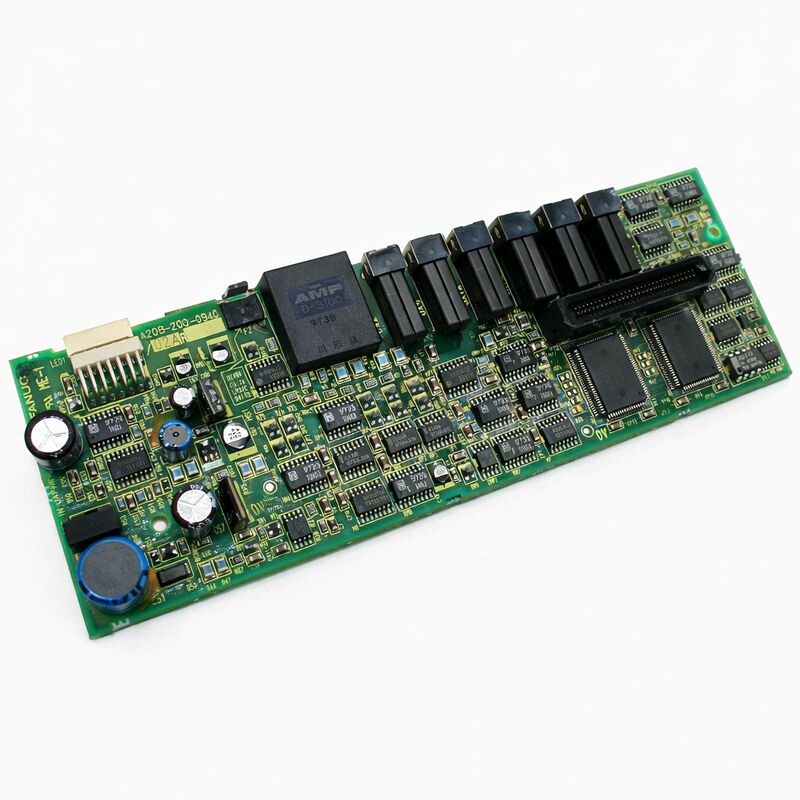
FANUC A20B-2001-0940 | Alpha SVM3 3-Axis Servo Drive Control PCB — A06B-6079 / Type A PWM / L-M-N Axes
Three Closed-Loop Servo Algorithms on One Card
The A06B-6079 SVM3 module packs three-axis servo amplification into a single 90mm booksize module — L, M, and N axes sharing a common DC bus from the PSM. The A20B-2001-0940 is the control card that makes this possible. It runs three independent closed-loop servo control algorithms simultaneously, receiving CNC position commands for all three axes, processing the encoder feedback from all three motors, computing current error for each, and generating the current commands for the power transistors on the A16B-2202-078x wiring board below it.
The three axes share a common clock on the control card, which is essential. FANUC's CNC interpolation generates position commands for all three axes simultaneously and expects them to track with tight synchronisation. A single control card managing all three loops from the same clock is the architecture that delivers this. When this card fails, all three axes typically alarm at once — the first diagnostic sign that the common control layer, not an individual axis, has failed.
Key Specifications
| Parameter |
Value |
| Part Number |
A20B-2001-0940 |
| Drive Series |
A06B-6079 (Alpha SVM3) |
| Compatible Modules |
H301 / H302 / H303 / H304 / H305 / H306 / H307 |
| Axes |
3 (L, M, N) |
| Interface |
Type A PWM |
| DC Bus Input |
283–325V (from PSM) |
| Max Output Voltage |
230V |
| Wiring Board |
A16B-2202-078x |
| Compatible Motors |
Alpha αC3/2000, αC6/2000 |
| Module Width |
90 mm |
| Status |
Discontinued |
Type A PWM — The Interface That Defines This Card's Generation
The A06B-6079 series communicates with the CNC via Type A PWM signals — duty-cycle-encoded current commands on hardwired cables, not optical fibre. The A20B-2001-0940 decodes these six PWM signals (two per axis) into the per-axis current demands that drive the servo loops. It also returns alarm and ready signals to the CNC through the same cable interface.
This places the 6079 SVM3 clearly in the generation before the A06B-6096 FSSB series. The two are not interchangeable — the 6079 connects to the CNC's Type A servo interface board; the 6096 connects to an FSSB optical fibre bus. Replacing a 6079 drive with a 6096 requires changing the CNC's servo interface hardware, not just the drive module. Match the drive series exactly to the installed CNC's servo interface type.
Fault Isolation: Control Card vs Power Board
The SVM3's two-board structure allows fault isolation before ordering a replacement. The symptom pattern identifies which board has failed:
| Symptom Pattern |
Likely Fault Location |
| All three axes alarm simultaneously |
A20B-2001-0940 control card |
| VRDY OFF at startup, no specific axis code |
Control card initialisation / PWM cable |
| Single-axis overcurrent or IPM alarm |
A16B-2202-078x wiring board (power stage) |
| Phase loss or DC bus fault |
Wiring board or external PSM |
| Intermittent alarms that clear and return |
Aging capacitors on control card |
The A20B-2001-0940 cannot be tested on a bench in isolation — it requires the complete 6079 SVM3 module assembly with motor loads on all three axes for functional verification. Swap testing with a confirmed-good control card in the module is the definitive diagnostic step when all three axes alarm simultaneously.
FAQ
Q1: All three axes show servo alarms simultaneously. Motors and cables are confirmed good. Is A20B-2001-0940 at fault?
Simultaneous three-axis alarms with confirmed motors and cables point strongly to the control card. The A20B-2001-0940 is the single common element for all three axis channels. A failure in the card's shared power supply rail or common signal processing circuits causes all three axes to alarm at the same time. Swap test with a confirmed-good card in the complete module as the definitive step.
Q2: The drive shows VRDY OFF at startup with no specific axis alarm. What should be checked first?
Before suspecting the control card, check the CNC-side PWM cable connections — the Type A interface signals from the CNC must be present before the drive asserts VRDY. If cable connections are confirmed good, inspect the switch settings on the A20B-2001-0940 against the drive documentation. Incorrect switch positions produce VRDY failures without axis-specific alarm codes.
Q3: What switch settings must be documented before removing the original card?
The A20B-2001-0940 carries configuration switches for axis count, interface type, battery connection, and other drive parameters. Photograph all switch positions or record them in writing before removing the original card. The replacement must be configured identically — incorrect settings produce VRDY failures, wrong alarm codes, or behaviour that does not match CNC expectations.
Q4: After 12 years of service, what is most likely to fail on this card?
The electrolytic capacitors in the card's internal power supply section are the primary aging concern. As capacitance decreases and ESR rises with age, regulated supply rails develop ripple — the early symptom is intermittent alarms that appear and clear without obvious cause. The absolute encoder backup battery (typical 2–3 year life) is the other time-limited component; battery depletion causes position data loss at power-off.
Q5: Can a 6096 SVM3 (FSSB) replace the 6079 SVM3 (Type A) with the same axis current ratings?
No. The 6079 Type A and 6096 FSSB drives use entirely different CNC-to-drive communication interfaces. Substituting an FSSB drive for a Type A drive requires replacing the CNC's servo interface hardware and reconfiguring its servo communication — it is not a module swap. Match the drive interface type exactly to the CNC's servo interface.


 Your message must be between 20-3,000 characters!