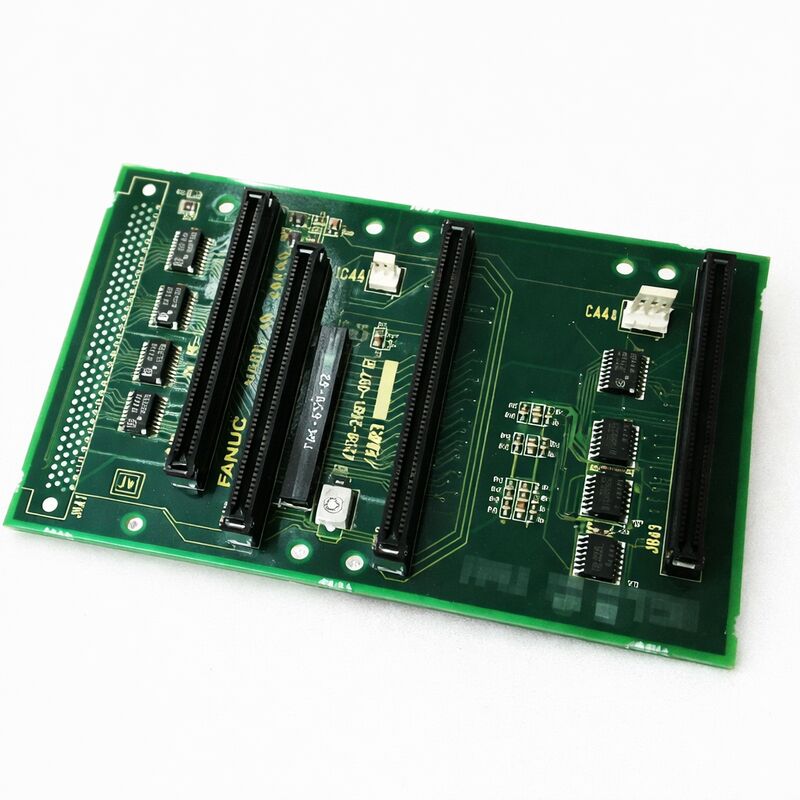
FANUC A20B-2001-0970 | A20B-2001 Series CNC Control PCB — FANUC Industrial Automation, Japan Origin
Part Number: A20B-2001-0970
Manufacturer: FANUC Corporation (Japan)
Product Type: CNC Control PCB Module
Board Series: A20B-2001
Application: FANUC CNC controller and industrial automation systems
Overview
The A20B-2001-0970 is a control printed circuit board from FANUC's A20B-2001 series — a family of CNC control boards serving FANUC's CNC and industrial automation platforms across several generations of machine tools and production systems.
The A20B-2001 series encompasses boards that perform specific, dedicated functions within the controller architecture they serve: master boards that act as the central backplane and processing unit for 0-series CNC controllers, various function boards that extend controller capability, and boards serving specialised communication, motion, or interface roles within the wider FANUC controller ecosystem.
The A20B-2001 series has its roots in the FANUC 0-series CNC generation — one of the most commercially successful and widely deployed CNC controller families ever produced. Machines built around 0-series controllers remain in active production across manufacturing facilities worldwide.
The boards that keep these controllers operational are not interchangeable — each variant in the A20B-2001 family serves the specific controller configuration it was designed for, and sourcing the precise part number is the starting point for any effective maintenance strategy.
The A20B-2001-0970 fills its defined role within the controller architecture it serves.
Like all boards in the A20B-2001 series, it was engineered for industrial reliability — operating continuously in the electrical noise environment of a machine tool cabinet, subject to the vibration and temperature cycling of a production environment, and expected to perform without intervention for years at a time.
Key Specifications
| Parameter |
Value |
| Part Number |
A20B-2001-0970 |
| Manufacturer |
FANUC Corporation |
| Product Type |
CNC Control PCB Module |
| Board Series |
A20B-2001 |
| Application |
FANUC CNC controller and automation systems |
| Origin |
Japan |
| Operating Temperature |
0 – 55°C |
| Storage Temperature |
−20 – 60°C |
| Humidity |
75% RH max (non-condensing) |
| Condition Available |
New (surplus) / Refurbished / Repaired / Exchange |
The A20B-2001 Series — Spanning the CNC Generations
The A20B-2001 series is FANUC's board family associated with the 0-series CNC platform's mature and late generations — the D and F model variants that represented the most capable iteration of the 0-series architecture before the transition to the i-series.
These controllers powered the turning centres, machining centres, and production machines that formed the backbone of the global machine tool industry through the 1990s and into the 2000s.
Within this series, different boards serve different purposes. Master boards in the A20B-2001 family act as the central backplane and processor that peripheral boards — memory, axes, I/O, PMC — plug into.
Other boards in the series serve specific function roles: sub-CPU boards for additional axis control, communication boards for DNC and serial data transfer, and specialised control boards for features like high-speed skip and remote buffer operation.
Each board has its place in the controller hierarchy.
The A20B-2001-0970 occupies its specific position in this hierarchy. Its function within the controller architecture determines what alarms appear when it fails and what controller capabilities are restored when it is replaced.
Identifying the alarm's functional area is the first step in confirming whether this board is the fault source.
Maintaining Legacy FANUC 0-Series Controllers
A20B-2001 series boards are legacy components. FANUC completed production of these boards as the industry transitioned to newer controller generations.
The machines that contain them are not legacy in the sense of being obsolete — many represent high-value machine tools with decades of productive life remaining in their mechanical and structural components. The electronics are what require attention.
The aftermarket supply chain for A20B-2001 series boards supports maintenance through several channels: tested surplus boards from decommissioned controllers, professionally refurbished boards with component-level restoration, and board-level repair services that address specific component failures.
These supply channels serve an extensive installed base of 0-series machines worldwide.
Accurate part number identification is critical. The A20B-2001 series contains many board variants.
Physical similarity between boards does not indicate functional compatibility.
The correct part number must match the exact board label from the installed unit. Sourcing the wrong board — even one that looks identical — can result in incorrect controller behaviour or compatibility alarms.
Fault Diagnosis and Board Identification
The A20B-2001-0970's failure will produce alarms in the functional area it serves within the controller. The specific alarm code — visible on the CNC's alarm display or the controller's LED indicator panel — points to the functional area affected.
A master board failure typically prevents startup; a function board failure produces alarms specific to the function that board provides.
Before attributing an alarm to a board failure, connector verification is essential.
A partially disengaged backplane connector produces the same alarm symptom as a board failure.
On the A20B-2001 series, connectors can work loose over years of thermal cycling and vibration.
Reseating the board and cleaning its connector contacts resolves a significant fraction of apparent board failures without any component replacement.
FAQ
Q1: The CNC controller alarm points to the functional area that the A20B-2001-0970 serves. Reseating and connector cleaning did not clear the alarm. What is the next diagnostic step?
If a known-good equivalent board is available for swap testing, this is the most definitive next step.
A swap test — replacing the suspect board with a confirmed-good unit and observing whether the alarm clears — definitively identifies whether the fault is in the board or the surrounding circuitry.
If a swap board is not available, review the maintenance manual's diagnostic procedure for the specific alarm code.
The manual typically identifies test points on the board and measurement procedures that distinguish board faults from peripheral faults.
Q2: A replacement A20B-2001-0970 has been obtained. Before installation, are there any settings on the board that need to match the original?
Many A20B-2001 series boards have configuration switches or jumpers that are set during initial installation to match the controller's hardware configuration.
Before removing the original board, photograph or document all visible switch and jumper positions.
Set the replacement board identically. Incorrect switch settings can produce alarms or incorrect behaviour even with a physically functional board.
Q3: The machine has been in storage for three years. On power-up, the CNC displays alarms that reference the A20B-2001-0970's functional area. Could storage have caused the board to fail?
Boards do not typically fail simply from being stored in a powered-off machine for a few years. What extended storage does cause is battery-related issues and capacitor degradation.
If the controller's SRAM battery (usually on the memory board in 0-series controllers) has been exhausted, parameter loss creates alarms that may appear to implicate various boards.
Check the battery condition first. If the battery is depleted, restore parameters from backup before investigating board failures.
Q4: How can the correct replacement A20B-2001-0970 be verified before purchase to ensure it will work in the installation?
Verify the complete part number including any revision suffix from the installed board's label. Confirm the seller's warranty terms specifically cover functional testing in a FANUC 0-series CNC system.
Request confirmation that the board has been tested in the relevant controller configuration if possible.
Ask whether the seller has experience with this specific board in field applications.
A board from a reputable specialist supplier with relevant testing experience is far more likely to be suitable than one from a general surplus channel with no functional verification.
Q5: Multiple boards in the 0-series controller are showing intermittent alarms. Is it more cost-effective to replace individual boards as they fail or to replace the entire controller?
Multiple intermittent alarms across several boards in an aging controller usually indicate systemic aging — electrolytic capacitors throughout the controller are nearing the end of their service life simultaneously.
In this situation, board-by-board replacement is essentially chasing a moving target.
A comprehensive refurbishment — professional inspection and capacitor replacement across all boards — addresses the root cause more effectively than sequential board replacement.
If the machine's productive value justifies significant investment, a CNC retrofit with modern equivalent hardware is another option that eliminates the legacy board maintenance concern entirely.


 Your message must be between 20-3,000 characters!