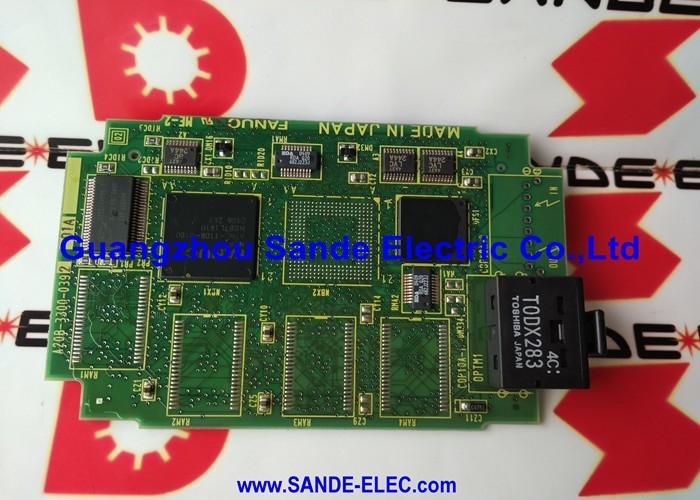
A20B-2002-0650 | FANUC Series 0-C 32-Bit Master Board — F0-C / 0MC / 0TTC / 0TTD / 0MF / 0TTF / CNC Motherboard
FANUC Series 0-C — The 32-Bit Generation of the World's Most Deployed CNC
The FANUC Series 0 is the most widely installed CNC in the history of machine tools — tens of thousands of machines worldwide use Series 0 CNC systems. The A20B-2002-0650 is the main CPU board (motherboard) for the Series 0-C variant — the generation that introduced 32-bit processing to the Series 0 platform.
32-bit advantage: The Series 0-C's 32-bit processor provided significantly faster interpolation and look-ahead capability compared to the 16-bit Series 0-A and 0-B — enabling higher feed rates, smoother arc interpolation, and improved CNC programme cycle times.
Machine type coverage: The A20B-2002-0650 serves five distinct Series 0-C machine type configurations — confirming it as a high-volume main board used across the full range of 0-C machining and turning applications.
Key Specifications
| Parameter |
Value |
| Compatible CNC |
FANUC Series 0-C (F0-C) |
| Processing |
32-bit |
| System Designations |
0MC, 0TTC, 0TTD, 0MF, 0TTF |
| Board Type |
Main CPU Board (Motherboard) |
| Confirmed Revision |
/03A |
| Weight |
2.56 lbs |
| Series |
A20B-2002 |
Five System Designations — One Master Board
The A20B-2002-0650 is confirmed across five FANUC Series 0-C machine type designations:
0MC (Series 0-C Machining Centre): Vertical and horizontal machining centres — the most widely deployed Series 0-C configuration. Full G-code machining capability with contouring, canned drilling/boring cycles, and tool length/radius compensation.
0TTC (Series 0-C Twin Turret Centre): CNC turning centres with twin turret capability — simultaneous operation of two independent turrets on one or two spindles. The 0TTC represents advanced turning centre control within the Series 0-C family.
0TTD (Series 0-C Turning Centre D): A D-variant of the twin turret configuration — specific to certain machine builder implementations within the Series 0-C turning centre range.
0MF (Series 0-C Machining F variant): The F-suffix variant of the Series 0-C machining centre — incorporating specific enhanced functionality beyond the standard 0MC.
0TTF (Series 0-C Turning F variant): The F-suffix variant of the twin turret turning centre — the highest-specification turning centre configuration within the Series 0-C family.
Application Scenarios
Series 0-C CNC system failure — motherboard fault: A FANUC Series 0-C CNC 0MC machining centre develops system-level faults — intermittent lockups, random alarms, and eventually failure to complete boot. Diagnosis isolates the fault to the A20B-2002-0650 main board. Replacement with full data restore returns the machine to production.
0TTC turning centre control restoration: A twin turret turning centre running a FANUC Series 0-TTC configuration develops CPU-level faults. The A20B-2002-0650 is replaced and all CNC data restored from backup — confirmed compatible with the 0TTC system designation.
FAQ
Q1: What exactly does "32-bit" mean in the context of the Series 0-C versus earlier Series 0 CNCs?
The Series 0-A and 0-B used 16-bit processors — limiting the speed of interpolation calculations and programme execution. The Series 0-C's 32-bit processor doubled the data path width, enabling significantly faster calculation of axis positions and faster execution of complex G-code programmes. In practical terms, 32-bit processing enabled higher maximum feed rates, smoother arc interpolation at high speeds, and faster MDI/programme response — making the 0-C a significant advance over the 0-A and 0-B for high-speed machining applications of its era.
Q2: After replacing A20B-2002-0650, what data needs to be reloaded into the Series 0-C CNC?
Replacing the main CPU board requires a complete reload of all CNC data from backup. This includes: all axis and servo parameters (P3000+), all programme-related parameters, all PMC parameters and PLC data (if stored separately), all tool offset data, all part programmes stored in CNC memory, and all macro variable data. Always maintain a current, complete backup of all CNC data for Series 0-C systems — backup frequency should match the rate of programme and parameter changes.
Q3: Which backup method is most reliable for Series 0-C CNC data?
Series 0-C CNC systems support RS-232 serial communication for data backup — transferring parameters and programmes to a PC via FANUC's serial communication protocol (using DNC or terminal software). Bubble memory or battery-backed SRAM stores data within the CNC; maintaining a charged backup battery is essential. For critical production machines, maintain multiple backup copies at different locations — stored on PC, floppy disk (period-appropriate media), or modern RS-232-to-USB adapters that work with FANUC CNC serial protocols.
Q4: Can A20B-2002-0650 be used across all five system designations (0MC, 0TTC, 0TTD, 0MF, 0TTF) without hardware modification?
Yes. The A20B-2002-0650 is a single hardware board confirmed for all five designations. The difference between 0MC, 0TTC, 0TTD, 0MF, and 0TTF lies in the CNC software and parameters loaded into the system — not in the motherboard hardware. The same physical board accepts the parameter set for any of the five machine configurations. Ensure the correct parameter set for the specific machine type is loaded after board replacement.
Q5: Is capacitor replacement (recapping) a viable alternative to full motherboard replacement for the A20B-2002-0650?
In some cases, yes. When the board's core components (processor, ROM, connectors) remain functional and only the electrolytic capacitors have degraded, recapping — replacing all electrolytics with new equivalents — can restore the board to full function at lower cost than a complete replacement board. This requires board-level repair by a technician familiar with CNC motherboard maintenance. The repair is most viable when the board is structurally sound and the symptoms clearly point to power rail instability from aged capacitors rather than other component failure.


 Your message must be between 20-3,000 characters!