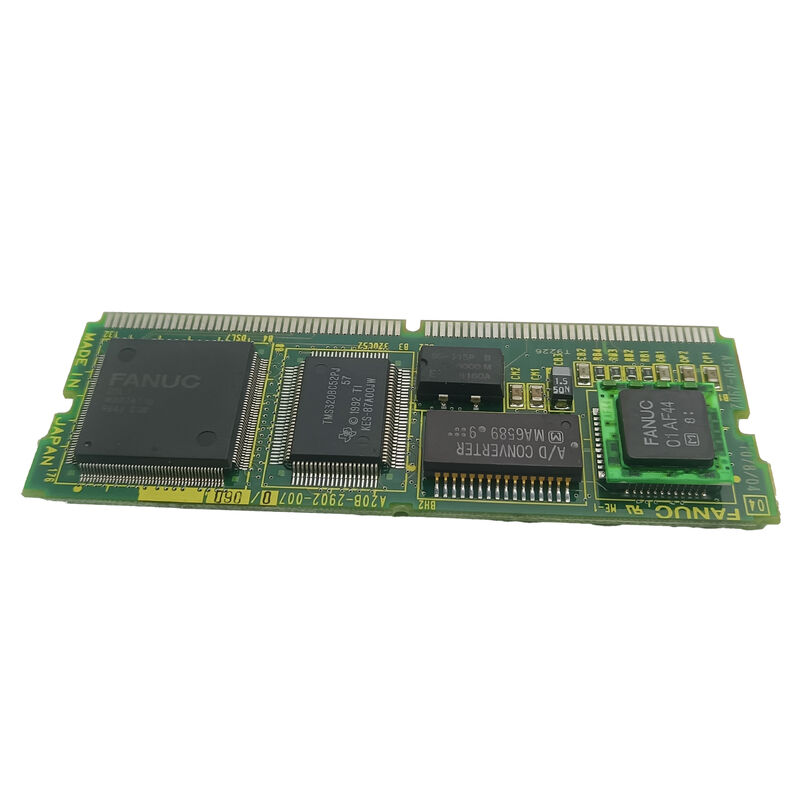
FANUC A20B-2902-0180 | A20B-2902 Series Servo Control Module — Soft 9070 / Cross-Ref A350-2902-T186/01
Servo Control at the Module Level
The A20B-2902-0180 is a plug-in servo control module from FANUC's A20B-2902 series — compact daughter boards that bridge the CNC's main CPU board and the servo amplifier drive stages. It installs into a dedicated slot on the CNC main board or servo motherboard and executes the real-time servo processing for the axis group it serves.
The control architecture is hierarchical. The CNC CPU updates axis positions at the interpolation rate (every 1–8ms). The servo module takes those position commands and runs the faster current and velocity control loops at the PWM switching frequency (typically 4–8kHz), translating commanded positions into actual motor torque. This two-level separation — slow interpolation in the CPU, fast servo loops in the dedicated servo module — is the reason the servo function lives on its own plug-in PCB rather than on the main CPU board itself.
Soft 9070 — Why the Software Version Matters
The "Soft 9070" designation is a critical compatibility parameter, not a background detail. FANUC servo software versions encode motor parameters, control law coefficients, encoder pulse count settings, and gain tables matched to specific motor and encoder generations. Installing a module with an incompatible Soft number produces: incorrect velocity scaling (the axis moves at the wrong speed for a given position command), wrong encoder count interpretation, or immediate servo alarms because the control loop gains do not match the connected motor's characteristics.
The required software version is on the label of the installed module. It is also accessible from the CNC's SYSTEM key MDI panel screen and in the machine tool builder's maintenance documentation. When sourcing a replacement A20B-2902-0180, match the firmware revision suffix (e.g., /02A on the board label) to the original wherever possible
Key Specifications
| Parameter | Value |
|---|
| Part Number | A20B-2902-0180 |
| Cross Reference | A350-2902-T186/01 |
| Series | A20B-2902 |
| Software | Soft 9070 |
| Type | Servo control module (plug-in PCB) |
| Technology | SMT |
| Status | Discontinued |
| Origin | Japan |
Dual Numbering: A20B and A350
The cross-reference A350-2902-T186/01 identifies the same board in FANUC's sub-assembly numbering system. A20B numbers identify the bare PCB; A350 numbers identify the same item as a sub-assembly that may include factory-fitted firmware or accessories. For ordering, both numbers refer to the same functional replacement — provide both to suppliers to avoid cataloguing confusion.
How Faults Present
Servo control module faults typically appear as:
- Servo communication alarms at power-up — the module cannot communicate with the servo amplifiers, causing servo initialisation failure
- Position deviation alarms — the module's error register grows beyond the CNC's alarm threshold, indicating a failed gain stage or corrupted firmware
- Simultaneous multi-axis alarms — when one module serves multiple axes, all axes on that module alarm together, distinguishing module failure from a single-axis motor or cable fault
FAQ
Q1: How is the correct Soft number identified for a replacement A20B-2902-0180?
Read the label of the installed module — the software version is printed there. It is also shown in the CNC's system information screen (SYSTEM key on MDI panel) and in the machine builder's maintenance documentation. Match the firmware revision suffix on the board label when possible. Mismatched Soft versions cause servo alarms or incorrect axis motion behaviour.
Q2: Can this module be repaired at component level?
Yes, at experienced FANUC repair centres with servo test rigs. Common failure items are SMD electrolytic capacitors (age-related), surface-mount ICs from ESD events, and failed voltage regulators. The compact SMT construction requires precision SMD rework equipment. For production-critical machines, a tested exchange board is faster; component repair is more economical for facilities with in-house repair capability.
Q3: Does the module need to match the specific CNC main board it will install into?
Yes. The main board must have the compatible backplane slot and interface protocol — slot dimensions, connector pin count, and signal protocol must all match. The CNC system software must also recognise the module's hardware version. Confirm the target CNC's main board part number and the module's slot position in the CNC maintenance manual before ordering.
Q4: What ESD precautions are needed when handling the A20B-2902-0180?
Handle with a grounded ESD wrist strap on an ESD-safe mat. Transport and store only in antistatic bags. ESD damage is often latent — the board may appear functional after an ESD event but fail within days or weeks under normal operating conditions. Never place the module on cardboard, ordinary plastic, or synthetic fabric surfaces.
Q5: The module label shows A350-2902-T186/01. Is this the same part as A20B-2902-0180?
Yes. The A20B number is the bare PCB; the A350 number is the sub-assembly reference for the same item. Both refer to the same functional replacement. Provide both numbers to suppliers — stock is sometimes catalogued under one numbering system only, and specifying both avoids ordering confusion.


 Your message must be between 20-3,000 characters!