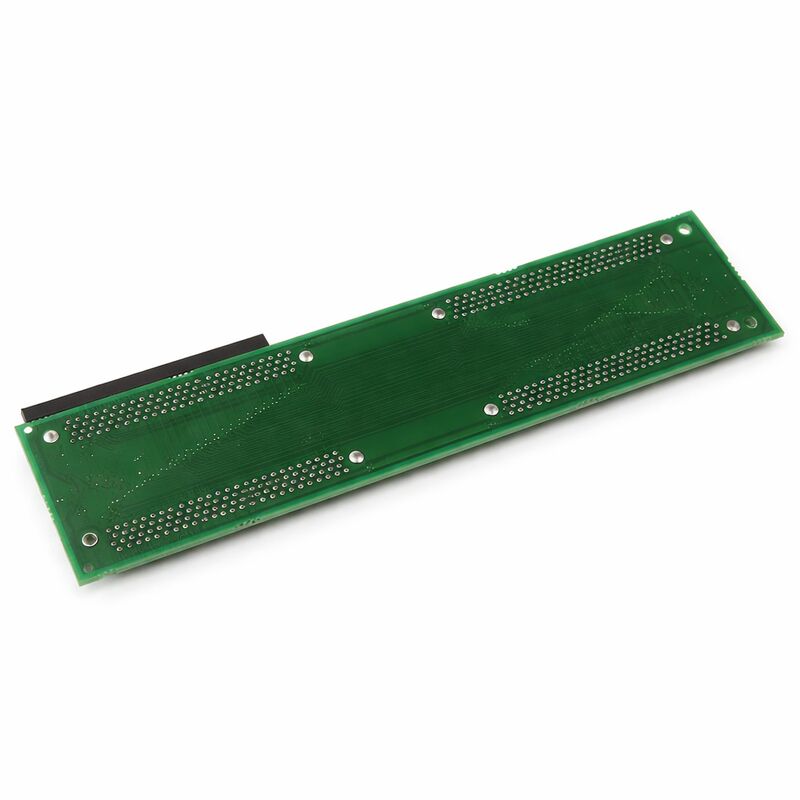
FANUC A20B-2002-0850 | A20B-2002 Series 1-Slot Backplane PCB — CNC Controller Rack Infrastructure Board
Single Slot, Passive Design
The A20B-2002-0850 is a single-slot backplane board from FANUC's A20B-2002 series — the family of rack infrastructure PCBs used in FANUC's modular CNC control architecture. The backplane itself holds no firmware and executes no processing. It is the physical and electrical foundation for one control module slot: it routes supply voltages to the module, carries the bus communication signals between the module and the rack's main backplane, and provides the mechanical connector interface that the plug-in module seats into.
FANUC's modular CNC architecture uses backplane boards of different slot counts — one, two, and three slots — combined within a control rack to create the specific configuration a machine builder requires. The A20B-2002-0850 handles exactly one slot. Where the machine's configuration requires accommodating a single option or expansion module — an additional I/O card, a communication interface, a data server board — the 1-slot backplane provides that position without leaving empty slots in the rack.
How to Identify a Backplane Fault
Backplane failures are often misidentified as module failures because the symptoms look identical — the module that occupies the failed slot alarms or fails to communicate, suggesting the module itself has failed. The diagnostic step that separates the two: move the suspect module to a known-good slot of the same type. If the module works in the alternate slot, the original slot's backplane is the fault source.
Common failure causes:
- Connector wear from repeated module removal and reinsertion — contact spring tension degrades, producing intermittent connection faults
- PCB trace cracks from mechanical impact or overtorqued mounting screws
- Contamination from coolant mist or fine metallic particles bridging insulation gaps, causing leakage current that triggers thermal shutdowns or power alarms
Replacing the backplane requires no data backup — the board stores nothing. Swap the board, reinstall the module, power up.
Key Specifications
| Parameter |
Value |
| Part Number |
A20B-2002-0850 |
| Series |
A20B-2002 |
| Slot Count |
1 |
| Type |
Passive backplane |
| Function |
Power + signal distribution |
| Status |
Refurbished available |
| Origin |
Japan |
FAQ
Q1: How can I confirm the backplane rather than the module is faulty?
Move the suspect module to a known-good slot of the same type in the same controller. If the module operates correctly in the alternate slot, the original slot's backplane is the fault source. If the module fails in both slots, the module itself has failed. A continuity check of the backplane's power and signal traces using the CNC hardware connection manual can also confirm trace integrity without needing a spare module.
Q2: Does replacing the A20B-2002-0850 require parameter changes?
No. The backplane stores no data and has no configurable parameters. After physical replacement, reinstall the module, power up, and verify the module communicates correctly. No software or parameter changes are needed unless the module itself was also replaced simultaneously.
Q3: Can a 2-slot backplane be used instead of the 1-slot A20B-2002-0850?
No — different slot counts are not interchangeable without physical modifications to the rack chassis. The 1-slot backplane fits the physical space and connector positions allocated for a single-slot position. A 2-slot board would create a dimensional mismatch with the chassis and adjacent boards.
Q4: Is there ESD risk when handling a passive backplane?
Yes, though lower than for active processor boards. Copper traces and any surface-mount passive components on the backplane are still at risk from electrostatic discharge. Use an ESD wrist strap, handle by the board edges, and avoid sliding the board on non-antistatic surfaces.
Q5: The connector on the A20B-2002-0850 is physically damaged but traces appear intact. Is connector-only repair possible?
If damage is confined to the connector — bent pins, cracked housing, individual contact failure — connector-level repair may be viable with appropriate SMD rework tools. However, verify that no PCB pad copper lifted during the failure event. If pads are damaged, connector replacement becomes impractical and full board replacement is the correct path.


 Your message must be between 20-3,000 characters!