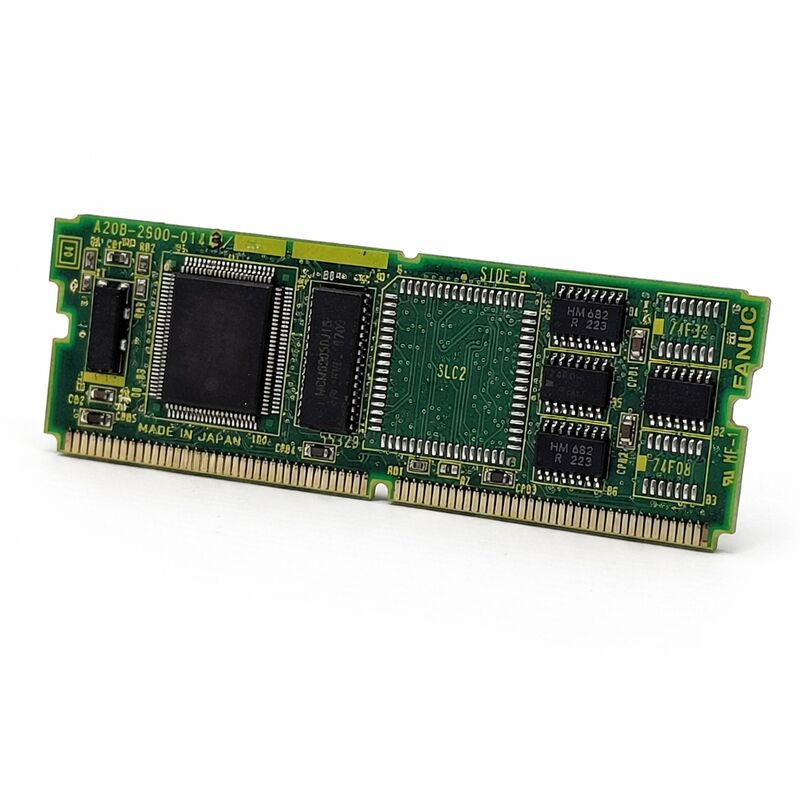
FANUC A20B-2900-0103 System Control Module with Analog Spindle
Overview
The A20B-2900-0103 is a system control module with analog spindle support in the A20B-2900 family.
It is described as SYSTEM CONTROL MODULE W/ ANALOG SPINDLE, and service channels also identify it as F16 System Control, Spindle Analog and F16 system module with analog spindle.
That places the board in the control-and-spindle coordination layer of the CNC rather than in the display, memory-only, or communication-only section.
This type of board is important because it combines control-side logic with spindle-side analog coordination.
In maintenance work, that means it should be selected by exact board role and machine context, especially where the spindle interface is still analog rather than serial or all-digital.
Matching the same module helps preserve both the control structure and the spindle-interface behavior already configured in the machine.
Several listings also tie the model specifically to F16 system control contexts.
That makes it particularly relevant in installed-base service of older FANUC control systems where analog spindle architecture is still part of the machine’s original configuration.
Technical Data
| Parameter |
Value |
| Part Number |
A20B-2900-0103 |
| Manufacturer |
FANUC |
| Product Type |
System Control Module / Control PCB |
| Product Series |
A20B-2900 |
| Functional Role |
System control module with analog spindle interface |
| Machine Context |
F16 system control |
| Listing Variants Seen |
Control module, system module, spindle analog board |
| Lifecycle Note Seen |
Discontinued by manufacturer in some channels |
Applications
This board is suitable for installed FANUC CNC systems that already use the A20B-2900-0103 control-module position with the same analog spindle arrangement.
It is especially relevant in control repair, spindle-interface restoration, and board-level replacement where the original F16 control architecture remains in service.
It is also useful in cases where the machine’s broader control hardware remains serviceable but the system-control / analog-spindle coordination board requires replacement.
In those situations, keeping the same model is the safest way to preserve the original machine-side spindle behavior.
Selection Guide
When selecting A20B-2900-0103, first confirm that the installed machine actually uses an analog spindle configuration.
That point matters because the spindle interface is part of the board’s defining role, and it separates this model from memory modules, communications cards, or system boards used in other control paths.
Second, confirm that the control environment matches the F16 system control context repeatedly associated with this model.
For installed-base FANUC systems, that is one of the strongest selection clues and should be checked alongside the board label on the hardware.
Third, compare the installed board function, not just the series number.
The A20B-2900 family covers more than one board role, so the strongest selection logic here is the exact board code plus the fact that the machine uses a control module with analog spindle support.
Replacement Guidance
Before ordering, verify the board code directly on the installed hardware, confirm the machine is using an analog spindle path, and check that the control is in the F16 family or the same equivalent installed context.
On older control systems, these function-based checks are often more reliable than relying only on cabinet documentation.
If the board is being sent for repair or exchanged, document the spindle-related fault behavior before removal.
Because this module ties system control to analog spindle coordination, preserving fault notes can help separate true board failure from upstream spindle-drive or control-parameter issues.
FAQ
Q1: What kind of board is A20B-2900-0103?
It is a system control module with analog spindle support. That places it in the control-and-spindle coordination layer of the machine rather than in a display, memory, or communication-only role.
Q2: Why is the analog spindle description important?
Because it defines the board’s installed machine-side function. A board tied to an analog spindle path should be matched to the same spindle architecture already present in the machine, especially when supporting an older installed-base CNC.
Q3: Why is the F16 system reference useful?
Because several service channels link the model specifically to F16 system control.
That gives the board a clearer machine context and helps distinguish it from other A20B-2900 family parts that serve different roles.
Q4: Is this just a generic PCB?
No. The stronger description for this part is a system control module with analog spindle interface.
That means it is better treated as a function-specific control board rather than as a generic spare circuit board.
Q5: What should be checked before buying?
Check the installed board label, confirm the machine uses an analog spindle path, and verify the control context around the board.
Those checks are the best way to keep the replacement aligned with the original machine structure.


 Your message must be between 20-3,000 characters!