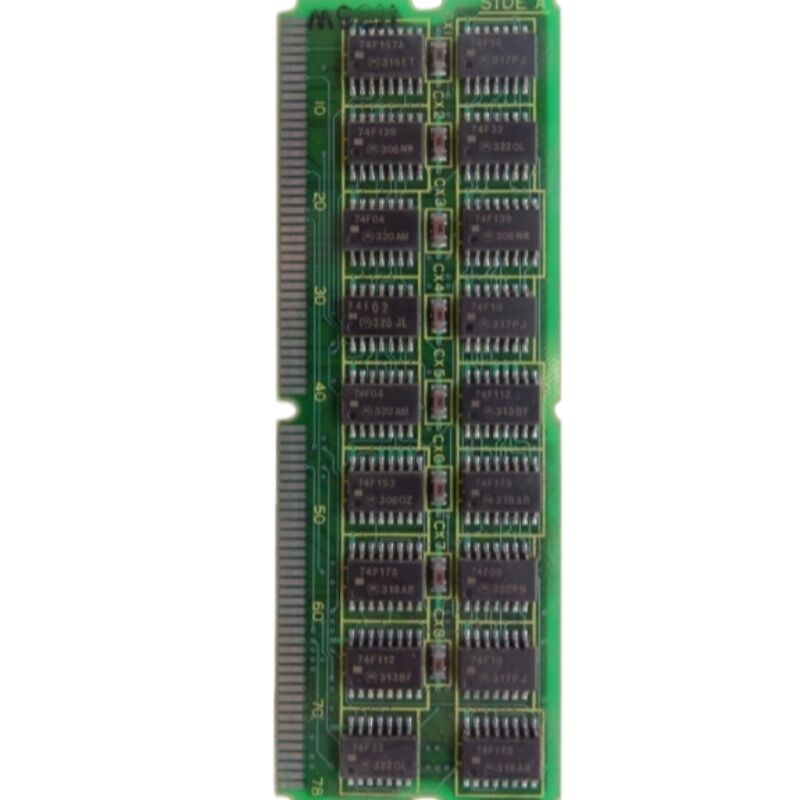
FANUC A20B-2900-0430 | A20B-2900 Series Control PCB Module — FANUC CNC Systems, Japan Origin
Part Number: A20B-2900-0430
Manufacturer: FANUC Corporation (Japan)
Product Type: Control PCB Module
Board Series: A20B-2900
Application: FANUC CNC control system automation
Overview
The A20B-2900-0430 is a printed circuit board module from FANUC's A20B-2900 series — a broad family of PCB modules that serves FANUC's pre-i-series CNC controller range, covering Series 15, 16, 18, 20, and 21.
The A20B-2900 family encompasses memory modules, system control modules, spindle interface boards, servo interface cards, and graphics modules. Each variant within the series performs a specific, defined function in the controller it is installed in.
The -0430 is one such variant, contributing its specific capability to the CNC system it supports.
FANUC built the Series 16 through 21 CNC controllers around a modular plug-in board philosophy.
The main CPU board provided the structural and electrical backbone, and plug-in modules delivered the specific functions that defined the controller's capabilities: what spindle interface it used, how much memory it had, which I/O connections were available, what graphics the operator display showed.
This philosophy allowed FANUC to configure a single main board for many different machine applications simply by selecting the appropriate combination of plug-in modules.
The A20B-2900-0430 occupies its defined position in this modular architecture.
Its function within the controller serves the machine's automation in a way that is consistent with the established role of A20B-2900 series boards.
The board is manufactured in Japan, built to FANUC's industrial-grade production standards, and designed for continuous operation in the CNC cabinet environment.
Key Specifications
| Parameter |
Value |
| Part Number |
A20B-2900-0430 |
| Manufacturer |
FANUC Corporation |
| Product Type |
Control PCB Module |
| Board Series |
A20B-2900 |
| Application |
FANUC CNC Series 16 / 18 / 20 / 21 and compatible |
| Origin |
Japan |
| Operating Temperature |
0 – 55°C |
| Storage Temperature |
−20 – 60°C |
| Humidity |
75% RH max (non-condensing) |
| Condition Available |
New (surplus) / Refurbished / Repaired |
The A20B-2900 Series — Module Diversity in One Family
The breadth of the A20B-2900 series is one of the distinguishing features of FANUC's pre-i-series modular architecture.
Within a single series designation, FANUC produced modules that ranged from simple SRAM chips on a daughter board to complex system control modules with integrated spindle interfaces, FROM storage modules of varying capacities, DRAM modules for working memory, CRT control modules for the display system, and servo interface boards for drive communication.
This diversity was the point.
The same main CPU board could serve a turning centre that needed an analog spindle interface, a machining centre that required a serial spindle, a system with a 9-inch CRT display, and a machine with a smaller LCD panel — all by selecting the appropriate A20B-2900 variant for each function position.
The machine builder chose the combination that matched their machine's design. FANUC produced the modules.
The A20B-2900-0430 fits within this ecosystem as one specific module for one specific function in one or more of these controller configurations.
Its presence in the controller's module complement defines part of that controller's capability set.
Modular Architecture and Serviceability
The modular design of the A20B-2900 series controllers has a direct practical benefit for machine owners: targeted replacement. When a module fails, only that module needs to be replaced. The main CPU board and all other modules continue in service.
This is the correct maintenance response — replacing the identified faulty module, not the complete controller assembly.
Achieving this benefit requires correct fault identification.
A single module fault typically produces alarms related to that module's function, while other controller functions remain intact.
A memory module fault produces memory-related alarms.
A spindle interface module fault produces spindle communication alarms. An I/O module fault produces I/O link errors.
These alarm categories help direct the diagnosis to the specific module family.
For the A20B-2900-0430, the diagnostic approach is to identify the alarm codes produced, relate them to the function area they indicate, and confirm whether that function area corresponds to this module's position in the controller.
Consulting the controller's hardware manual and alarm code documentation provides the mapping from alarm code to module type.
Legacy Module Availability
The A20B-2900 series was produced for FANUC's pre-i-series CNC platforms. FANUC discontinued original production of these modules years ago, following the transition to the i-series controller generation. The machines that use them are still in service.
The aftermarket supply chain supports these machines effectively.
Tested surplus modules from machine decommissioning provide the primary source of replacement units. Professionally refurbished modules — where key components are replaced and the board is functionally tested — offer higher confidence than untested surplus.
Repair services that work at the component level can restore failed modules that are genuinely repairable, extending the availability of functional units even as the total supply gradually contracts.
When sourcing a replacement A20B-2900-0430, the part number must be confirmed exactly.
The A20B-2900 series contains many variants, and the physical similarity between variants can mislead. Read the part number from the installed board's label and source that exact number.
FAQ
Q1: The alarm produced by the controller points to the function area that the A20B-2900-0430 serves. How can the fault be confirmed as the module before ordering a replacement?
First check the board's connector. Remove and reseat it, inspect the contacts for damage or contamination, and retest.
A loose or dirty connector can produce function-area alarms that appear to be module faults.
If the alarm persists after confirmed connector reseating, swap the suspect module with a known-good module from a compatible source if available.
If the alarm follows the module, the board is confirmed faulty.
If the alarm stays with the position regardless of which module is installed, the fault is in the main board's socket area, not the module.
Q2: After replacing the A20B-2900-0430, the controller shows a new alarm that wasn't present before. The original alarm is gone. What happened?
A new alarm after module replacement typically indicates that the replacement module has a different functional configuration from the original, or that the system software needs to recognise and initialise the new module.
Check that the replacement module's part number exactly matches the original.
If it does, check whether the controller requires a parameter to be set that recognises the module's configuration.
In some A20B-2900 series configurations, a parameter change is needed to declare the new module's presence to the controller software.
Q3: The module appears physically undamaged. Is it worth attempting repair rather than replacement?
Physical inspection catches obvious faults — burned components, cracked capacitors, damaged traces — but many electronic component failures produce no visible signs.
A capacitor can fail electrically while appearing intact.
An IC can degrade into marginal operation without any visible evidence.
If the module produces consistent fault symptoms and the connector has been confirmed good, the board has failed internally.
Repair by a qualified technician is worth exploring for A20B-2900 modules given their scarcity, but the repair must include functional testing in the controller to confirm the fault is resolved.
Q4: How should a spare A20B-2900-0430 module be stored for future use?
Store in original or equivalent anti-static packaging. Keep at stable room temperature, away from humidity extremes and temperature cycling.
Inspect the connector contacts annually — contamination and oxidation on copper contacts increase with time.
If the board carries any battery-backed memory or has a backup battery, check the battery voltage at regular intervals and replace before it drops below the retention threshold. Label the stored board clearly with its part number and the date it was placed in storage.
Q5: The machine is due for a complete CNC upgrade. Is the A20B-2900-0430 specific to the current controller, or could it be reused in a replacement CNC system?
A20B-2900 series modules are specific to the controller architectures of the pre-i-series FANUC platforms.
If the CNC upgrade replaces the controller with a modern i-series or newer platform, the old modules cannot be carried over — the new controller uses a completely different module format, backplane architecture, and software environment.
The A20B-2900-0430 will have no place in the new controller.
Retain it as a spare for the original controller only if that controller remains in service elsewhere, or dispose of it responsibly once the upgrade is complete.


 Your message must be between 20-3,000 characters!