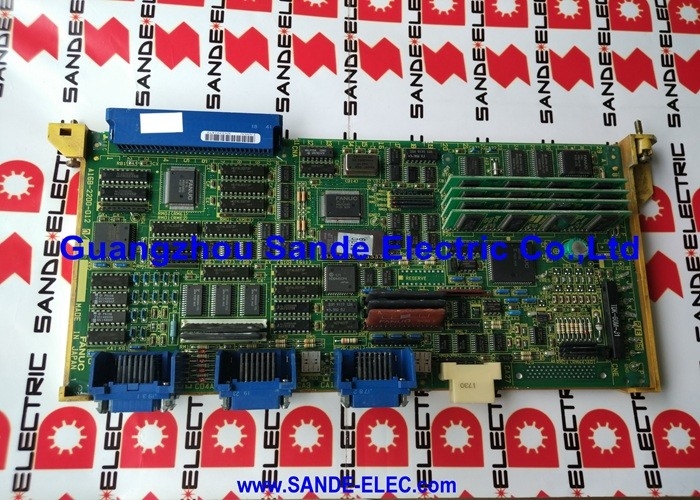
A16B-1200-0742 | FANUC Detector PCB — Position Encoder Interface / A16B-1200 Series / 6058 Era AC Servo Drive Feedback
Detector PCB — Position Feedback at the Drive
In FANUC servo drive architecture, "detector" refers to the servo motor's position encoder — the device that measures the motor's rotational position and speed for feedback to the drive's velocity and position loops. The A16B-1200-0742 is the PCB that interfaces between the servo motor's encoder (position detector) and the drive's control electronics. The detector PCB performs several key functions:
Encoder signal reception: The encoder fitted to the servo motor generates pulse trains or serial digital data proportional to motor rotation. The A16B-1200-0742 receives these signals from the encoder cable.
Signal conditioning: Raw encoder signals are conditioned — filtered, amplitude-adjusted, and edge-triggered to produce clean, stable pulse data for the drive's counting circuitry.
Position counting and data transfer: The conditioned encoder pulses are counted or decoded to produce the actual position value. This value is fed into the drive's velocity loop comparator and transmitted to the CNC's position loop.
Encoder fault detection: The detector PCB monitors the encoder's signal integrity — detecting open circuits, short circuits, and signal amplitude failures. An encoder cable break or encoder failure is reported as a servo alarm through this board.
Key Product Information
| Parameter |
Value |
| Function |
Encoder/detector interface |
| Series |
A16B-1200 |
| Application |
AC servo drive encoder feedback |
| Position in Series |
074x (between 1200 lower boards and 0800 drive PCB) |
A16B-1200 — The Servo Drive Board Series
The A16B-1200 series is confirmed across this session as a servo drive PCB family:
| Board |
Function |
| A16B-1200-0742 |
Detector PCB (encoder interface) |
| A16B-1200-0800 |
6058 2-axis AC servo drive PCB |
The 074x position of the A16B-1200-0742 precedes the 080x drive PCB in the same series — consistent with a detector (encoder) interface board that feeds position data into the drive system of which the 0800 drive PCB is the control centre. In AC servo drive systems:
- The drive PCB (A16B-1200-0800) handles velocity control, current regulation, and CNC interface
- The detector PCB (A16B-1200-0742) handles encoder signal reception and position data conversion
Application Scenarios
Servo encoder alarm: A FANUC CNC develops encoder alarms on specific axes — "detector alarm" or "pulse coder alarm" in the CNC's alarm display. The servo motor encoder tests correctly. The A16B-1200-0742 detector PCB is identified as the signal conditioning fault. Replacement restores encoder signal integrity.
Drive system maintenance: A FANUC CNC machine tool with 6058-era servo drives undergoes comprehensive drive maintenance. Both the drive PCB and the detector PCB are replaced to ensure complete drive reliability.
FAQ
Q1: What is the difference between a "detector PCB" and a "drive PCB" in servo drives?
The detector PCB (A16B-1200-0742) handles the encoder interface — receiving and conditioning the motor's position feedback signals. The drive PCB (A16B-1200-0800) uses this position data to regulate motor speed and current — the actual power electronics control. Both are required for the complete servo drive function.
Q2: What servo motor encoders does A16B-1200-0742 interface with?
The A16B-1200 series serves the 6058-era drive system, which works with FANUC's digital pulse coder motors. The specific encoder types supported by A16B-1200-0742 are confirmed from the applicable A06B-6058 servo drive maintenance manual.
Q3: Can a detector PCB fault cause axis positional errors without triggering an alarm?
Yes. A partially-degraded detector PCB may process encoder signals incorrectly — producing position count errors that accumulate gradually without triggering an immediate alarm threshold. These manifest as dimensional inaccuracy in machined parts. If unexplained machining errors correlate with specific axes, the detector PCB is among the components to investigate.
Q4: Does replacing A16B-1200-0742 require encoder recalibration?
In most FANUC servo systems, the encoder's reference position (zero mark) establishes the home/reference position through the machine's reference return cycle rather than through the detector PCB. After fitting the replacement A16B-1200-0742, the reference return cycle re-establishes the axis reference position normally.


 Your message must be between 20-3,000 characters!