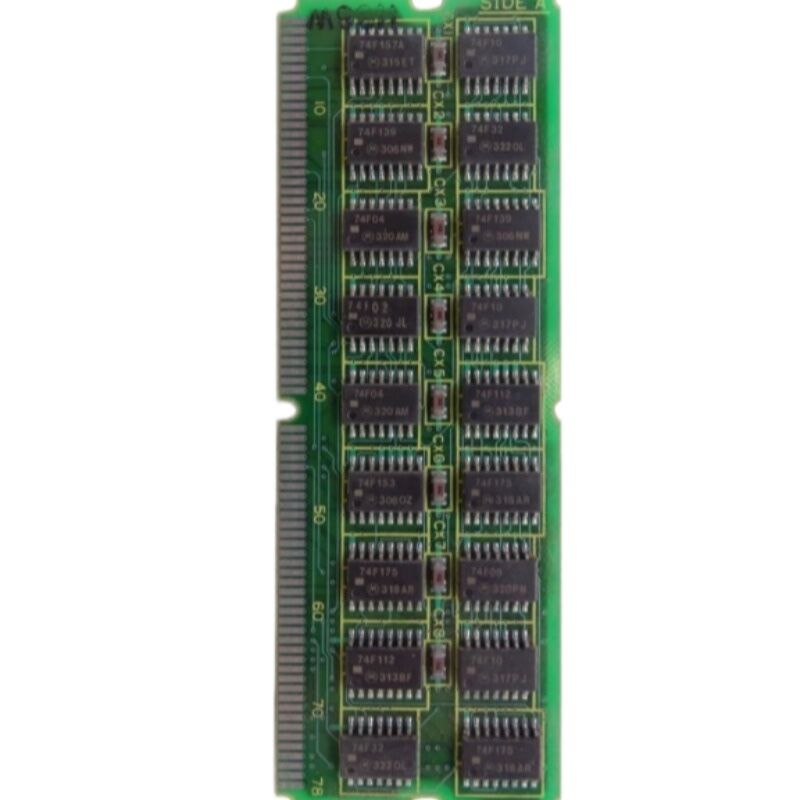
FANUC A20B-2900-0930 | CPU Module 80386SX — Series 18-A / 21, Japan Origin, Discontinued
Part Number: A20B-2900-0930
Manufacturer: FANUC Corporation (Japan)
Product Type: CPU Module (MPU Board)
Processor: Intel 80386SX (i386sx)
Board Series: A20B-2900
Compatible Systems: FANUC Series 18-A, Series 21 and compatible
Status: Discontinued by Manufacturer
Overview
The A20B-2900-0930 is the CPU module for FANUC Series 18-A CNC systems, and serves as either the main or sub-CPU in Series 21 and compatible controllers.
It is the board that contains the central processing unit — an Intel 80386SX — along with the surrounding support circuitry that makes the processor functional within the CNC architecture: clock generation, bus buffering, memory interface logic, and the connections to the main CPU board it plugs into.
In FANUC's modular control architecture, the CPU is not integrated directly onto the main board. It occupies its own plug-in module.
This allows the processor module to be replaced independently if it fails, and it allowed FANUC to offer different processing capabilities on the same main board platform by fitting different CPU modules.
The A20B-2900-0930 carries the 80386SX — Intel's 32-bit processor with a 16-bit external data bus, positioned as an efficient and cost-effective processing solution when these controllers were produced.
The CNC controller cannot operate without this module. It is the processing core from which all other functions in the controller derive.
When this module fails, the controller does not boot. There is no workaround — the module must be replaced and the software reloaded before the machine can run again.
Key Specifications
| Parameter |
Value |
| Part Number |
A20B-2900-0930 |
| Manufacturer |
FANUC Corporation |
| Product Type |
CPU Module / Processor Sub-Module |
| Processor |
Intel 80386SX (i386sx) |
| Board Series |
A20B-2900 |
| Compatible Systems |
FANUC Series 18-A / 21 and compatible |
| Role |
Main CPU (smaller systems) or Sub-CPU (larger systems) |
| Origin |
Japan |
| Production Status |
Discontinued |
| Weight (approx.) |
0.3 kg |
| Dimensions |
~114 × 38 × 5 mm |
| Operating Temperature |
0 – 55°C |
| Condition Available |
New (surplus) / Refurbished / Repaired |
The 80386SX — Processing Core of Its Generation
The Intel 80386SX was a prominent processor in industrial embedded computing during the late 1980s and into the 1990s.
It offered 32-bit internal processing capability — meaning it could work with 32-bit data values internally — while using a 16-bit data bus to communicate with external memory and peripherals. This combination provided strong computational performance at a lower system cost than the full 32-bit bus 80386DX.
For CNC control applications, what matters is not clock speed in isolation but the processor's ability to execute control tasks — interpolation, servo position calculation, PMC ladder processing, communication management, and display rendering — within the required timing cycles.
The 80386SX provided the headroom the Series 18-A control demanded for its generation of machining applications.
FANUC used this processor across multiple controller variants in the same generation, and the CPU module architecture allowed the same main board to be used with different processor speeds or types by swapping the CPU module.
Main CPU vs. Sub-CPU Role
The A20B-2900-0930 serves two distinct roles depending on the specific controller it is installed in.
In smaller systems — the Series 21 Model B is a specific example — this module acts as the main CPU.
The Series 21 is a more compact control platform where this CPU module carries the primary processing load.
The same physical board serves this higher-responsibility role.
In larger systems — Series 18-A — the main CPU board may contain a more powerful primary processor, with the A20B-2900-0930 functioning as a sub-CPU. In these configurations, the sub-CPU handles specific processing tasks that are partitioned from the main CPU's workload, improving overall system throughput.
The distinction matters for replacement sourcing.
Confirm which role the module plays in your specific machine. Both configurations use the same hardware, but the software loaded into the FROM must correspond to the specific controller type and configuration.
Software Loading After Replacement
Replacing a CPU module on a FANUC system is not simply a hardware swap. The CNC's operating software is stored in FROM memory — separate module(s) on the main board. When a new CPU module is installed, the FROM contents load into the CPU module's DRAM at power-up and the system boots from there.
If the FROM is intact and contains the correct software version, the system should boot after the CPU module replacement.
If FROM content was also corrupted, both the CPU module and the FROM module require attention before the system will operate correctly.
Always confirm FROM integrity as part of the diagnostic process when a CPU module failure is suspected.
FAQ
Q1: The Series 18-A controller does not boot. The power supply appears functional. Is the A20B-2900-0930 the likely fault?
A no-boot condition with a functional power supply is consistent with a CPU module failure, but also with FROM corruption or a main board fault.
Check the LED status indicators on the main board at power-up — the LED sequence is documented in the maintenance manual and indicates how far the boot process progresses before stopping.
If the sequence stops immediately after power-on without any CPU-related activity, the CPU module is a strong suspect.
Q2: The controller boots intermittently — sometimes it starts normally, sometimes it hangs on startup. What does this suggest?
Intermittent boot failure is often a connector fault rather than a module failure.
The CPU module connects to the main board through edge or pin connectors. If these contacts have developed oxidation or mechanical looseness, the module may make inconsistent electrical contact.
Clean the connector contacts with appropriate contact cleaner, reseat the module firmly, and retest.
If the intermittent fault persists, the module itself may have a thermal or component issue.
Q3: A replacement A20B-2900-0930 was installed and the machine boots but immediately alarms with a CPU error. What happened?
A CPU error after installation with a new module typically indicates a software incompatibility — the FROM software version does not match the CPU module revision, or the FROM content is for a different controller type.
Verify that the FROM module's software version is compatible with the replacement CPU module.
Confirm the module revision from the label on the board and cross-reference against the maintenance documentation.
Q4: Can the A20B-2900-0930 from a Series 21 system be used in a Series 18-A system?
Both systems use the same CPU module hardware. Whether the module is interchangeable depends on whether the FROM software in the target system is compatible with the module variant (e.g., hardware revision).
If the part numbers match exactly, the hardware is compatible.
The software loaded from FROM determines the functional behaviour — it does not need to be changed just because the module was physically sourced from a different controller type.
Q5: The machine worked correctly until a power surge. After the surge, it will not boot. Should the CPU module be replaced first?
A power surge can damage any electronic component in the controller. The CPU module is susceptible, but so are the power supply, the main board, and the FROM module.
Rather than replacing components randomly, use the LED status indicators and any diagnostic information available on the controller display.
If the CPU module specifically shows physical damage — burnt components, cracked ICs — it is the starting point.
Otherwise, systematic diagnosis based on what the controller reports at power-up is more reliable.


 Your message must be between 20-3,000 characters!