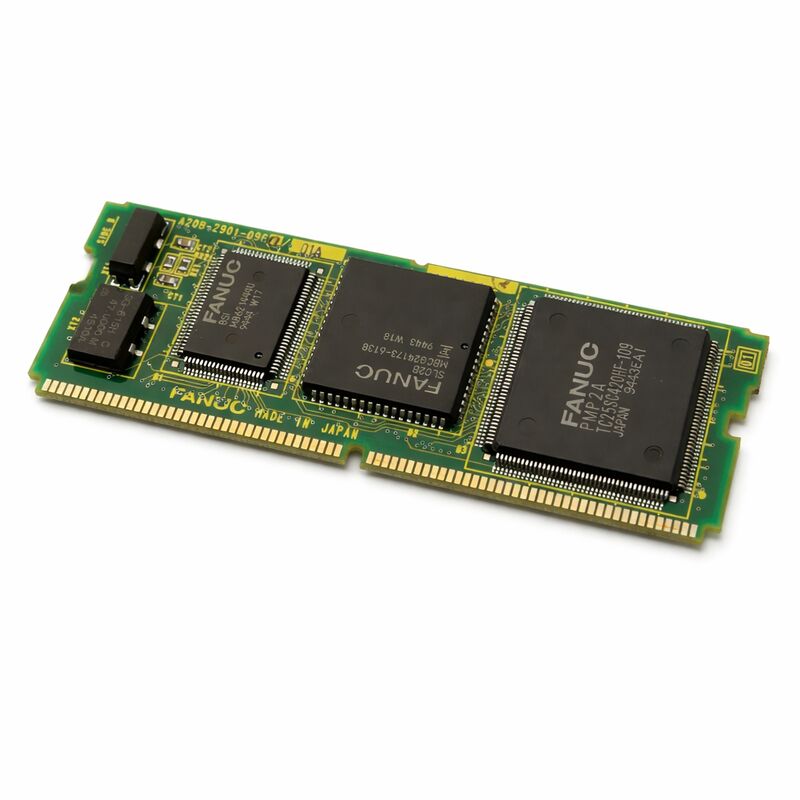
FANUC A20B-2901-0480 | A20B-2901 Series Control PCB Module — FANUC CNC Systems, Japan Origin
Part Number: A20B-2901-0480
Manufacturer: FANUC Corporation (Japan)
Product Type: Control PCB Module
Board Series: A20B-2901
Application: FANUC CNC controller and automation system
Overview
The A20B-2901-0480 is a PCB module from FANUC's A20B-2901 series — a family of printed circuit board modules used across FANUC's CNC controller range covering memory, system control, PMC, servo interface, and expansion functions for the pre-i-series controller generation.
The A20B-2901 series served FANUC's Series 15, 16, 18, 20, and 21 controller platforms as functional plug-in modules that extended or defined specific controller capabilities through their installation in defined positions on the main controller board.
The modular architecture that the A20B-2901 series serves was one of the defining characteristics of FANUC's controller design in this generation. Rather than producing fixed-configuration controllers, FANUC designed the controller main board with socket positions for a range of function modules.
Each module performed a defined function. The machine builder selected the combination that matched their machine's requirements.
The result was a controller that could be precisely configured to the application — no redundant functionality, no missing functionality — from a library of standardised modules.
The A20B-2901-0480 is one member of this library.
Its specific function within the controller architecture makes it an indispensable component for the machines that were configured with it. When this module fails, the specific capability it provided is lost, and the machine's correct operation depends on its restoration.
Key Specifications
| Parameter |
Value |
| Part Number |
A20B-2901-0480 |
| Manufacturer |
FANUC Corporation |
| Product Type |
Control PCB Module |
| Board Series |
A20B-2901 |
| Application |
FANUC CNC controller systems |
| Compatible Systems |
FANUC Series 15 / 16 / 18 / 20 / 21 and compatible |
| Origin |
Japan |
| Operating Temperature |
0 – 55°C |
| Storage Temperature |
−20 – 60°C |
| Humidity |
75% RH max (non-condensing) |
| Condition Available |
New (surplus) / Refurbished / Repaired |
The A20B-2901 Series — Functional Breadth
The A20B-2901 series is the successor generation to the A20B-2900 series within FANUC's modular controller module family.
The two series share the same architectural role — plug-in function modules for the pre-i-series CNC controllers — but the A20B-2901 series reflects the hardware generation transition that accompanied the refinement of FANUC's Series 15/16/18/20/21 platforms.
Within the A20B-2901 family, the function range spans: SRAM memory modules in various capacities for program and parameter storage, DRAM modules for working memory, PMC control modules with or without I/O Link interfaces, FROM modules for non-volatile software storage, and dedicated function modules for specific applications.
Each variant is identified by its full part number — variants that share the A20B-2901 prefix but differ in the suffix serve different functions and are not interchangeable.
The position of the A20B-2901-0480 within this functional range places it in its specific role.
The controller's hardware documentation lists which module belongs in which board socket and what function it provides in that position.
This documentation is the definitive reference for understanding what the -0480 contributes to the controller configuration it serves.
Maintenance Principles for A20B-2901 Modules
Maintaining a FANUC controller that uses A20B-2901 series modules follows the same structured approach as maintaining any modular industrial controller:
The first principle is correct fault identification.
A module fault produces alarms in the functional area the module serves. Identifying the alarm code precisely, and mapping it to the module responsible for that function, focuses the replacement effort on the correct component.
The second principle is connector verification. Before replacing a module, verify that the module's connector is in good condition and fully engaged. Intermittent board-related alarms are often connector faults rather than board faults.
Reseating the module and cleaning the connector contacts resolves many apparent board failures.
The third principle is exact part number matching.
The A20B-2901 series contains many variants. Physical similarity between variants does not indicate electrical compatibility. Only an exact part number match guarantees the replacement module performs the correct function in the correct position.
The fourth principle is data preparation. If the module stores any volatile data — parameters, program data, machine constants — a complete backup must be taken before removal. The replacement module starts blank.
Restoration from backup is the only way to recover the data without manual re-entry.
Availability and the Legacy Supply Chain
The A20B-2901 series was produced for controllers that are now considered legacy — the Series 15, 16, 18, 20, and 21 generation that preceded the i-series. FANUC discontinued original production of these modules following the transition to newer controller platforms.
The machines that these controllers power are still in service. Many represent productive capacity that their operators intend to maintain for years to come.
The supply chain that supports these machines — tested surplus stock from decommissioned equipment, professionally refurbished modules with new components and functional testing, and component-level repair services — remains active and accessible.
When sourcing an A20B-2901-0480 replacement, specify the complete part number and, if possible, the hardware revision suffix. Board revision suffixes indicate PCB layout or component changes that were made during the module's production run.
Later revisions are typically backward compatible with earlier revision sockets, but confirming this for the specific application avoids unexpected compatibility issues.
FAQ
Q1: The controller generates an alarm that the documentation maps to the function area served by this module. The module connector was already verified as good. What is the next diagnostic step?
If the connector is confirmed good and the alarm persists, the most rigorous next step is a module substitution test: install a known-good module of the same part number in the same socket, and observe whether the alarm clears.
If it does, the original module is confirmed faulty. If the alarm follows the known-good module to its socket, the fault is in the main board's socket area rather than the module itself.
Q2: The A20B-2901-0480 module was replaced after a confirmed fault. The replacement board resolved the original alarm but now a different, related alarm is appearing. What is happening?
A new but related alarm after a module replacement can indicate that the original alarm was a symptom of an underlying condition that has not been resolved. For example, a power supply transient that damaged the original module may continue to stress the replacement.
Another possibility is that the replacement module's hardware revision has a minor operational difference that exposes a marginal condition in the surrounding circuitry.
Review the alarm documentation carefully and check whether the new alarm points to the module itself or to a circuit the module interacts with.
Q3: The module shows no visible physical damage, but it fails intermittently. How should this be handled?
Intermittent failure with no visible damage typically indicates a component that is operating at its margin. Electrolytic capacitors, certain ICs, and solder joint integrity issues can all produce intermittent behaviour.
A board in this condition will likely progress to permanent failure under continued operation. If the board can be sent to a qualified repair service for assessment while the machine continues with a replacement module, the intermittent board may be repairable rather than write-off.
Assessment before disposal is the economical approach.
Q4: How should the A20B-2901-0480 be packaged and stored for long-term spare use?
Store in anti-static packaging — either the original foam-and-bag packaging or equivalent anti-static materials. Keep in a controlled environment: stable temperature (room temperature), low humidity, no temperature cycling.
Inspect annually for any signs of moisture damage or oxidation on connector contacts. Clean oxidised contacts with appropriate electronics-safe contact cleaner.
Label the package with the complete part number and storage date. If the module has a backup battery, check and replace the battery on a regular schedule to maintain any stored content.
Q5: Can this module be used in both Series 16 and Series 18 controllers, or is it specific to one?
Compatibility across Series 16 and Series 18 depends on the specific function the module serves and the hardware generation of the controller.
Some A20B-2901 modules are documented as compatible across multiple series because their function — memory storage, for example — is generic enough to serve both.
Others are configuration-specific.
The controller's hardware manual for each specific series and model is the authoritative source. Do not assume cross-series compatibility based on physical fit alone.


 Your message must be between 20-3,000 characters!