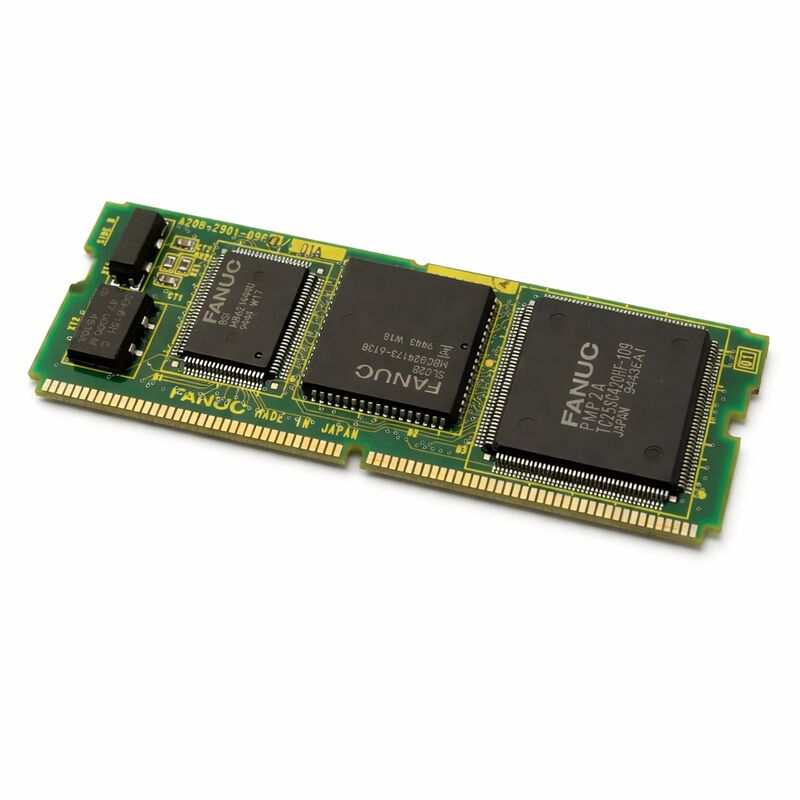
FANUC A20B-2901-0660 | PMC-RA3 Module with I/O Link — Series 16 / 20 / 21, Japan Origin
Part Number: A20B-2901-0660
Manufacturer: FANUC Corporation (Japan)
Product Type: PMC Module — RA3 with I/O Link
Board Series: A20B-2901
Compatible Systems: FANUC Series 16A / 16B / 16C, Series 20 / 21
Overview
The A20B-2901-0660 is the PMC-RA3 module with I/O Link for FANUC Series 16 and Series 20/21 CNC systems.
It is the Programmable Machine Controller engine for these controllers — the hardware that runs the machine builder's ladder program and manages all machine-level I/O sequencing.
The RA3 designation identifies the PMC engine generation and capability level.
The I/O Link capability enables this module to communicate with distributed I/O units mounted remotely from the CNC cabinet.
In a FANUC CNC, the PMC operates simultaneously with the CNC motion control.
The motion control manages axis positions, speeds, and interpolation. The PMC manages everything at the machine level: tool changers, coolant systems, door interlocks, hydraulic sequencing, spindle orientation, and the logic that turns M-codes into actual machine actions.
Every M-code the CNC executes is processed by the PMC ladder before it becomes a physical machine event.
The A20B-2901-0660 is an SMD-type module that installs on the main CPU board of the Series 16 or Series 20/21 controller.
It occupies the PMC slot in the controller's modular architecture. Without a functioning PMC module, the controller cannot execute its ladder program.
Axis motion may remain possible in limited modes, but no machine functions respond correctly.
Key Specifications
| Parameter |
Value |
| Part Number |
A20B-2901-0660 |
| Manufacturer |
FANUC Corporation |
| Product Type |
PMC Module |
| PMC Engine |
RA3 (PMC-RA3) |
| I/O Link |
Yes — with I/O Link |
| Board Series |
A20B-2901 |
| Compatible Systems |
FANUC Series 16A / 16B / 16C, Series 20 / 21 |
| Design |
SMD-type plug-in daughter board |
| Origin |
Japan |
| Operating Temperature |
0 – 55°C |
| Storage Temperature |
−20 – 60°C |
| Humidity |
75% RH max (non-condensing) |
| Condition Available |
New (surplus) / Refurbished / Repaired |
PMC-RA3 Engine — Capability Level
The RA3 engine designation indicates the processing capability and instruction set of the PMC on this module. Different FANUC CNC generations use different PMC engine levels. The RA3 is the engine for the Series 16 and Series 20/21 generation — it defines the maximum ladder step count, the execution speed, and the instruction set available to the machine builder when writing the ladder program.
The RA3 engine provides the processing headroom appropriate for the machine tools in its generation.
Series 16 machines — machining centres, turning centres, and compound machines from this era — have PMC ladder programs of varying complexity.
The RA3 handles these without capacity constraints for typical configurations.
The companion module A20B-2901-0661 is the RA3 variant without I/O Link.
The -0660 is specifically the I/O Link-equipped version. This distinction matters in systems that use distributed I/O units connected via the I/O Link bus.
I/O Link — Distributed I/O Architecture
The I/O Link is FANUC's serial bus for connecting I/O units to the CNC. Rather than running individual wires from every sensor and actuator in the machine to the CNC cabinet, I/O Link allows I/O units to be distributed throughout the machine — near the field devices they serve — and connected to the CNC over a single serial bus cable.
The A20B-2901-0660 provides the CNC-side interface for this bus.
Each I/O unit connected to the I/O Link appears in the PMC's I/O address map. The PMC ladder reads input signals from and writes output signals to these units across the serial bus exactly as it would through hard-wired I/O.
I/O Link reduces cabinet wiring complexity significantly. A machine with many I/O points spread across a large structure — a transfer machine, a large machining centre with multiple work zones, or a machine with a separate electrical cabinet at the workholding end — benefits substantially from this distributed architecture.
The A20B-2901-0660 enables this architecture on Series 16 and 20/21 systems.
Ladder Program and Module Relationship
The ladder program does not reside on this module. It is stored in the CNC's FROM memory — a separate module.
The A20B-2901-0660 is the processor that executes the ladder program stored in FROM at each scan cycle.
This separation has a maintenance implication: replacing the PMC module does not cause ladder program loss. The program is in FROM and remains intact. After replacing the module, the ladder program reloads automatically from FROM on power-up and begins executing.
No ladder restore procedure is required unless FROM itself has been changed.
What does change after PMC module replacement is the PMC parameter set, if PMC parameters are stored in a battery-backed area of the controller.
Confirm the parameter backup status before replacing the module and restore if necessary after installation.
FAQ
Q1: The machine powers on but M-codes do not execute. Axis motion works. Is the A20B-2901-0660 the likely fault?
M-code execution is a PMC function. Axis motion operating normally while M-codes fail to respond is a strong indicator of a PMC module fault — the CNC's motion control and the PMC operate independently, and a failed PMC module takes down machine I/O while leaving motion control intact.
Check the PMC status screen for execution state and alarm codes before concluding the module has failed.
A PMC software alarm (ladder-generated) is a different fault from a PMC hardware alarm.
Q2: What is the difference between the A20B-2901-0660 and the A20B-2901-0661?
Both are PMC-RA3 modules for the same controller platform. The -0660 includes I/O Link capability; the -0661 does not.
Installing the -0661 in a system configured for I/O Link (with distributed I/O units on the I/O Link bus) will result in the distributed I/O not being recognised.
Always confirm whether I/O Link is used in the machine's configuration before selecting between these two variants.
Q3: The PMC module was replaced. The machine powers on but shows an alarm on I/O Link communication. Why?
After a module replacement, the I/O Link configuration may need to be confirmed. Some Series 16 system configurations require I/O Link parameters to be set or verified when the PMC module is new.
Check the I/O Link parameters in the CNC parameter screen and confirm they match the machine's documented configuration.
Also verify the physical I/O Link bus cabling is correctly connected to the new module.
Q4: Can the A20B-2901-0660 run a ladder program written for a different PMC engine (e.g., RB)?
PMC ladder programs are engine-specific. A ladder written for an RA3 engine runs on the RA3.
Ladder written for an older engine (such as RA1 or RB series) requires conversion before it can run on the RA3. FANUC's PMC development tools support ladder conversion, but it is not automatic — the machine builder or a qualified service partner must perform the conversion before the machine can operate with a converted ladder on the new module.
Q5: How long can the A20B-2901-0660 be stored before installation?
Stored correctly — dry environment, stable temperature, anti-static packaging — the module retains its condition indefinitely.
The module itself contains no battery and no time-critical components that degrade during passive storage.
Inspect the connector contacts for oxidation before installation if the module has been stored for several years.


 Your message must be between 20-3,000 characters!