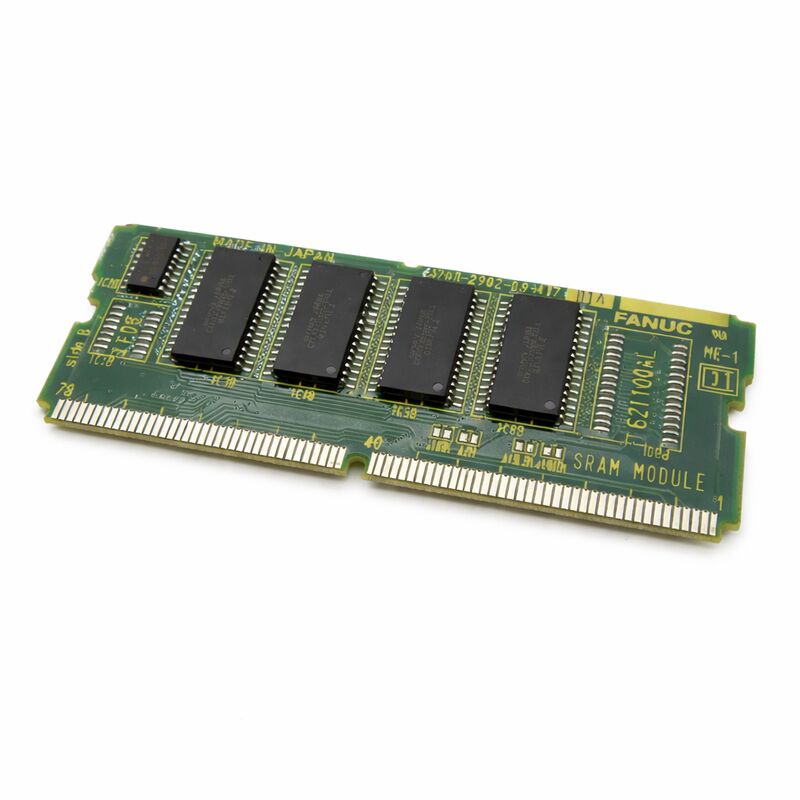
FANUC A20B-2902-0030 | CNC Control PCB Board — Genuine FANUC, Japan Origin
Part Number: A20B-2902-0030
Manufacturer: FANUC Corporation (Japan)
Product Type: Printed Circuit Board (PCB)
What This Board Does
The A20B-2902-0030 is a printed circuit board manufactured by FANUC Corporation in Japan. It serves a specific control function within FANUC CNC systems.
FANUC builds its CNC controllers on a modular PCB architecture. Each board owns a defined slice of the system's overall function.
This one is part of that structure.
FANUC CNC controllers house multiple PCBs simultaneously.
They communicate through backplane connectors and dedicated harness cables. When one board fails, the function it handles stops. The rest of the controller can continue operating.
That isolation is useful — it makes fault identification concrete and the replacement path clear.
The A20B prefix is FANUC's standard designation for printed circuit board components. Manufacturing happens in Japan, under FANUC's own production and testing processes. Component selection, board-level electrical testing, and quality inspection are all completed within FANUC's chain before the board ships.
Key Specifications
| Parameter |
Value |
| Part Number |
A20B-2902-0030 |
| Manufacturer |
FANUC Corporation |
| Product Type |
Printed Circuit Board (PCB) |
| Board Series |
A20B-2902 |
| Product Category |
CNC Control PCB |
| Origin |
Japan |
| Application |
FANUC CNC Control Systems |
| Housing Color |
Yellow (original FANUC generation) |
| Installation |
Plug-in module, controller backplane |
| Operating Temperature |
0 – 55°C (standard FANUC control cabinet range) |
| Storage Temperature |
−20 – 60°C |
| Humidity |
75% RH max (non-condensing) |
| Condition Available |
New / Refurbished / Repaired |
Why the Exact Part Number Matters
Sourcing a correct replacement PCB is not optional — it is the repair. FANUC CNC systems are sensitive to board-level compatibility.
Substituting an incorrect variant triggers system alarms that are difficult to diagnose without knowing the substitution happened.
Using the exact part number ensures a clean swap with no compatibility questions.
The A20B-2902-0030 has a defined position in the controller rack. Its connector layout, its interface standard, and its firmware belong to that position.
Another board in the same A20B-2902 family may look similar physically and still not be interchangeable. The suffix matters.
PCB Reliability and Service Life
Replacement boards keep long-running machines alive. Aging components on circuit boards degrade over time. Capacitors lose capacitance.
Connectors oxidise at contact surfaces. Logic devices accumulate operating hours and stress cycles.
A failed board in a production machine can halt that machine entirely. The correct spare, on hand, means a swap — not a sourcing delay measured in days or weeks.
Handling and storage protect the board's value. Anti-static packaging prevents electrostatic discharge damage during transport and storage.
Keep spares away from moisture and temperature extremes.
A correctly stored FANUC PCB remains viable for installation years after procurement.
FAQ
Q1: How do I confirm this is the right board for my machine?
Check the label on the board currently installed in the controller. FANUC part numbers are printed on the PCB itself. Match it to the replacement exactly.
Cross-reference against the machine's electrical documentation for a second confirmation.
Q2: Can the A20B-2902-0030 be repaired at the component level instead of replaced?
Component-level repair is possible through electronics shops experienced with FANUC PCBs.
Failed capacitors, damaged protection circuits, and corroded connectors are repairable faults. However, some boards contain proprietary FANUC logic devices that cannot be sourced separately — if the fault is in one of those, repair is not viable.
A tested replacement board eliminates the uncertainty a repaired board carries.
Q3: Will replacing this board erase CNC parameters?
In most FANUC control architectures, parameters are stored in the CNC memory system, not on the individual PCB being replaced.
The board swap itself typically does not affect stored data.
That said — back up all parameters, programs, and offsets before opening the controller. No exceptions. Recovery without a backup is a significant project.
Q4: The replacement board has a slightly different suffix. Are they interchangeable?
Not necessarily. Suffix variations within a FANUC PCB series indicate revision levels or functional differences. Some revisions are compatible; others are not. Do not assume interchangeability based on physical similarity.
Confirm compatibility through FANUC technical documentation or a FANUC-certified service partner before installation.
Q5: What environmental factors most commonly damage FANUC control PCBs?
Heat is the primary one. Boards in poorly ventilated cabinets age faster than the design intends. Humidity and condensation attack solder joints and exposed metal contacts.
Power transients — spikes and surge events — stress protection circuits. Vibration from the machine environment can crack solder joints over years.
Regular cabinet maintenance — clean filters, functional cooling fans, stable incoming power — extends PCB service life significantly.


 Your message must be between 20-3,000 characters!