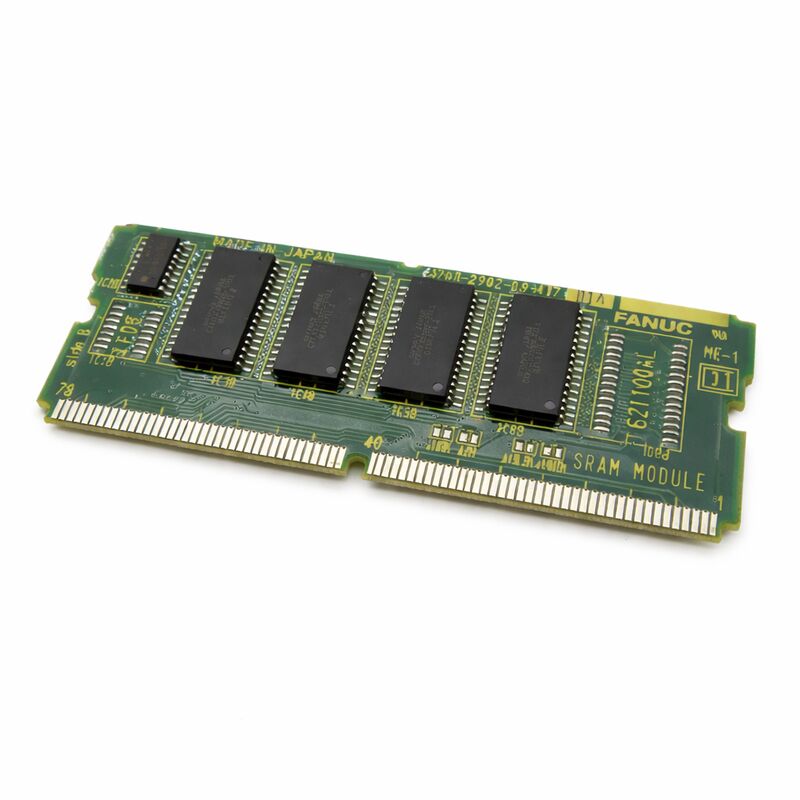
FANUC A20B-2902-0040 | CNC PCB Board — Genuine FANUC, Japan Origin
Part Number: A20B-2902-0040
Manufacturer: FANUC Corporation (Japan)
Product Type: Printed Circuit Board (PCB)
Board Overview
The A20B-2902-0040 is a FANUC Corporation printed circuit board, designed for a specific control function within FANUC CNC systems.
It belongs to the A20B-2902 family — a group of FANUC PCBs sharing a common physical generation and interface standard.
Within that family, the -0040 suffix identifies this specific variant, with its own defined function distinct from other boards in the same series.
FANUC CNC controllers are assemblies of multiple boards working in parallel. Some manage operator interface signals.
Others process axis position data. Some handle I/O communication between the controller and the machine's field devices.
The A20B-2902-0040 occupies a defined position in this architecture. Its physical mounting location, connector layout, and electrical interface are all specified by the controller design it belongs to.
Key Specifications
| Parameter |
Value |
| Part Number |
A20B-2902-0040 |
| Manufacturer |
FANUC Corporation |
| Product Type |
Printed Circuit Board (PCB) |
| Board Series |
A20B-2902 |
| Product Category |
CNC Control PCB |
| Origin |
Japan |
| Application |
FANUC CNC Control Systems |
| Housing Color |
Yellow (original FANUC generation) |
| Installation |
Plug-in module, controller backplane |
| Operating Temperature |
0 – 55°C (standard FANUC control cabinet range) |
| Storage Temperature |
−20 – 60°C |
| Humidity |
75% RH max (non-condensing) |
| Condition Available |
New / Refurbished / Repaired |
Differences from Related Boards
The A20B-2902-0040 is a separate board from the A20B-2902-0030, despite belonging to the same series. Same family.
Different function. FANUC uses unique dash-number suffixes precisely to distinguish boards that would otherwise be hard to tell apart from their physical appearance alone.
Ordering by part number — not by physical appearance or general description — is the only reliable method for FANUC PCB procurement.
Two boards in the same series can look nearly identical and perform entirely different functions. Installing the wrong one typically results in system alarms rather than correct operation.
The alarm codes point back to the installed board, but the root cause is the incorrect part. Starting with the right part number avoids this diagnostic loop entirely.
FANUC PCBs carry hardware-defined or firmware-defined logic tied to their specific role.
The controller expects a specific board in a specific slot. That expectation is not flexible. Precision in sourcing is the foundation of a clean repair.
Maintenance Context
The A20B-2902-0040 is an active spare part for the installed base of FANUC-controlled machine tools using this board series.
Many of these machines entered service in the 1990s or early 2000s. They are still productive assets in shops around the world. Keeping them running requires access to the correct spare PCBs.
A controller that loses a PCB does not need to be retired. It needs the correct replacement part.
The machine itself — its mechanical components, its fixtures, its tooling — may have years of useful life remaining.
The PCB is one of the serviceable components in the control system, and the repair path is well defined.
FAQ
Q1: There is a CNC alarm active. How do I know if the A20B-2902-0040 is the failed board?
FANUC CNC alarm codes indicate which subsystem has faulted. Look up the active alarm number in the maintenance manual for the specific control series.
The alarm description will identify the functional area involved.
If that area corresponds to the function this board handles in the system, it becomes a diagnostic candidate.
Alarm-guided diagnosis is more reliable than substitution guessing.
Q2: Is a data backup required before replacing this board?
Always. Back up CNC programs, parameters, tool offsets, and pitch error compensation data before any board work.
This is standard practice regardless of which board is being replaced. Data loss during a board swap is uncommon but not impossible.
Recovery without a backup can require full recommissioning of the machine.
Q3: The machine lost power abnormally and now shows a board-level alarm. Could the power event have caused the fault?
Power transients and sudden power loss during operation can damage PCB components.
On-board protection circuits absorb some surge energy, but severe events can damage those circuits or the logic behind them.
A board that faults immediately after a power event is a strong replacement candidate.
Inspect the board visually for burn marks, bulging capacitors, or discoloured areas before concluding the fault is purely internal.
Q4: How long can a spare A20B-2902-0040 be stored before installation?
FANUC PCBs stored correctly — dry environment, stable temperature, anti-static packaging — remain serviceable for extended periods.
Electrolytic capacitors on the board are the most time-sensitive components in storage.
After five to eight or more years of storage, inspect the board or have it bench-tested before installing it in a critical machine.
A board from a recently purchased, correctly stored spare is lower risk than one stored in unknown conditions.
Q5: The machine powers up after the board swap but does not run correctly. What should be checked first?
Confirm the board is fully seated in its backplane connector — partial seating causes intermittent signal faults that look like system errors.
Check all cable harnesses connected to the replaced board for full insertion.
Verify that the post-replacement procedure specified in the control maintenance manual has been followed — some FANUC controllers require an initialisation step after a board exchange.
If all connections are confirmed and the procedure is followed, check whether the replacement board itself carries the correct revision level for the installed control software version.


 Your message must be between 20-3,000 characters!