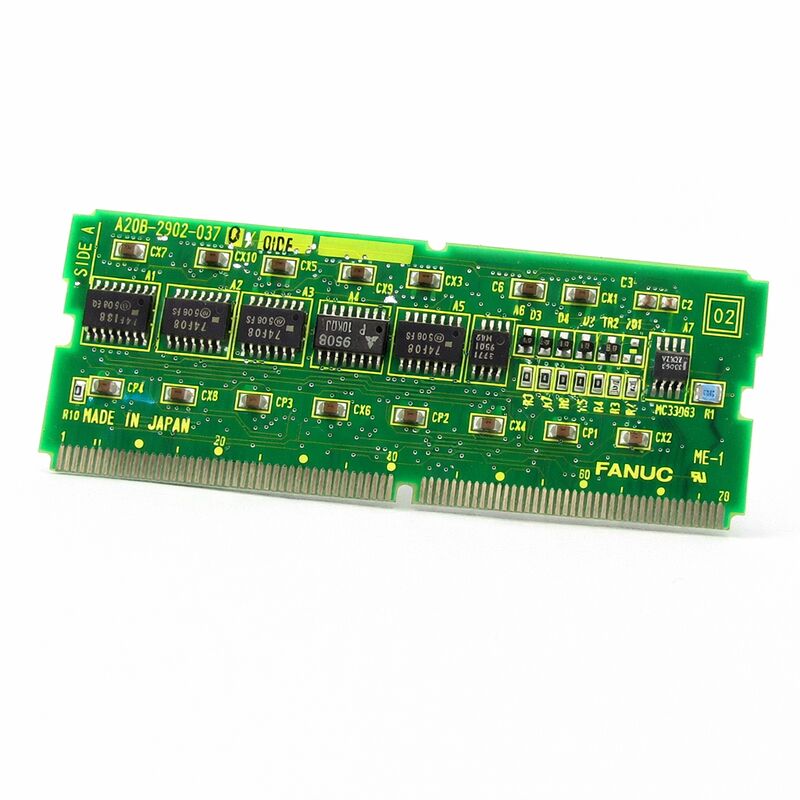
FANUC A20B-2902-0235 Analog Spindle Control Module
Overview
The A20B-2902-0235 is a spindle-side control module in the A20B-2902 family. Across service and seller channels, it is described in two closely related ways: as an analog spindle module without additional RAM and as a spindle memory module using SRAM.
The consistent point across those descriptions is that the part belongs to the spindle-control side of the installed FANUC system rather than to the display, general I/O, or motherboard layer.
One detailed parts description links the model to Power Mate D/F and to compatible Series 0/16/18/21 style setups, while emphasizing analog spindle speed and orientation control through integrated control circuitry.
Other channels describe it as a spindle memory module with SRAM and a 256K capacity. In practice, the safest way to work with this model is to treat it as a spindle-side control/memory board and to confirm the exact label on the installed hardware before replacement.
Another critical maintenance detail is that service channels explicitly note that programming is required and that all parameters and programs must be reloaded after installation. That makes this board different from a simple plug-and-run spare and means replacement planning should always include backup and reload preparation.
Technical Data
| Parameter |
Value |
| Part Number |
A20B-2902-0235 |
| Manufacturer |
FANUC |
| Product Type |
Spindle-side control / memory module |
| Product Series |
A20B-2902 |
| Functional Positioning Seen |
Analog spindle module |
| Additional Positioning Seen |
Spindle memory module |
| Memory Technology Seen |
SRAM |
| Memory Capacity Seen |
256K |
| Control Context Seen |
Power Mate D/F and Series 0/16/18/21 style setups |
| Programming Note |
Parameters and programs must be reloaded |
Applications
This module is suitable for installed FANUC CNC and motion-control systems where the existing hardware already uses the A20B-2902-0235 spindle-side board position.
It is especially relevant in spindle-control repair, spindle-side memory/control board replacement, and installed-base restoration work where the original spindle architecture must remain unchanged.
It is particularly useful where the machine’s broader control hardware remains functional but the spindle-related module has failed, lost integrity, or requires exchange-based service. In those cases, keeping the same board model is the safest way to preserve the existing spindle-control path.
Selection Guide
When selecting A20B-2902-0235, the first step is to verify the exact board code on the installed hardware. That is especially important here because market descriptions split between analog spindle and spindle memory module language.
The exact board label is the strongest selection reference.
Second, confirm the machine’s spindle architecture.
This board should be matched where the system actually uses the same spindle-side board role, especially in installations with analog spindle handling or Power Mate / early i/o style control arrangements.
Third, plan for the software side before the hardware swap.
Because listings state that parameters and programs must be reloaded, the job should be treated as a controlled service action rather than a simple board exchange. Backups and setup documentation are essential.
Replacement Guidance
Before ordering, confirm the installed label, verify the spindle-side board role, and ensure that a valid machine backup is available. If the system backup is incomplete or uncertain, replacement planning should pause until the parameter and program situation is understood.
If the board is being sent for repair or exchanged, document current spindle behavior and any related fault conditions before removal.
On spindle-side boards, those notes are often useful in distinguishing board failure from spindle-drive or parameter-related issues.
FAQ
Q1: What kind of module is A20B-2902-0235?
It is best described as a spindle-side control module. Depending on the service channel, it is sold either as an analog spindle module or as a spindle memory module using SRAM, but both descriptions point to the same spindle-related installed role.
Q2: Why do some listings call it analog spindle and others call it a spindle memory module?
Because different stock channels emphasize different aspects of the same board. Some focus on the board’s spindle-control role, while others highlight the memory technology used on the module.
For service work, the safest approach is to verify the exact installed board label and treat the board as a spindle-side control/memory module.
Q3: Does this board need programming after installation?
Yes. Service listings clearly note that programming is required and that all parameters and programs must be reloaded. That means backup planning is a necessary part of the replacement job, not an optional extra step.
Q4: Is this a generic PCB?
No. It is better treated as a function-specific spindle-side module. Even where some channels list it under broad PCB inventory, the repeated spindle-control and spindle-memory descriptions make its installed role much more specific than a generic board classification.
Q5: What should be checked before buying?
Check the installed board label, confirm the machine’s spindle architecture, and verify that parameters and programs can be reloaded after installation.
Those checks are more important on this model than a simple visual comparison.


 Your message must be between 20-3,000 characters!