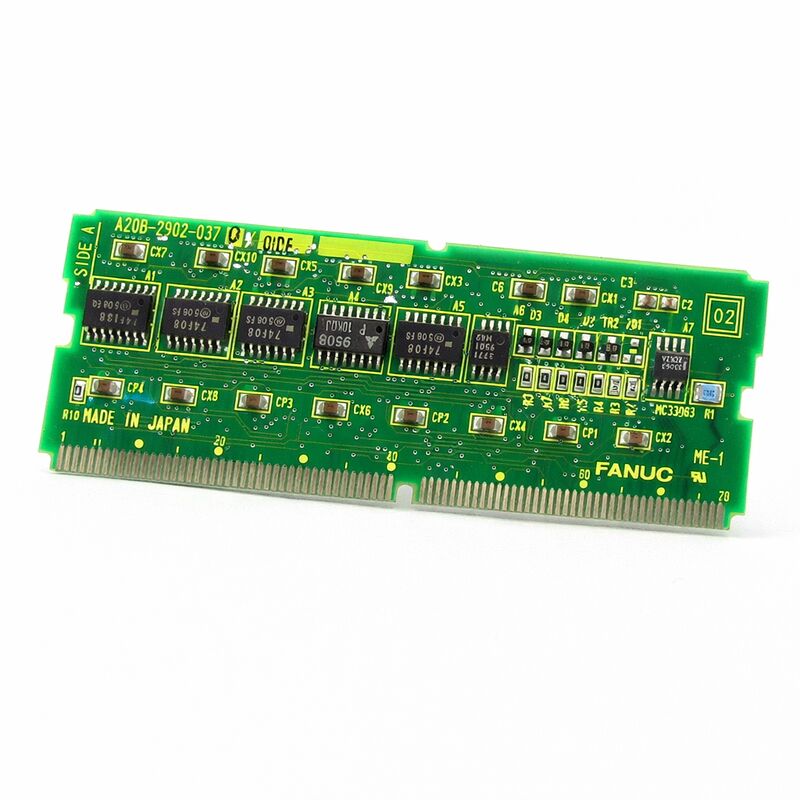
FANUC A20B-2902-0302 | SRAM Memory Module — Series 16 / 18 / 160 / 180 Model C, Power Mate-H, Japan Origin
Part Number: A20B-2902-0302
Manufacturer: FANUC Corporation (Japan)
Product Type: SRAM Memory Module (SMD Daughter Board)
Memory Type: SRAM (Static RAM — battery-backed, non-volatile with battery)
Compatible Systems: FANUC Series 16/18/160/180 Model C, Power Mate-H (with position data)
Design: SMD plug-in daughter board
Overview
The A20B-2902-0302 is an SRAM memory module from FANUC's A20B-2902 series. It provides static RAM storage for FANUC CNC controllers in the Series 16/18/160/180 Model C family, and carries a documented application in the Power Mate-H controller where it supports position data storage.
This is a surface-mount (SMD) daughter board — a compact plug-in module that seats into a dedicated socket on the host PCB within the controller.
SRAM is the memory technology of choice for data that must be retained between power cycles but also needs to be writable during operation. It is faster than Flash memory, endures many more write cycles, and requires only a small continuous current to hold its data when the main power is off.
For a CNC controller, SRAM holds the data that evolves during normal machine use: part program storage, parameter tables, tool and work offset data, and in the case of the Power Mate-H, the axis position data that allows accurate position management across power cycles.
The Series 16/18/160/180 Model C was a significant generation in FANUC's CNC history.
The 16/18 Model C represented the transition to FANUC's modern digital servo architecture and compact controller form factor. The 160 and 180 designations extended the platform for multi-path and expanded axis configurations.
The Power Mate-H was a compact single-axis CNC dedicated to specific machine control applications — pallet changers, loader axes, and similar auxiliary motion systems. All of these systems used the A20B-2902 memory module family for their expandable SRAM requirements.
Key Specifications
| Parameter |
Value |
| Part Number |
A20B-2902-0302 |
| Manufacturer |
FANUC Corporation |
| Product Type |
SRAM Memory Module |
| Memory Type |
Battery-backed SRAM |
| Compatible Systems |
FANUC Series 16/18/160/180 Model C; Power Mate-H |
| Application (Power Mate-H) |
Position data storage (with position function) |
| Design |
SMD plug-in daughter board |
| Origin |
Japan |
| Operating Temperature |
0 – 55°C |
| Storage Temperature |
−20 – 60°C |
| Humidity |
75% RH max (non-condensing) |
| Condition Available |
New (surplus) / Refurbished / Repaired |
SRAM Technology and Battery Backup
Static RAM uses flip-flop circuits to store each bit of data. Each bit is held by two cross-coupled transistors locked in one of two stable states.
This structure is more complex than DRAM — which uses a single capacitor per bit — but the benefit is that the data state is genuinely stable.
As long as power is supplied, the data doesn't drift or require periodic refresh. This makes SRAM fast and consistent.
The trade-off is power. The flip-flop structures in SRAM consume more quiescent current than DRAM cells. When the controller is powered off, a battery takes over to supply the small current needed to keep the flip-flop states intact. CMOS SRAM — the technology used in FANUC's memory modules — dramatically reduces this quiescent current through its transistor design, allowing a small lithium battery to maintain SRAM content for years under typical conditions.
When the battery voltage falls below the SRAM's retention threshold, the flip-flop states become unstable. Data is lost — either gradually, with cells failing in isolation until the data pattern is thoroughly corrupted, or suddenly, if the voltage drops sharply.
FANUC controllers monitor the backup battery voltage and generate a low battery alarm before reaching the critical threshold, providing a window for preventive replacement.
Power Mate-H and Position Data
The Power Mate-H represents a specific application domain within FANUC's control product range. Unlike a full multi-axis CNC system, the Power Mate-H is a dedicated single-axis controller designed for auxiliary machine functions — a tool magazine indexing axis, a pallet shuttle axis, a part loading arm axis. Its role is motion management for a single purpose, tightly integrated with the machine's main CNC.
The A20B-2902-0302's position data function in the Power Mate-H application is straightforward but critical.
The controller must know the current axis position to resume operation correctly after a power cycle. This position data is stored in the SRAM, updated continuously during operation.
If this position data is lost — due to battery failure, SRAM corruption, or module replacement — the controller cannot confirm its axis position. A reference position return (zero return or home operation) is required before the axis can resume automatic operation safely.
This position data requirement makes battery health particularly important for Power Mate-H applications. Unlike a main CNC controller where parameter loss is inconvenient but restoreable from backup, position data loss in a Power Mate-H requires a physical reference operation on the machine.
In automated transfer line applications where the Power Mate-H controls a frequently cycling auxiliary axis, battery maintenance is a regular maintenance task.
Module Replacement and Data Management
Replacing the A20B-2902-0302 module always results in blank SRAM — the replacement module has no prior content.
For Series 16/18 Model C applications, this means all data previously stored in that SRAM bank is lost: part programs (if stored in SRAM), work offsets, and any data registers allocated to SRAM storage.
Before replacing the module, take a complete backup of the CNC controller's memory.
This backup should capture parameters, tool data, work offsets, PMC data tables, and part programs.
The backup medium — typically a PC via RS-232 serial connection or USB storage — must be accessible and the backup verified as complete before the module is removed.
After installing the replacement module and powering on the controller, restore from backup.
Verify each data category against the backup to confirm the restore was complete.
For Power Mate-H applications, perform a reference position return after data restore to establish the axis position reference.
FAQ
Q1: The Series 16-C controller shows a memory error alarm for SRAM at power-on. All data seems to have been lost overnight. The battery tested as 3.1V. What happened?
A 3.1V reading on a lithium battery cell suggests it is near the end of its service life — lithium cells maintain near-nominal voltage until quite close to failure.
The critical threshold for SRAM retention is typically around 2.0-2.5V, but the battery's internal resistance increases with age, meaning the effective voltage under load is lower than the open-circuit reading.
The data loss suggests the battery could no longer maintain the SRAM during the overnight power-off. Replace the battery and the SRAM data, and schedule regular battery checks going forward.
Q2: The Power Mate-H is showing a position data error after a power interruption. What does this mean for machine operation?
A position data error in the Power Mate-H means the SRAM's stored axis position was corrupted or lost during the power interruption.
The controller does not know where the axis is. It cannot resume automatic operation safely without re-establishing its position reference.
Perform a manual reference position return (reference point return operation) to move the axis to its defined home position.
Once the controller has re-established the reference, position data storage resumes and automatic operation can continue.
Q3: Can the A20B-2902-0302 be used to expand memory in a Series 18 Model C that currently has only FROM storage, no additional SRAM?
Adding SRAM capacity to a Series 18 Model C requires a compatible module for the available memory expansion socket and the appropriate software configuration to recognise the additional SRAM. The -0302 module must match the socket type on the main board.
Check the Series 18-C hardware manual's memory configuration table to confirm the -0302 is listed as an expansion option for the specific board revision in use.
Some controllers require a software parameter change to activate newly installed SRAM.
Q4: After a CNC software upgrade, the SRAM module shows a capacity error. The module was not changed. What is the issue?
A software upgrade can change the SRAM address map or the expected memory configuration.
The new software version may expect a different SRAM capacity or a different module configuration than was present before the upgrade.
Check the software upgrade documentation for memory configuration changes.
It is possible the upgrade requires a different SRAM module, or that a parameter setting needs to be updated to correctly define the installed memory layout for the new software version.
Q5: The replacement A20B-2902-0302 module has a different revision suffix from the original (e.g., /01A vs /02A). Is this a concern?
Minor revision suffixes in FANUC part numbers generally indicate PCB layout revisions or component substitutions that maintain the same function.
In most cases, a later revision is directly interchangeable with an earlier one within the same base part number.
However, if there is any doubt, confirm compatibility with the specific controller model's maintenance documentation or with a qualified FANUC service resource before installing the revised module.


 Your message must be between 20-3,000 characters!