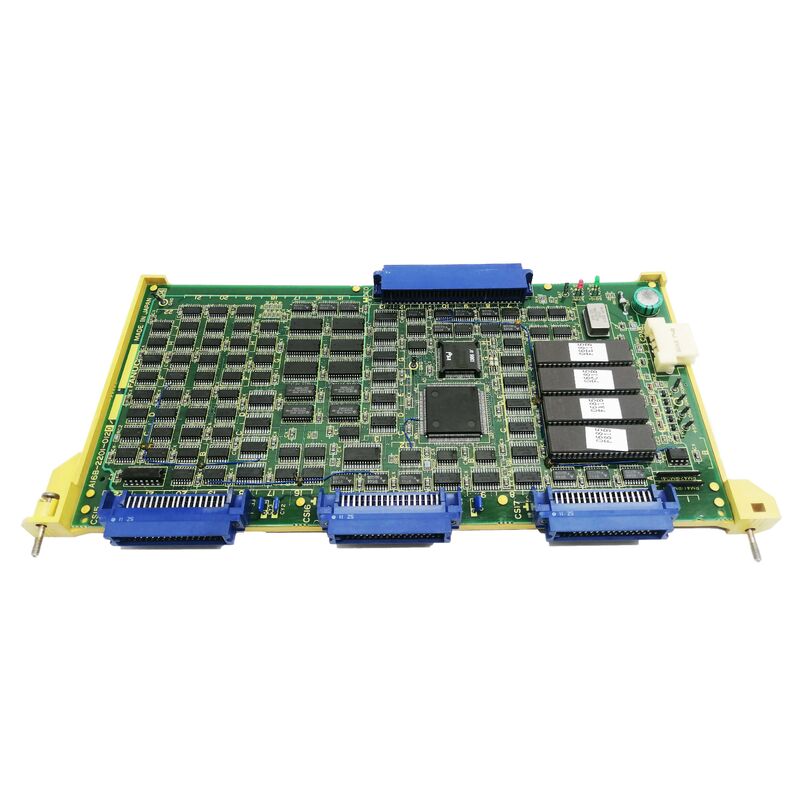
A16B-1300-0220 | FANUC Built-In Sensor / Sensor Signal Conversion PCB — A16B-1300 Series / CNC Measurement Integration
Sensor Signal Conversion — Bridging Machine Sensors and CNC Control
The A16B-1300-0220 is a signal conversion PCB that bridges the physical measurement world of machine tool sensors and the digital signal environment of the FANUC CNC. The two functions implied by its description reveal its complete role:
Built-In Sensor interface: "Built-In Sensor" refers to sensors embedded within the machine tool — touch probes, part measurement sensors, or other integrated measurement devices that are physically built into the machine rather than externally attached. These sensors generate signals when they contact a workpiece or reference surface.
Sensor signal conversion circuit: Raw sensor signals — typically analogue voltage or current signals, or simple on/off switching contacts — must be conditioned and converted to the digital signal format that the CNC's input circuitry expects. The A16B-1300-0220 performs this conversion:
- Analogue-to-digital conversion for sensors producing analogue output (force sensors, distance sensors, capacitive measurement systems)
- Signal conditioning to amplify, filter, or reshape raw sensor signals before CNC processing
- Level conversion between the sensor's signal voltage and the CNC's logic input voltage levels
- Isolation between the sensor circuit and the , preventing noise or transient voltages from the machine body reaching the CNC
Key Product Information
| Parameter |
Value |
| Functions |
Built-In Sensor + Signal Conversion |
| Application |
CNC machine tool measurement |
| Board Type |
Signal conversion PCB |
| Series |
A16B-1300 |
Why Signal Conversion Matters in CNC Applications
Machine tool sensors generate signals in environments that are fundamentally different from the CNC controller's electronics environment:
Electrical noise: Machine tools generate substantial electromagnetic interference from servo drives, spindle drives, hydraulic solenoids, and arc welding equipment. Sensor wiring running through the machine's electrical cabinet picks up this noise. Without signal conditioning, noise corrupts the measurement signal.
Signal format mismatch: Sensors may output analogue voltages (0–10V, 4–20mA) or differential signals that the CNC's standard digital inputs cannot process directly. Signal conversion maps these formats to CNC-compatible digital inputs. Ground isolation: Sensors mechanically integrated with the machine may have different ground references from the CNC controller. Isolation prevents ground loops and their associated measurement errors. The A16B-1300-0220 addresses all these issues — converting the sensor's raw output to a clean, correctly-formatted signal that the CNC can use for measurement, control, and feedback.
Application Scenarios
Built-in part measurement fault: A FANUC CNC machining centre with integrated touch-probe measurement loses measurement accuracy or generates sensor communication alarms. The A16B-1300-0220 signal conversion board is identified as the fault. Replacement restores accurate measurement signal conversion.
CNC sensor integration maintenance: A FANUC CNC machine tool with built-in measurement sensors undergoes control board maintenance. The A16B-1300-0220 is replaced to ensure accurate signal conditioning for the measurement system.
FAQ
Q1: What types of sensors does A16B-1300-0220 interface with?
The description "BUILD IN SENSOR" suggests sensors physically integrated within the machine tool — typically touch probes (Renishaw, FANUC-branded), in-spindle measurement probes, or workpiece presence sensors. The signal conversion circuit accommodates the specific electrical characteristics of these built-in sensors. Confirm the compatible sensor types from the applicable FANUC machine tool and CNC documentation.
Q2: Is A16B-1300-0220 the same as a standard I/O board?
No. Standard I/O boards (like the A16B-1212-0221 I/O Card C6 confirmed in this session) handle digital on/off machine I/O signals — switches, solenoids, lamps. The A16B-1300-0220 is specifically a signal conversion board for measurement sensors, providing the additional conditioning, conversion, and isolation that precision measurement circuits require beyond standard I/O functionality.
Q3: Does replacing A16B-1300-0220 require any sensor recalibration?
Signal conversion boards that include gain or offset adjustment components may affect measurement accuracy after replacement. Whether recalibration is required depends on the specific sensor system and whether the new board's conversion characteristics match the original. Confirm from the applicable FANUC measurement system documentation.
Q4: Does A16B-1300-0220 failure affect the CNC's axis servo control?
Sensor signal conversion board failures affect measurement functions — part measurement, probe cycles, and sensor-based feedback — but typically do not affect the CNC's primary axis servo control. The CNC continues machining using programmed coordinates; only sensor-dependent functions (measurement macros, sensor-triggered operations) are affected.


 Your message must be between 20-3,000 characters!