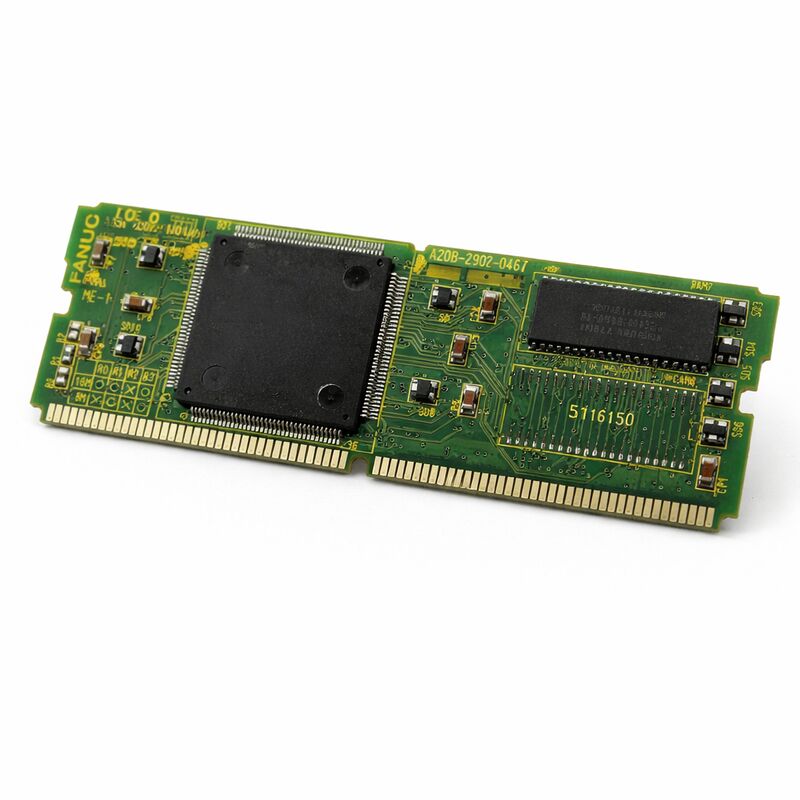
Type A Interface Servo Control Module
Overview
The FANUC A20B-2902-0400 is described as a Type A Interface Servo Control Module, a control-oriented unit developed for applications where motion precision, response consistency, and efficient integration are important.
As part of the A20B-2902 series, it belongs to a product family associated with servo-side interface and control functions in industrial machine systems.
In practical use, a servo control module sits closer to the motion-control layer of the machine than a general support PCB.
That makes it especially important in systems where axis behavior, response timing, and command stability directly affect production quality.
For this reason, the A20B-2902-0400 is best understood as a functional control module used to support precise servo-related operation within a FANUC-based machine environment.
For repair buyers and maintenance engineers, this module is relevant when original motion-control hardware must be restored with the correct model rather than approximated with visually similar parts.
In industrial automation, servo-related hardware is usually selected with tighter caution because incorrect replacement can lead to persistent alarms, inconsistent axis response, or operating instability under load.
Functional Position in the System
| Parameter |
Value |
| Part Number |
A20B-2902-0400 |
| Brand |
FANUC |
| Product Type |
Interface Servo Control Module |
| Series |
A20B-2902 |
| Main Function |
Servo control / interface support |
| Typical Use |
Replacement, maintenance, machine repair |
Key Product Value
Precise control orientation
This module is intended for applications where accurate servo-side command handling matters.
That makes it relevant in machines where motion performance is closely tied to product quality and operating consistency.
Efficient system integration
As an interface servo control module, it supports the connection and control logic between system layers that rely on coordinated servo response.
In maintenance terms, that means it plays a direct role in restoring intended machine behavior.
Industrial reliability for established equipment
Modules in this category remain important long after the original machine installation because servo control architecture is rarely replaced casually.
For many users, replacing the correct FANUC module is a far safer decision than modifying machine logic around a substitute.
Suitable Applications
- CNC machine servo repair
- Motion-control hardware replacement
- Maintenance support for FANUC equipment
- Industrial service stock
- Restoration of existing control architecture
FAQ
Q1: What does “Type A Interface Servo Control Module” mean in industrial use?
It means the A20B-2902-0400 is not just a passive board, but a functional module associated with servo control and interface-related tasks inside the machine’s control structure.
In practical terms, it is relevant where motion commands, control logic, and servo-side coordination need to work together without instability.
That is why this kind of part is treated as a precision replacement item in maintenance work.
Q2: Why is a servo control module more sensitive to compatibility than a general PCB?
Servo-related components interact more directly with machine motion, which means compatibility is not only mechanical or electrical, but also functional.
If the wrong module is used, the machine may show axis alarms, poor response, inconsistent motion, or commissioning failure.
In industrial environments, servo replacement decisions are usually made with tighter verification because motion quality and machine safety depend on control integrity.
Q3: What symptoms may indicate that this kind of module should be inspected?
Typical triggers include servo-related alarms, abnormal motion response, unstable operating behavior, startup faults after power-on, or unresolved issues after checking power supply and wiring.
While final diagnosis depends on the machine, a technician may move toward module inspection when basic external causes have already been ruled out.
Q4: What should engineers review before replacing an interface servo module?
They should verify the exact model number, inspect connectors and associated harnesses, check cabinet grounding and thermal condition, and make sure the issue is not being caused by amplifier faults, encoder feedback problems, or supply instability elsewhere in the system.
In motion-control maintenance, replacing a module is most effective when done as part of full-path diagnosis rather than isolated guesswork.
Q5: Why do factories keep servo modules like A20B-2902-0400 in spare inventory?
Because machine downtime related to motion control can be expensive and disruptive. A correct spare module shortens fault recovery time and helps preserve the original machine configuration.
In plants with older but still productive equipment, stocking the right servo-related part is often more economical than risking long shutdowns while searching for replacements later.


 Your message must be between 20-3,000 characters!