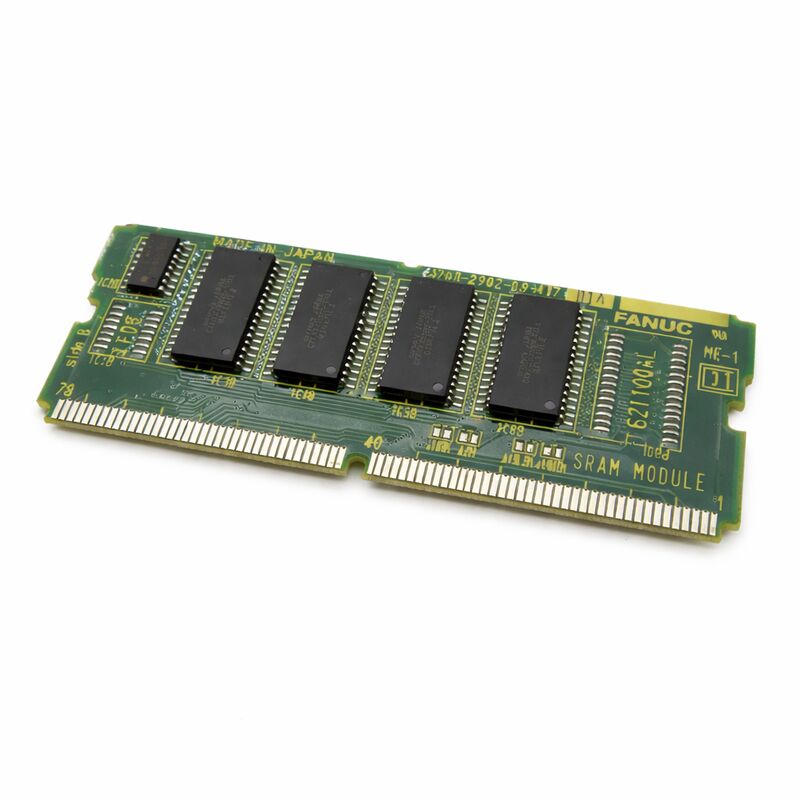
FANUC A20B-2902-0642 | 256K SRAM Module with Analog Spindle Control — Series 16/18/21, Japan Origin
Part Number: A20B-2902-0642
Manufacturer: FANUC Corporation (Japan)
Product Type: SRAM Memory Module with Analog Spindle Interface (SMD Daughter Board)
Memory Capacity: 256 KB SRAM
Compatible Systems: FANUC Series 16 / 18 / 21 and compatible
Overview
The A20B-2902-0642 is a dual-function plug-in module for FANUC Series 16, 18, and 21 CNC systems. It combines 256 kilobytes of SRAM with an integrated analog spindle interface on a single SMD-type daughter board.
The board mounts directly onto the main CPU motherboard and provides two capabilities simultaneously: volatile memory for CNC data storage and an analog velocity command output for controlling analog-type spindle amplifiers.
Two functions on one board matters in practice. On Series 16/18/21 systems configured for analog spindle drive, this module is how both the spindle control interface and the additional SRAM are delivered to the controller.
Separate boards for each function exist in this module family, but the A20B-2902-0642 handles both from a single plug-in position.
The analog spindle interface is the specific hardware that converts the CNC's spindle speed command into an analog voltage signal.
Spindle amplifiers designed for analog command input — older or cost-optimised amplifiers common in the generation of machines that use Series 16/18/21 controls — receive this voltage as their speed reference.
The interface on this board generates and conditions that signal.
Key Specifications
| Parameter |
Value |
| Part Number |
A20B-2902-0642 |
| Manufacturer |
FANUC Corporation |
| Product Type |
SRAM + Analog Spindle Interface Module |
| Board Series |
A20B-2902 |
| SRAM Capacity |
256 KB |
| Spindle Interface |
Analog (velocity command output type) |
| Compatible Systems |
FANUC Series 16 / 18 / 21 and compatible |
| Design |
SMD-type plug-in daughter board |
| Installation |
Plugs directly onto main CPU motherboard |
| Origin |
Japan |
| Operating Temperature |
0 – 55°C |
| Storage Temperature |
−20 – 60°C |
| Humidity |
75% RH max (non-condensing) |
| Condition Available |
New / Refurbished / Repaired |
The Analog Spindle Interface — How It Works
The spindle in a CNC machine tool requires precise speed control. Modern FANUC CNC systems communicate spindle speed commands to the spindle drive via a digital serial link — the spindle amplifier reads a digital command and executes it.
But many spindle amplifiers, particularly those from the 1990s generation that matches Series 16/18/21 machine installations, are analog-command type.
They expect a ±10V or 0–10V signal proportional to the commanded spindle speed.
The analog spindle interface on the A20B-2902-0642 converts the CNC's internal digital spindle speed reference into this analog voltage. The spindle amplifier reads the voltage. The CNC has no analog output of its own — that analog capability is provided entirely by this interface board. Without it installed, the CNC has no path to command an analog-type spindle amplifier.
The machine may power up but the spindle will not respond to speed commands.
The velocity command output is precisely controlled.
The CNC's spindle control algorithm computes the correct speed reference and passes it to the interface DAC (digital-to-analog converter) on this board.
The resulting voltage reflects the commanded speed accurately within the amplifier's input range.
256K SRAM — Volatile Memory for CNC Operation
The 256 kilobytes of SRAM on this module are battery-backed volatile memory.
They hold data that the CNC writes and reads continuously during operation: part programs, parameter tables, tool offset data, macro variables, and other runtime information.
This data must survive power cycles — the backup battery keeps the SRAM contents intact when the machine is switched off.
256 KB is a moderate SRAM allocation by current standards, but it is appropriate for many Series 16/18/21 configurations. Systems with large part program libraries, extensive tool life management data, or many macro variables may benefit from a larger SRAM module.
For standard machine configurations, 256 KB accommodates normal program and parameter storage requirements.
The SRAM backup battery is a maintenance item. It has a finite service life and must be replaced before it fails. When the battery drops below its threshold voltage, SRAM data is lost on the next power-off event.
The machine will alarm on restart with a memory error. Replace the battery on a scheduled basis, not in response to a memory alarm.
When This Module Is the Right Choice
FANUC offered multiple variants of the A20B-2902-0XXX analog spindle and memory module family for Series 16/18/21.
The correct choice depends on the machine's spindle configuration. If the machine uses an analog spindle amplifier and requires a 256 KB SRAM allocation, the A20B-2902-0642 is the matching module.
If the machine uses a serial spindle drive instead, a different module variant — without the analog spindle interface — is required.
Always confirm the spindle drive type and the existing module's part number before sourcing a replacement. Installing an analog interface module in a serial spindle system produces spindle alarms.
Installing a serial spindle module in an analog spindle system leaves the spindle uncontrollable.
FAQ
Q1: The spindle does not respond to speed commands. The CNC shows no alarm. Could the A20B-2902-0642 be the cause?
Start by confirming the analog command voltage is present at the spindle amplifier's command input using a voltmeter.
If the CNC commands spindle speed but the voltage at the amplifier input does not change, the analog output path — including this board — is the fault location.
If the voltage changes correctly but the spindle does not respond, the fault is in the amplifier or the spindle motor itself.
Q2: The machine shows a SRAM memory error on startup after a weekend shutdown. The SRAM battery is not alarmed. What else could cause this?
A memory error after a short power-off period with a reportedly healthy battery may indicate the battery voltage has fallen below the SRAM holding threshold even before the low-battery alarm threshold is reached. Measure the battery voltage directly.
If it reads below 2.7V, replace it and restore parameters from backup.
The low-battery alarm threshold and the actual SRAM-holding threshold are not the same point.
Q3: Is the analog spindle output on this module adjustable?
The analog output voltage range is determined by the CNC's spindle parameter settings.
Maximum spindle voltage, direction polarity, and gain can be adjusted through CNC parameters.
The hardware on this board supports these software-settable functions. No hardware jumper adjustment is required for standard installations.
Q4: Can the A20B-2902-0642 be used in a machine currently fitted with a different analog spindle module variant?
SRAM capacity and spindle interface features vary between variants in the A20B-2902 analog spindle module family.
If the replacement module carries the same SRAM capacity and the same spindle interface type as the one being replaced, it is a direct substitute.
If either parameter differs, verify compatibility with the system documentation before installation.
Q5: After replacing this module, the spindle works correctly but tool offsets are wrong. What happened?
A new module installs blank — all SRAM data, including tool offsets, is absent.
Tool offset tables must be restored from backup after any SRAM module replacement.
If no backup exists, offsets must be re-measured and re-entered manually before production resumes.
This applies to all SRAM-resident data: parameters, programs, and offsets.


 Your message must be between 20-3,000 characters!