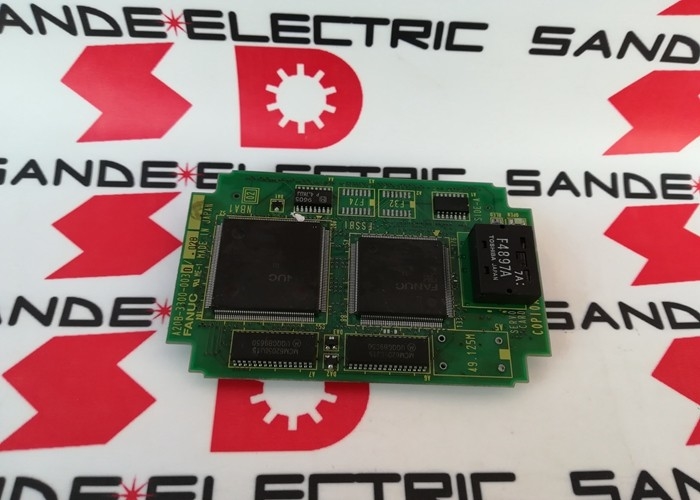
A20B-3300-0030 | FANUC i Series 2/3/4-Axis FSSB Servo Controller PCB — 15i / 16i / 18i / 20i / 21i Motherboard Mount
FSSB — Why the Interface Architecture Matters
In earlier FANUC CNC generations (Series 0, 6, 10, 15), servo command signals travelled between the CNC and the amplifiers over dedicated analogue or digital parallel cables — one cable per axis, with separate wires for position commands, velocity references, and feedback. As axis counts increased, the cable count grew proportionally. A 4-axis system needed four complete command cable runs.
FSSB (Fiber Optic Servo Signal Bus) replaced this with a single optical fibre loop. All axis commands and encoder feedback data travel as serial packets over the fibre, daisy-chained from the CNC's FSSB output through each servo amplifier in sequence. For a 4-axis system, one fibre cable loop handles all axes.
The A20B-3300-0030 is the PCB that implements the FSSB interface on the CNC side — it generates the axis command packets and receives the encoder feedback from the amplifier chain, translating this data into the axis position loop calculations running inside the CNC.
Key Specifications
| Parameter |
Value |
| Interface |
FSSB (Fiber Optic Servo Serial Bus) |
| Axis Capacity |
2, 3, or 4 axes |
| Compatible Systems |
FANUC 15i, 16i, 18i, 20i, 21i |
| Generation |
i-generation, Model A |
| Installation |
Direct mount to i series motherboard |
2, 3, or 4 Axes — Flexible Configuration
The A20B-3300-0030 can control 2, 3, or 4 axes via FSSB depending on the CNC configuration. The number of active axes is determined by the CNC parameters — the servo card hardware supports up to 4 axes, but a 3-axis machining centre uses only 3 channels, and a 2-axis lathe uses 2.
For the FANUC 16i, 18i, and 21i systems, which are the most common deployment platforms for this card, 3-axis (X, Y, Z on a machining centre) and 4-axis (X, Y, Z plus a rotary axis or fourth feed axis) are typical configurations. The card provides the servo command bandwidth and feedback processing for all active channels simultaneously — the FSSB serial update cycle runs fast enough that all axes receive their position commands at the CNC's interpolation cycle rate.
Application Scenarios
4-axis machining centre: A vertical machining centre with X, Y, Z, and a rotary 4th axis uses the A20B-3300-0030 to control all four axes via a single FSSB fibre loop. The card handles the servo command and feedback for all axes simultaneously at the CNC interpolation rate.
Servo card replacement on Series 16i: A FANUC 16i CNC machining centre develops axis following error alarms on all controlled axes. The fault is isolated to the A20B-3300-0030 servo controller card. Replacing the card restores normal servo operation across all axes.
CNC maintenance overhaul: During a scheduled CNC overhaul on a Series 18i lathe, the servo controller card is replaced as part of a board refresh to reset component life on the critical axis control hardware.
FAQ
Q1: Can the A20B-3300-0030 control a 5th or 6th axis when combined with a second servo card?
Some FANUC i series CNC configurations support two FSSB channels from two servo controller cards to extend axis capacity beyond 4 axes. Whether this configuration is supported depends on the specific CNC model, the motherboard version, and the CNC software option. The A20B-3300-0030 provides up to 4 axes on its single FSSB channel. For confirmed multi-card axis expansion configurations, consult the FANUC i series installation manual for the applicable CNC model.
Q2: What servo amplifier types connect to the A20B-3300-0030 via FSSB?
The FSSB interface connects to FANUC's Alpha i series and Beta i series servo amplifier modules that include an FSSB input port. Amplifiers using Type A or Type B (analogue/digital parallel) interfaces do not connect to FSSB. Confirm that the installed servo amplifiers have FSSB-type connectors before fitting the A20B-3300-0030.
Q3: Are there CNC parameters to reconfigure after replacing the A20B-3300-0030?
The A20B-3300-0030 is a hardware card — it does not store CNC parameters. All servo parameters (axis assignment, loop gains, encoder type, FSSB node address assignment) are held in the CNC's main parameter memory. After fitting a replacement card, the CNC should power up and re-establish FSSB communication automatically, using the existing parameter set. If FSSB communication alarms persist, verify the fibre connection and the FSSB parameter settings in the CNC's servo parameter table.
Q4: Is the A20B-3300-0030 specific to Model A, and what does Model A mean?
The FANUC i series was produced in multiple hardware generations — Model A and later Model B revisions. Model A refers to the first-generation i-series CNC hardware. The A20B-3300-0030 is the servo controller card for Model A motherboards of the 15i, 16i, 18i, 20i, and 21i series. Later Model B hardware uses different motherboard connectors and different servo card part numbers. Check the CNC's hardware generation from the control unit's nameplate before ordering.
Q5: What are the signs of A20B-3300-0030 failure compared to servo amplifier failure?
A failed servo controller card typically generates FSSB communication alarms across multiple axes simultaneously — since the card is the single FSSB source for all connected axes. A failed amplifier usually affects only one axis at a time, with axis-specific alarms. If all axes go into alarm at the same time with FSSB-related codes, the servo controller card is the first candidate for investigation. Single-axis alarms typically point to the amplifier or motor for that specific axis.


 Your message must be between 20-3,000 characters!