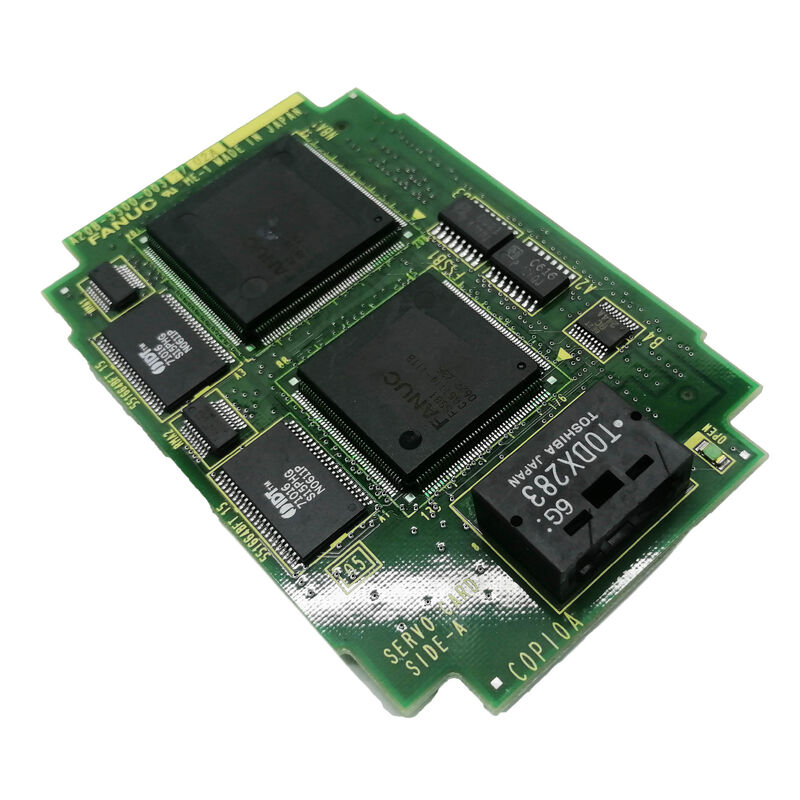
A20B-3300-0070 | FANUC Intel 486DX2 66MHz CPU Module — F20i / F21i / 16i / 18i / 21i CNC CPU Card
Intel 486DX2 at 66MHz — The Processing Core
The A20B-3300-0070 carries an Intel 486DX2 processor as its central processing unit. The 486DX2 uses a clock-doubling technique: the processor's internal core runs at 66 MHz while its external bus interface runs at 33 MHz. The "DX2" designation reflects this doubling — DX being the floating-point-equipped 486 variant and 2 indicating the 2× internal clock multiplier.
In a CNC context, 66 MHz represents significant processing capacity for the generation of CNC in which this card operates. The CNC's real-time tasks — interpolation calculations, servo loop closure, programme block look-ahead, PMC ladder execution — all run on this CPU core. The 66 MHz clock rate provides enough headroom to execute these tasks within the tight real-time deadlines the CNC imposes.
Key Specifications
| Parameter |
Value |
| Processor |
Intel 486DX2 |
| Clock Speed |
66 MHz (2× internal) |
| Compatible |
FANUC F20i / F21i / 16i / 18i / 21i |
| Memory Interfaces |
SRAM, DRAM, Flash |
| Installation |
Plug-in to i series main board |
| Generation |
i-generation, Model A |
Memory Interfaces — SRAM, DRAM, and Flash
The A20B-3300-0070 supports three types of memory interface, each serving a different function in the CNC system:
Flash (FROM — Flash Read-Only Memory): Stores the CNC system software, servo parameters, and the machining programmes in non-volatile form. Flash retains its contents indefinitely without power. This is the long-term storage layer — the CNC system image that restores operation after power cycling.
SRAM: Battery-backed static RAM stores programmes and parameters that the operator modifies during normal machine operation — work offsets, tool offsets, machine parameters, and data registered during setup. SRAM needs the backup battery to retain data during power-off. SRAM access is fast and allows the CNC to read and write these settings rapidly during operation.
DRAM: Dynamic RAM provides the main working memory for the CPU's active programme execution — the buffer where running programme blocks, calculation results, and OS execution state live during operation. DRAM is volatile and does not require battery backup because its contents are reloaded on every power-up from flash and SRAM.
Application Scenarios
CNC CPU fault: A Series 16i machining centre fails to complete its boot sequence, displaying a CPU module-related alarm. After ruling out memory module issues, the A20B-3300-0070 CPU card is identified as the failed component. Replacement restores normal CNC startup and operation.
F21i controller restoration: An F21i CNC unit with an inoperative processor is restored by fitting a tested A20B-3300-0070. The CNC reloads its system software from flash and resumes normal operation with the previous parameter set.
Workshop CPU spare: A machine tool maintenance department maintains an A20B-3300-0070 as a workshop spare for i-series CNC units, enabling rapid CPU module replacement on any 16i, 18i, or 21i CNC in their plant without waiting for component procurement.
FAQ
Q1: Does the A20B-3300-0070 work in all 16i, 18i, and 21i systems, or only specific hardware revisions?
The A20B-3300-0070 is confirmed for the i-generation Model A hardware. Later hardware revisions of the 16i/18i/21i series use updated main boards that may require different CPU card versions. Verify the target CNC's hardware generation from its system information screen (diagnostics menu) before fitting. The card designation F20i/F21i in the product description identifies the FANUC Series 20/21 generation as the primary target, with 16i and 18i compatibility as confirmed cross-applications.
Q2: Are CNC parameters retained when the A20B-3300-0070 CPU card is replaced?
CNC parameters are stored in SRAM (battery-backed) and Flash memory on the main board and memory modules — not on the CPU card itself. Replacing the CPU card does not delete CNC parameters as long as the SRAM battery is healthy and the flash modules remain installed. However, always perform a full parameter backup before any board replacement. If the system fails to boot after the CPU replacement, parameters and CNC software may need to be restored from the backup media.
Q3: What is the 486DX2 processor's performance significance for CNC applications?
For the CNC tasks this processor handles — interpolation, servo loop closure at sub-millisecond rates, PMC programme execution, and look-ahead buffering — 66 MHz provides the computation bandwidth required for smooth multi-axis contouring and high-feed-rate machining. The DX2's integrated floating-point unit (FPU) accelerates the trigonometric calculations in circular and helical interpolation. For the machine tool generation these CNC systems serve, the 486DX2's performance is well-matched to the CNC's real-time requirements.
Q4: Can the A20B-3300-0070 be upgraded to a faster processor?
No. The CPU card is designed around the specific timing, bus interface, and signal levels of the Intel 486DX2. Fitting a different processor type — a Pentium, 486DX4, or any other — would require a different CPU card designed for that processor's bus architecture. Processor upgrades in FANUC CNC systems are implemented by replacing the complete CPU card with a higher-generation card, not by swapping the processor chip.
Q5: How does an A20B-3300-0070 failure present at the CNC?
Typical symptoms of CPU card failure include: the CNC fails to complete startup and displays a CPU or system alarm; the CNC hangs at a fixed point in the boot sequence; the CNC operates erratically — executing some tasks incorrectly while others appear normal; or the CNC passes startup but generates unexplained programme execution errors that do not correspond to valid programme faults. These symptoms differ from memory module failures (which typically cause specific alarm codes related to SRAM, DRAM, or FROM) and point specifically to the CPU processing core.


 Your message must be between 20-3,000 characters!