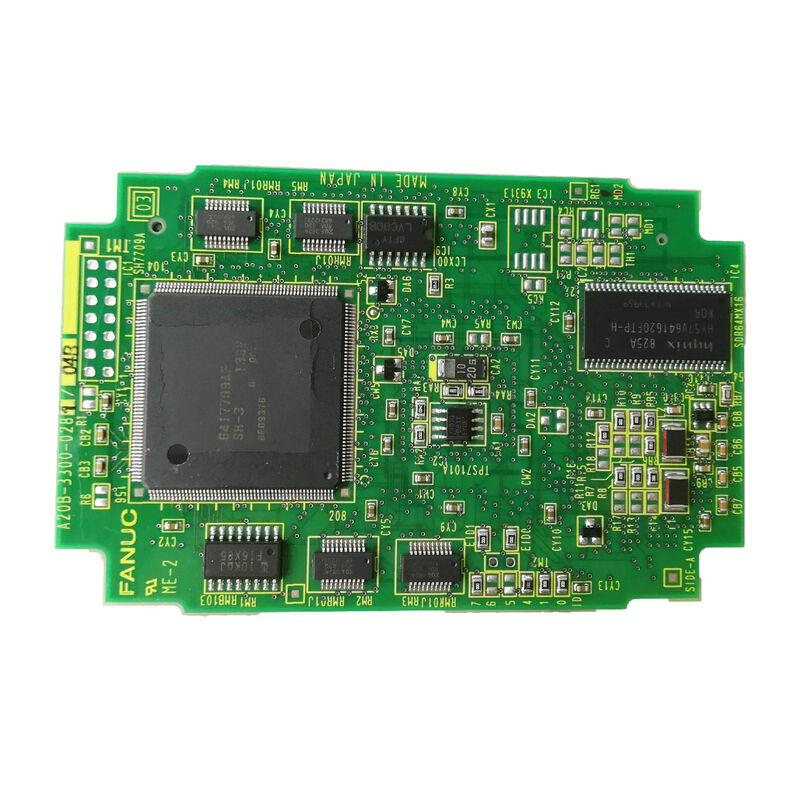
FANUC A20B-3300-0225 | i Series Main CPU Board — Master PCB for Series 16i / 18i / 21i CNC
Part Number: A20B-3300-0225
Cross Reference: A20B33000225
Manufacturer: FANUC Ltd. (Japan)
Product Type: Main CPU Board — i Series Master PCB
Product Series: A20B-3300
The Master Board of the i Series Control
The A20B-3300-0225 is the main CPU board — the master PCB — for FANUC Series 16i, 18i, and 21i CNC systems. It is the primary carrier board within the CNC control unit, hosting all the plug-in modules that together form the complete CNC controller: the CPU processor module, FROM/SRAM DIMM memory modules, FSSB servo module, graphics module, and any option boards fitted to the control.
The main board itself does not execute CNC processing — that is the role of the plug-in CPU module mounted on it. The main board provides the backplane interconnect that lets all plug-in modules communicate, distributes supply voltages to each module, and provides the external connector interfaces (drive bus, I/O, display) that connect the control to the rest of the machine.
When the main board fails — typically through backplane connector damage, a cracked PCB trace, or a failed interface circuit — the entire CNC control goes offline. Replacing the main board requires careful transfer of all original plug-in modules to the new board, followed by firmware and parameter reload.
What Must Be Loaded After Replacement
The A20B-3300-0225 is a hardware board — it stores no CNC software or parameters. After installing a replacement main board with the original plug-in modules, the following must be verified or reloaded:
- FROM contents: If the original FROM DIMM module is transferred intact, firmware is preserved.
- SRAM contents: If the original SRAM module is transferred and battery backup was maintained during the swap, parameters and programs are preserved. If SRAM was unpowered during transfer, all parameters and programs must be reloaded from backup.
- PMC ladder: Reloaded from backup if SRAM content was lost.
A complete pre-removal data backup is essential before replacing the main board.
Key Specifications
| Parameter |
Value |
| Part Number |
A20B-3300-0225 |
| Type |
Main CPU Board (Master PCB) |
| Platform |
Series 16i, 18i, 21i |
| Series |
A20B-3300 |
| Condition |
Used, tested |
| Plug-In Modules |
Not included |
FAQ
Q1: The A20B-3300-0225 is listed as used and tested. What does this mean for reliability?
A used board removed from a decommissioned CNC and tested for functionality on a compatible test rig is a practical replacement option, particularly for a board type that the CNC aftermarket holds in volume. The test should confirm that the backplane connectors are intact, the external interface circuits are functional, and the board powers up correctly with its plug-in modules. Request test documentation from the supplier before accepting the board.
Q2: The replacement board was installed but several plug-in modules are not recognised. What should be checked?
Non-recognition of plug-in modules after main board replacement is almost always caused by incomplete module seating in the new board's slots. The A20B-3300 main board's DIMM slot and edge connector positions are mechanically tight. Remove and reseat each module firmly. If a module is confirmed correctly seated but still not recognised, the main board's backplane interface circuit for that slot may be faulty.
Q3: The SRAM module was transferred with the CNC powered down. Are parameters preserved?
Unpowering the SRAM module — even briefly — risks parameter loss if the SRAM battery is low. When transferring a SRAM module during main board replacement, the safest method is to keep the battery voltage supplied to the SRAM at all times during the swap. This typically requires a temporary external battery connection. If parameters were lost, restore from the backup taken before the board change.
Q4: Is the A20B-3300-0225 interchangeable with other A20B-3300 variants (e.g., 0226, 0227)?
Adjacent A20B-3300 variants are typically successive hardware revisions of the same master board. Minor differences in component revision or PCB layout generally do not affect functional compatibility — the plug-in module interface and external connector positions are standardised. Confirm with a FANUC parts specialist if the exact variant is critical for the specific CNC production state.
Q5: Where is a used A20B-3300-0225 sourced reliably?
FANUC i-Series CNC repair companies and legacy parts dealers hold used A20B-3300 master boards in exchange inventory. The volume of 16i/18i/21i machines decommissioned from production provides a steady supply. Verify the specific 0225 variant is available — adjacent numbers may have different connector positions or hardware revisions. Functional testing on a 16i/18i/21i-compatible test rig is the most valuable quality assurance step.


 Your message must be between 20-3,000 characters!