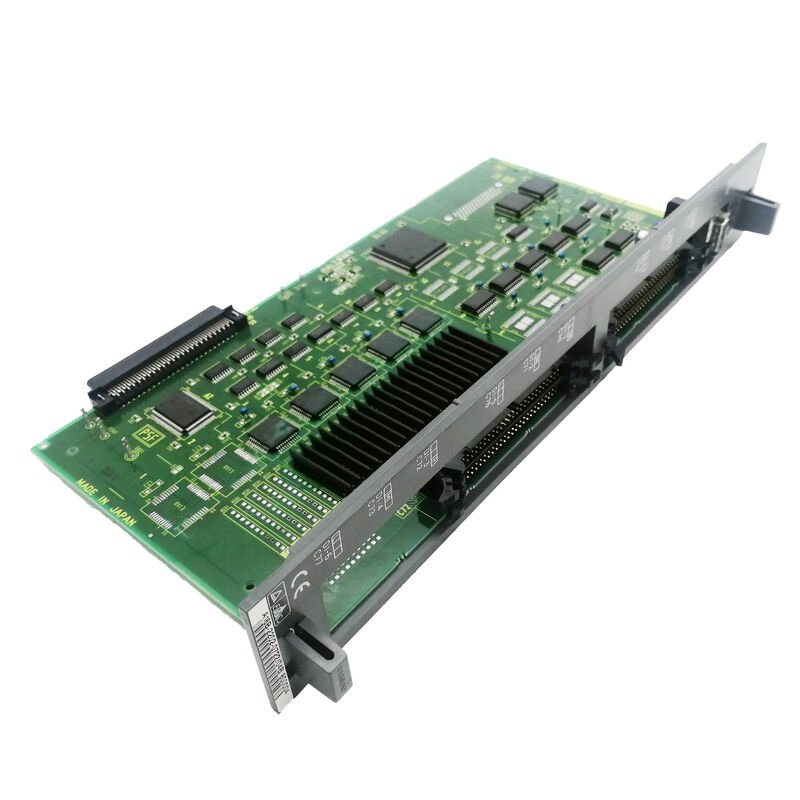
A16B-2200-0854 | FANUC 8-Axis Robot Axis Control Board — R-J Controller / Serial Plus 2LT / A16B-2200 Series
8-Axis Robot Axis Control — For Complex Robot Cells
The A16B-2200-0854 provides 8-axis servo control for FANUC's R-J series robot controller. Eight axes exceeds the 6 joints of a standard robot body — the additional axes serve extended robot cell configurations:
6 robot joint axes + external axes: A 6-joint robot body (J1–J6) plus one or two external axes — positioning tables, servo conveyors, slide tracks, or coordinated fixtures. The R-J controller manages all axes synchronously for coordinated motion.
Multiple robot coordination: In some R-J configurations, the controller coordinates multiple robot arms, where the combined axis count exceeds 6.
High-DOF robot bodies: Specialty robots with more than 6 joints — redundant robots for complex workspace geometries — require the expanded axis capacity.
Key Product Information
| Parameter |
Value |
| Axis Count |
8 |
| Controller |
R-J series robot |
| Interface |
Serial Plus 2LT |
| Type |
Axis control board |
| Series |
A16B-2200 |
FANUC R-J Series Robot Controllers
The R-J family represents an important generation of FANUC's robot controller product history. Preceding the R-J2 and R-J3 generations, R-J controllers powered FANUC industrial robots through the Arc Mate, M-series, and related families. The A16B-2200-0854 axis board's "R-J CONTROL" specification places it firmly in this generation.
R-J controllers were used in:
- Spot and arc welding systems
- Material handling and palletising robots
- Machine tending applications
- Assembly automation
Application Scenarios
R-J robot controller axis board fault: A FANUC R-J robot controller develops servo communication alarms on multiple axes. The A16B-2200-0854 axis board is identified as the fault. Replacement restores 8-axis servo communication.
Robot controller refurbishment: An older FANUC R-J robot controller undergoes refurbishment for continued production service. The A16B-2200-0854 is replaced as part of a comprehensive axis control board renewal.
FAQ
Q1: What robot bodies connect to a system using A16B-2200-0854 (8-axis)?
The 8-axis capacity serves FANUC robot bodies with 6 joints plus 1 or 2 external axes — the most common extended robot configuration. Standard 6-joint robot bodies (Arc Mate, M-series) use 6 axes; the remaining 2 axis channels connect to servo-controlled positioners, conveyors, or slide tracks in the robot cell.
Q2: What is the difference between Serial Plus 2LT and FSSB?
Serial Plus uses shielded copper cables for servo communication; FSSB uses fibre-optic cables. FSSB provides complete EMI immunity (critical in welding and high-noise environments); Serial Plus is susceptible to electrical noise. FSSB also supports higher data bandwidth for more axes and higher servo update rates. R-J controllers with Serial Plus predate the FSSB generation that came with R-J2 and later.
Q3: Can A16B-2200-0854 be upgraded to an FSSB axis board?
Upgrading from Serial Plus to FSSB requires not just replacing the axis board, but also replacing the servo drive amplifiers with FSSB-compatible models. This is a system-level retrofit, not a simple board swap. For most R-J systems, maintaining the installed Serial Plus architecture with A16B-2200-0854 is the correct service approach.
Q4: Does replacing A16B-2200-0854 require robot programme backup?
Robot programmes reside in the controller's SRAM — separate from the axis board. Replacing A16B-2200-0854 does not affect stored programme data. As a precaution, always backup all robot programmes and system variables before any controller board maintenance.


 Your message must be between 20-3,000 characters!