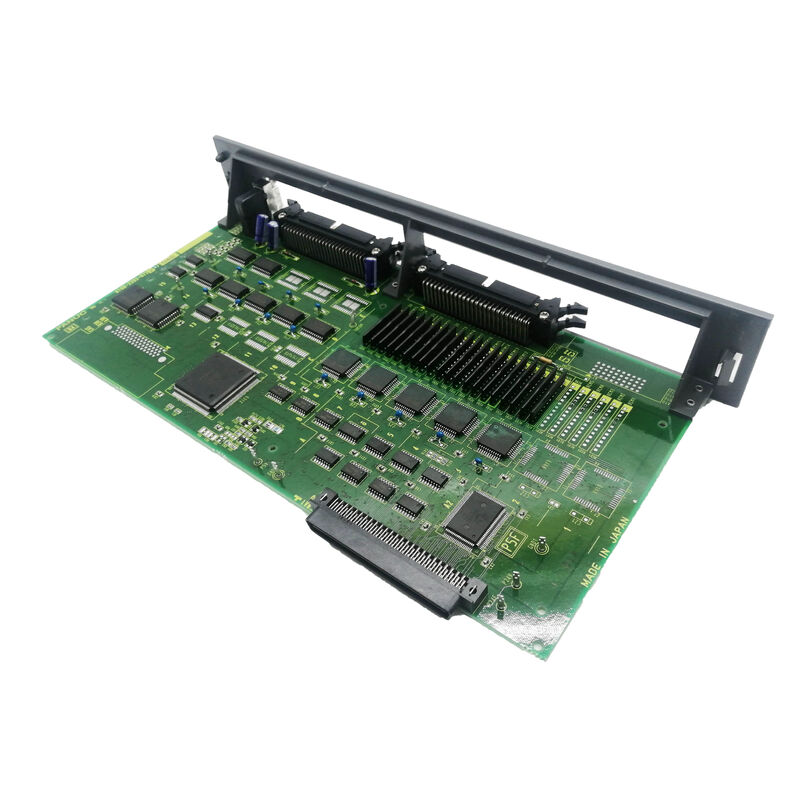
A16B-2200-0900 | FANUC Series 16-A Main CPU PCB — F-16M / F-16T / 4-Axis / CRT / MDI / RS-232 / First-Wave Series 16
Series 16-A — The First Wave of FANUC's Modern CNC
CNC Electronics confirms: "Fanuc A16B-2200-0900 main card. Part of the first wave of 16, 18, and 21 control systems. This MAIN CPU is one of many which make up the 16 Model A control series."
"First wave" is the key context. The Series 16-A was FANUC's first Model A generation of the Series 16 CNC — the initial production hardware, before the Model B revision that followed. These machines represented FANUC's CNC capability at the time of their introduction: compact multi-axis control in an integrated main board architecture.
The "A" in 16-A identifies the hardware generation — the first model of the Series 16 hardware platform, serving both F-16M machining centre and F-16T turning centre configurations from a single main CPU board.
Key Specifications
| Parameter | Value |
|---|
| Compatible | F-16M (Machining), F-16T (Turning) |
| Axis Count | 4 |
| Axis Interface | Type A or Type B |
| Spindle | 1 |
| Display | Basic CRT output |
| Keyboard | MDI interface |
| Communication | RS-232C channels |
| Feedback | 4 encoder inputs + 4 linear scale inputs |
| Weight | 2.40 lbs |
What the A16B-2200-0900 Does
CNC Electronics details the complete function set:
4-axis servo control: Drives up to 4 servo axes via Type A or Type B interface. Both interface types connect the main CPU to the servo amplifiers — Type A uses analogue velocity commands; Type B uses a serial digital interface (an early precursor to FSSB).
One spindle: Provides the spindle speed command and feedback interface for one spindle motor.
CRT display output: Generates the video signal for the CNC's CRT monitor — the operator's display screen for programme display, parameter entry, and diagnostics.
MDI keyboard: Manages the MDI keyboard for manual data entry — programme input, parameter changes, and manual jog operations.
RS-232C communication: Provides RS-232C serial channels for programme upload/download between the CNC and a PC, and for "drip feeding" (DNC operation where the programme is streamed from a PC while machining).
Linear scale feedback: Beyond the 4 servo motor encoders, the board supports 4 linear scale inputs — allowing position measurement directly from the machine's slides for closed-loop feedback independent of the motor encoder.
Application Scenarios
16-A CNC main board failure: A FANUC Series 16-A machining centre loses CNC function — no display, no axis control. The A16B-2200-0900 is identified as the main board fault. Replacement restores full F-16M CNC operation.
Core exchange maintenance: A production line running Series 16-A CNCs participates in MRO Electric's core exchange programme — A16B-2200-0900 boards are exchanged for refurbished units on a rolling maintenance schedule.
FAQ
Q1: What is the difference between F-16M (machining) and F-16T (turning) configurations on the same A16B-2200-0900 board?
The A16B-2200-0900 hardware is the same for both F-16M and F-16T. The distinction is in the CNC system software — the FROM modules loaded with machining centre software (G-code cycles for milling) versus turning centre software (G-code cycles for turning). The SMD modules and the base board hardware serve both configurations.
Q2: What does "Type A or Type B interface" mean for the 4 axes?
Type A is an analogue velocity command interface — the main CPU sends a ±10V analogue voltage representing the commanded speed to each axis drive amplifier. Type B is a serial digital interface — an early FANUC digital servo bus using a serial protocol. The specific interface type in a given machine is determined by the servo drives installed. Both are pre-FSSB (pre-fibre optic) interface technologies.
Q3: Is A16B-2200-0900 the same as A16B-2202-0860 (Series 18-B main CPU)?
No. A16B-2200-0900 is the Series 16-A main CPU — an older Model A hardware generation for the Series 16 platform. A16B-2202-0860 is the Series 18-B main CPU — the newer Model B generation for the Series 18 platform. Different hardware series (A16B-2200 vs A16B-2202), different CNC generations (Model A vs Model B), not interchangeable.
Q4: Does replacing A16B-2200-0900 require parameter reloading?
CNC parameters reside in SRAM modules. If the SRAM modules are intact and transferred to the replacement board, all parameters are preserved. If the SRAM data is lost, parameters must be restored from backup. Always backup all parameters before any main board maintenance.


 Your message must be between 20-3,000 characters!