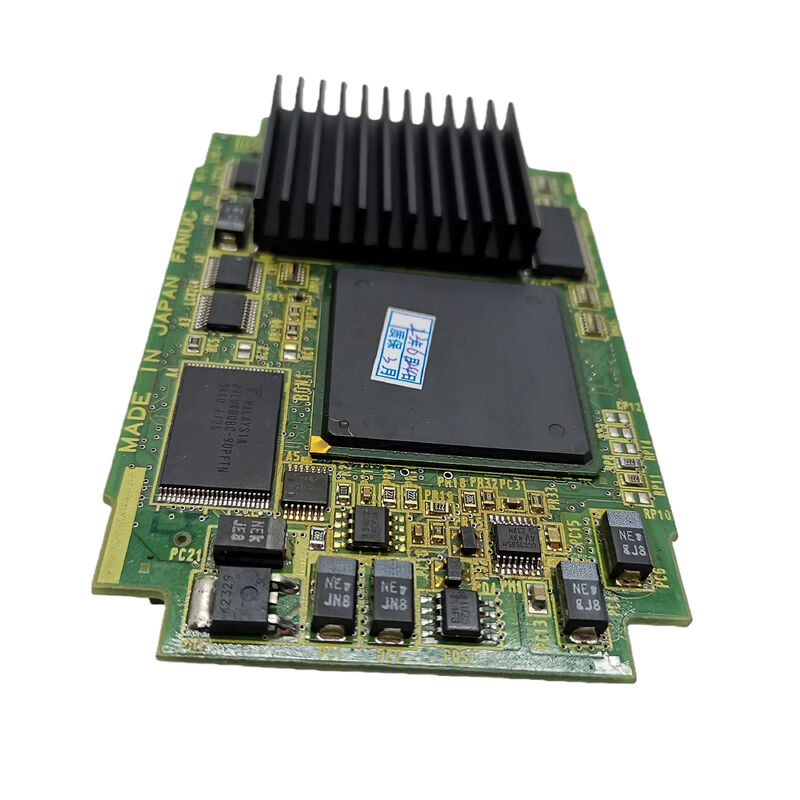
A20B-3300-0313 | FANUC F0i-C Pentium CPU Module — 32MB SDRAM / Series 0i-C CNC / Plug-In Processor Card / Machine Control and Logic
Series 0i-C — The Pentium Era CNC Platform
The FANUC Series 0i-C (F0i-C) is the third generation of the 0i CNC platform. The A20B-3300-0313's Intel Pentium processor marks a significant step from the 486DX2 class hardware of the earlier 0i-A generation:
Processing architecture: The Pentium introduces a superscalar pipeline capable of executing two instructions per clock cycle (versus the 486's single instruction per cycle). For
CNC tasks that are compute-bound — complex interpolation with multiple simultaneous axes, high look-ahead block count — the Pentium's throughput advantage translates to more programme blocks processed per millisecond.
Wider data path: The Pentium's 64-bit external data bus (versus the 486's 32-bit) doubles the memory bandwidth per clock cycle. For memory-intensive CNC operations — loading large programme blocks into the look-ahead buffer, handling the real-time parameter tables — higher bandwidth reduces the CPU's wait time on memory.
32MB SDRAM: The A20B-3300-0313 integrates 32MB of SDRAM directly on the CPU module. SDRAM (Synchronous DRAM) synchronises its operations with the system clock, eliminating the wait states of asynchronous DRAM. For a CNC running the full 0i-C software suite with advanced options active, 32MB provides the working space needed.
Key Specifications
| Parameter |
Value |
| Processor |
Intel Pentium class |
| Memory |
32MB SDRAM |
| CNC System |
FANUC Series 0i-C (F0i-C) |
| Board Type |
Plug-in CPU module |
| Series |
A20B-3300 |
| Official Desc. |
PCB - F0I-C CPU PENTIUM SDRAM 32MB |
Ethernet and Advanced Processing
The fanuc-controller.com description notes the A20B-3300-0313 is "engineered for use in FANUC CNC controllers (e.g., Series 21i with embedded Ethernet and advanced processing needs)." The Pentium processor and 32MB SDRAM capacity supports the 0i-C/21i generation's advanced features:
- Built-in Ethernet for DNC and data collection
- PC function for custom HMI applications
- Higher-density programme look-ahead for smoother high-speed contouring
- Advanced PMC functions
Application Scenarios
0i-C CNC CPU module failure: A Series 0i-C CNC develops a processor-level fault — alarms pointing to CPU card failure, CNC stalls partway through boot, or intermittent system resets. Replacing the A20B-3300-0313 CPU module restores the processing core without affecting any other module.
Planned CPU module replacement: A high-production machine with a long-running 0i-C CNC replaces the A20B-3300-0313 as part of a preventive maintenance schedule, resetting the CPU module's service life.
FAQ
Q1: Does the A20B-3300-0313 require the SDRAM to be configured or tested after installation?
The SDRAM is integrated directly onto the A20B-3300-0313 module — it requires no separate configuration or testing. On first power-up after fitting the replacement, the CNC's POST (Power-On Self Test) automatically tests the SDRAM as part of the startup sequence. Any SDRAM fault detected at this stage generates a system alarm before the CNC reaches normal operation.
Q2: How does A20B-3300-0313 compare to the A20B-3300-0475 (A3 type, 128MB DRAM)?
Both are plug-in CPU modules in the A20B-3300 series, but for different CNC generations:
- A20B-3300-0313: Pentium class, 32MB SDRAM, for Series 0i-C
- A20B-3300-0475: A3 type, 128MB DRAM, for newer platform (0i-D A3 configuration)
The 32MB SDRAM on 0313 versus 128MB on 0475 reflects the software footprint and processing requirements of their respective CNC generations. These modules are not interchangeable.
Q3: What should be checked when A20B-3300-0313 is suspected faulty?
Before replacing the CPU module: verify the main board slot's power supply rails are within specification (5V and 3.3V as applicable); confirm the FROM modules are properly seated and undamaged; check that the SRAM battery is healthy (a failed SRAM battery can produce symptoms that mimic CPU faults). If all external factors are confirmed correct and system alarms continue pointing to CPU-level faults, the A20B-3300-0313 replacement is appropriate.
Q4: Is the Pentium processor on A20B-3300-0313 a standard Intel consumer CPU or a FANUC-specific embedded variant?
The Pentium-class processor used in FANUC CNC modules is an embedded industrial version of the Intel Pentium architecture, selected for the extended temperature range, reliability specifications, and longevity availability requirements of industrial CNC applications. It is not the same device as a standard desktop PC Pentium, though it uses the same instruction set architecture.


 Your message must be between 20-3,000 characters!