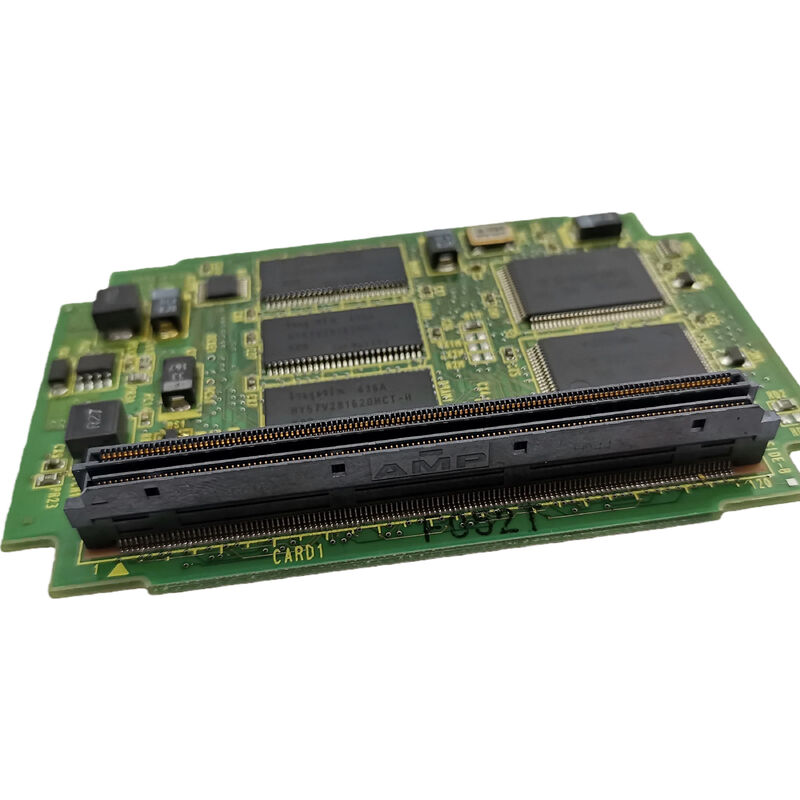
A20B-3300-0393 | FANUC 2-Axis FSSB Servo Control Card — Single-Channel / 2-Axis CNC Module / A20B-3300-039x Series
2-Axis FSSB — Compact Servo Control
The A20B-3300-0393 delivers 2-axis FSSB servo control in a single plug-in card. While the 8-axis (0390) and 6-axis (0391) variants in the same family address multi-axis machines and robot controllers, the 2-axis card serves applications where just two servo axes need FSSB-connected control.
Two axes is the fundamental minimum for CNC motion — and covers a significant portion of the CNC machine tool population:
Basic CNC lathes: The simplest CNC turning centre controls Z-axis (carriage traverse along the bed) and X-axis (cross-slide movement for diameter control). Exactly 2 axes. The A20B-3300-0393 covers this configuration completely with one card.
2-axis grinding machines: A surface grinder or cylindrical grinder with servo X and Z axes — no more — uses 2-axis servo control.
Auxiliary 2-axis positioners: In robot cells or FMS (Flexible Manufacturing Systems), 2-axis servo positioners handle workpiece orientation or transfer. The A20B-3300-0393 provides the FSSB servo interface for these peripheral servo units.
Servo upgrades from analogue to FSSB: Machines originally using analogue servo interface, when upgraded to FSSB-compatible drives, may use A20B-3300-0393 to provide the FSSB host interface for a 2-axis configuration.
Key Specifications
| Parameter | Value |
|---|
| Axes | 2 |
| FSSB Channels | 1 |
| Interface | FSSB (fibre optic) |
| Type | Servo control card |
| Series | A20B-3300 |
A20B-3300-039x Family — Axis Count Options
The 039x C5410A servo card family covers the full range of FSSB axis counts:
| Board | Axes | Application |
|---|
| A20B-3300-0390 | 8 | Series 16i-MB/TB/WB; R-J3iB |
| A20B-3300-0391 | 6 | 16i-B CNC; robot controllers |
| A20B-3300-0393 | 2 | 2-axis CNC and automation |
The 2-axis card is the compact end of this family — providing the essential FSSB servo interface for the most basic CNC axis configurations. Despite its smaller axis count, it uses the same FSSB technology and servo control architecture as the higher-axis-count siblings.
Application Scenarios
2-axis CNC lathe servo card fault: A CNC lathe's Z and X axes develop simultaneous FSSB communication alarms. The A20B-3300-0393 is identified as the fault. Replacement restores Z and X axis FSSB communication.
2-axis positioner servo interface: A robot cell's 2-axis servo positioner uses A20B-3300-0393 as the FSSB servo card for its positional drives.
FAQ
Q1: What happens if the FSSB daisy chain between the two drives is interrupted?
If the fibre cable between Drive 1 and Drive 2 is broken, the FSSB card can no longer communicate with Drive 2. Axis 2 will generate FSSB communication alarms. The integrity of both fibre connections — from the card to Drive 1, and from Drive 1 to Drive 2 — must be maintained for both axes to function.
Q2: Can A20B-3300-0393 drive more than 2 axes if additional drives are added to the FSSB chain?
No. The A20B-3300-0393 is configured for 2 axes only. The servo card's FSSB protocol configuration defines how many drives are addressed in each FSSB frame. Adding a third drive to the daisy chain will not be recognised — only 2 axes are served.
Q3: Does replacing A20B-3300-0393 require servo parameter re-entry?
No. Servo parameters for both axes reside in the CNC's main SRAM. After fitting the replacement, the CNC reloads parameters automatically. Verify servo response at low speed on both axes before resuming production.
Q4: Is the FSSB connection from A20B-3300-0393 identical to that from A20B-3300-0391 (6-axis)?
Both use the same FSSB physical interface — a fibre-optic connector connecting to the first drive in the daisy chain. The fibre cables and drive hardware are compatible across the 039x family. The difference is the number of drives the card's protocol is configured to address: 2 for A20B-3300-0393, 6 for A20B-3300-0391.
Q5: What servo drive amplifiers can A20B-3300-0393 connect to?
The A20B-3300-0393 connects to any FANUC servo amplifier with an FSSB input connector — including Alpha-i SVM1, SVM2, and SVM3 series (A06B-6096, A06B-6114) and βi-series drives with FSSB interface. The drive must support the FSSB protocol version compatible with the CNC system.


 Your message must be between 20-3,000 characters!