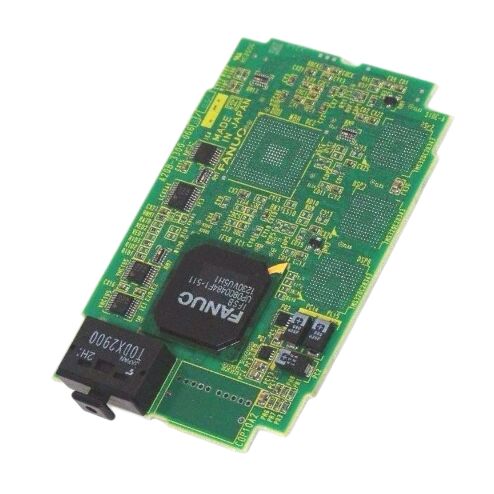
FANUC A20B-3300-0664 6-Axis Axis Control Card Auxiliary Board
Product Description
The FANUC A20B-3300-0664 is described as an Axis Control Card / Servo Module CPL Auxiliary Board for the R-30iB Mate Controller, with 6-axis application relevance.
This makes it a specialized board-level component for motion-related control architecture where axis coordination and servo-related system support are central to machine or robotic operation.
In industrial practice, axis control boards are highly application-sensitive.
They are closely related to coordinated movement, controller structure, and the interaction between the control platform and the servo side of the system.
Because of that, technical buyers do not usually search for this type of part through broad terms alone.
They search by exact FANUC number to maintain system alignment and reduce the risk of mismatched replacement in motion-control environments.
The A20B-3300-0664 is especially relevant in service workflows involving FANUC robotic or control platforms where the original R-30iB Mate controller structure must be supported without unnecessary redesign.
Even though the part is associated with discontinued manufacturer status in legacy descriptions, that does not reduce its importance in the field.
In fact, discontinued board-level parts often become more critical because installed systems remain active long after catalog status has changed.
Functional Context
This board is relevant to environments such as:
- R-30iB Mate controller service
- 6-axis control architecture support
- Servo-related auxiliary board replacement
- FANUC robotics and motion-control maintenance
- Spare-parts planning for installed controller systems
Technical Parameter Table
| Item |
Value |
| Brand |
FANUC |
| Part Number |
A20B-3300-0664 |
| Model Number |
A20B33000664 |
| Product Type |
Axis Control Card / Auxiliary Board |
| Board Category |
Servo Module CPL Auxiliary Board |
| Controller Compatibility |
R-30iB Mate Controller |
| Axis Capacity |
6-Axis |
| Application Field |
Robotics / Motion Control / Industrial Automation |
| Typical Use |
Replacement, Repair, Maintenance Spare |
| Product Status Note |
Discontinued by manufacturer |
FAQ
1. What kind of board is the A20B-3300-0664?
The A20B-3300-0664 is an axis control card described as a servo module CPL auxiliary board for the R-30iB Mate controller, with relevance to 6-axis applications.
In industrial terms, this places the board within a motion-control environment rather than a general-purpose control function.
It is the kind of component that technical buyers typically source when maintaining systems where coordinated axis behavior and controller-level integration are critical.
2. Why is this board important in a 6-axis control system?
In a 6-axis system, axis coordination is fundamental to machine or robotic performance.
A board associated with axis control can influence how motion-related functions are supported within the broader controller structure.
That makes it more sensitive than a simple support PCB.
In service work, this is why engineers prefer exact-number replacement: multi-axis systems depend on consistency in hardware role, controller relationship, and overall motion architecture.
3. What does “auxiliary board” mean in this context?
An auxiliary board in an industrial controller does not mean it is unimportant.
It usually means the board supports a specific subsystem or extends a dedicated function within the controller architecture.
In this case, because the board is tied to axis control and servo module context, its role should be understood as specialized support within the motion-control structure.
In practical maintenance terms, auxiliary boards often matter greatly because they sit in highly specific functional positions.
4. Does discontinued manufacturer status mean the board is no longer useful?
Not at all. In industrial automation and robotics, discontinued status often means the part is no longer in routine new production, but the installed equipment base may still be active for many years.
As long as the machine or controller remains in service, discontinued parts can remain highly valuable.
In fact, their importance may increase because they become essential for sustaining older but still productive systems without forcing a costly controller migration.
5. What should be verified before ordering the A20B-3300-0664?
A technical buyer should verify the exact part number, the controller platform, the board’s installed location, and whether the target system is indeed an R-30iB Mate configuration requiring 6-axis-related support.
It is also important to review the fault condition carefully, because motion-related issues can originate from connected hardware, servo-side problems, cabling, or controller-level interactions.
Good verification reduces unnecessary parts replacement and supports a more efficient repair strategy.


 Your message must be between 20-3,000 characters!