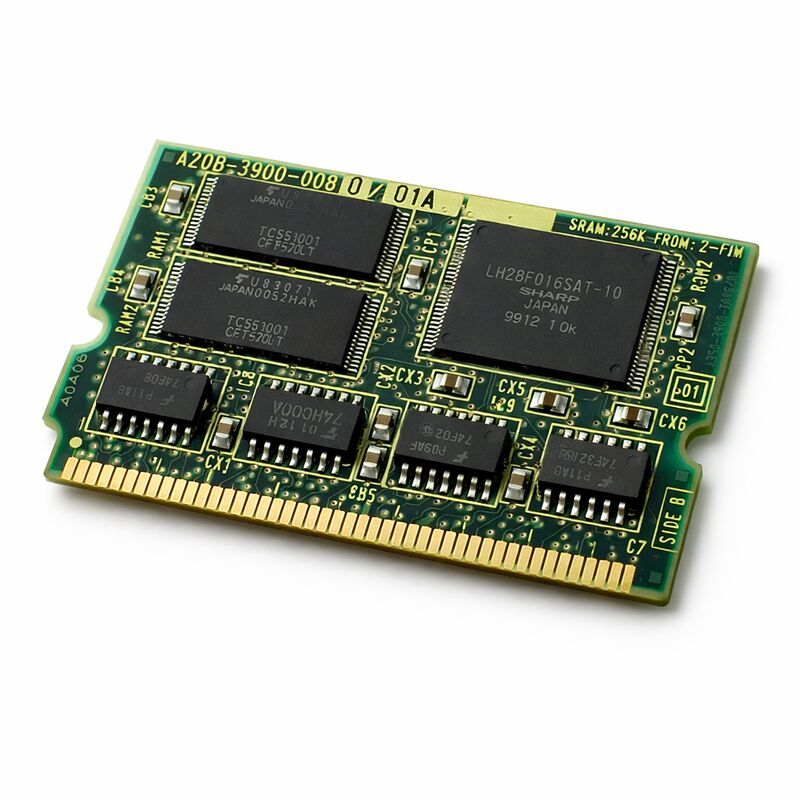
FANUC A20B-3900-0080 Memory Board 256K SRAM PCB
Product Overview
The FANUC A20B-3900-0080 is a memory board used in FANUC control and industrial electronic systems where stable memory handling is required at the PCB level.
Identified as a 256K SRAM memory board, this unit is typically selected by maintenance teams, CNC service providers, and automation spare-parts buyers who need a board-level replacement that matches existing hardware architecture.
In practical service work, memory boards are not treated as generic electronic parts.
They affect system retention, board communication behavior, and overall control reliability during startup, diagnostics, and routine operation.
That is why buyers usually look for the exact part number rather than only the board category. For applications involving FANUC legacy equipment, correct board identification is especially important because memory-related boards often need to align with the existing control platform, installed PCB stack, and maintenance history of the machine.
This part is suitable for users who are replacing a damaged board, restoring an older FANUC assembly, or securing maintenance stock for service support.
On industrial sites, this kind of PCB is commonly purchased not only for immediate failure response, but also to reduce downtime risk where production continuity matters more than the board price itself.
Key Features
- Designed as a FANUC memory board
- Identified with 256K SRAM configuration
- PCB-level replacement format for industrial control systems
- Suitable for maintenance, repair, and spare stock planning
- Useful for restoring or supporting legacy FANUC electronic assemblies
Typical Applications
The A20B-3900-0080 is commonly considered in environments such as:
- CNC machine control maintenance
- Industrial automation board repair
- Factory spare parts inventory
- Legacy FANUC system refurbishment
- Service replacement for memory-related PCB failures
Technical Parameter Table
| Item |
Value |
| Brand |
FANUC |
| Part Number |
A20B-3900-0080 |
| Model Number |
A20B39000080 |
| Product Type |
Memory Board |
| Board Category |
PCB |
| Memory Type |
SRAM |
| Memory Capacity |
256K |
| Application Field |
Industrial Control / CNC / Automation |
| Typical Use |
Replacement, Repair, Maintenance Spare |
Why This Part Matters in Industrial Maintenance
In industrial electronics, a memory board is rarely an isolated purchase. It is usually part of a wider troubleshooting process involving startup issues, system alarms, memory retention faults, control instability, or board replacement after age-related failure.
For maintenance engineers, the real value of a part like the A20B-3900-0080 is not only that it fits physically, but that it supports consistent recovery of the original control structure without forcing a larger retrofit project.
For older FANUC installations, keeping the original board family in service can be more practical than redesigning the cabinet or changing the controller.
This is one reason exact memory boards remain in demand across repair workshops and industrial spare-parts channels.
FAQ
1. What is the main function of the A20B-3900-0080 memory board?
The A20B-3900-0080 functions as a memory board within a FANUC electronic control environment. In industrial systems, a board of this type is generally associated with memory handling at the PCB level, which can influence data retention behavior, control board interaction, and system operating stability.
For maintenance personnel, the importance of such a board is not limited to simple storage capacity.
It also lies in whether the replacement matches the original electronic structure well enough to preserve the machine’s intended control behavior.
2. Is this board suitable for direct replacement in an existing FANUC system?
It can be suitable as a replacement when the installed machine or control assembly requires the exact same part number and board type.
In industrial service practice, engineers normally confirm the full part number, board family, mounting format, and related system compatibility before installation.
This is especially important for older FANUC platforms, where visually similar boards may still differ in memory specification, revision logic, or system role.
Exact matching is the safest approach.
3. Why do industrial buyers search for the exact part number instead of only “memory board”?
Because in CNC and automation maintenance, general category matching is usually not enough.
A “memory board” describes the function class, but not the board identity required by the machine. The exact part number helps reduce installation risk, troubleshooting time, and return issues.
For many repair teams, the correct FANUC code is what determines whether a part can be integrated into an existing board stack without introducing communication errors or startup problems.
4. Is a 256K SRAM board still useful in legacy industrial equipment?
Yes. In legacy industrial systems, older memory configurations are still operationally important because the entire machine architecture was designed around them.
Even when the memory capacity appears small by modern standards, the board may still be essential for preserving the intended control design.
In retrofit-sensitive environments, maintaining the original board class is often more efficient than modifying the entire control section to accept a newer alternative.
5. What should be checked before purchasing this board for repair stock?
A buyer should verify the full part number, model marking on the existing board, the machine’s control series, and whether the board is being used for immediate replacement or long-term spare stock.
It is also good practice to inspect the original board location, connector arrangement, and service history of the machine.
In industrial maintenance, a board may fail because of age, electrical stress, cabinet conditions, or related upstream faults, so confirming the surrounding conditions can help avoid repeated replacement cycles.


 Your message must be between 20-3,000 characters!