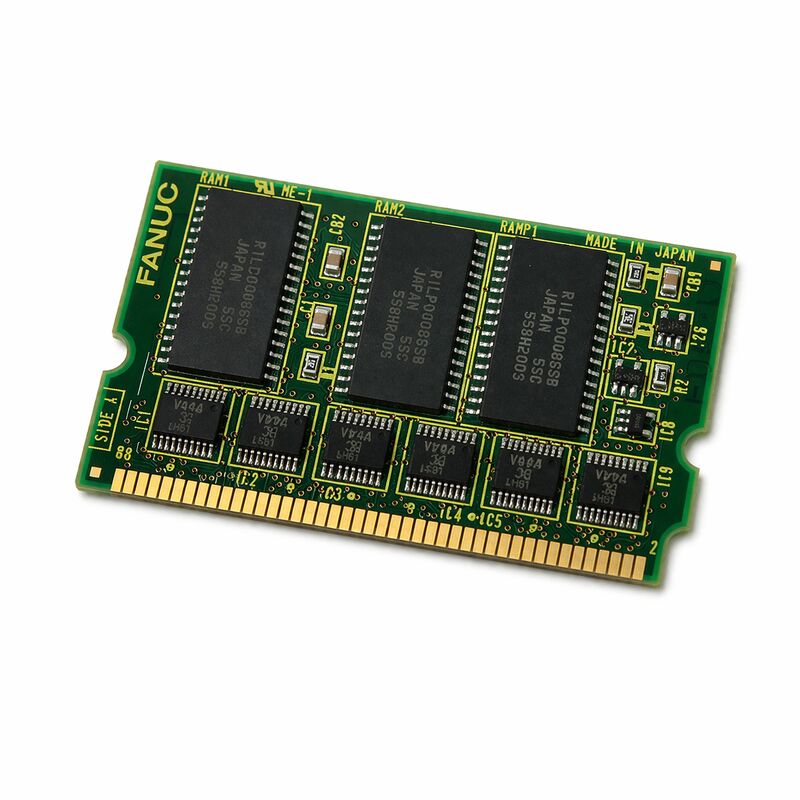
FANUC A20B-3900-0140
Robotics Control Memory Module with Dual-Sided Chipset
Product Overview
The FANUC A20B-3900-0140 is commonly sold as a memory module for robotics control, and listings also describe it as using a dual-sided chipset.
Some replacement-part listings further identify it as a 12MB FROM / 1MB SRAM module, which gives the part a clearer internal memory profile for service and replacement use.
For an industrial product page, the safest and clearest positioning is to treat A20B-3900-0140 as a robotics-control memory board rather than as a general PCB.
That wording matches the way it appears in replacement channels and helps buyers understand that it belongs to the controller memory side of a robotics platform, not to motion power hardware or front-end user interface electronics.
Parameter Table
| Parameter |
Value |
| Part Number |
A20B-3900-0140 |
| Brand |
FANUC |
| Product Type |
Memory Module / Memory Board |
| Application Context |
Robotics control |
| Chipset Style |
Dual-sided chipset |
| Commonly Listed Memory Profile |
12MB FROM / 1MB SRAM |
| Product Family |
A20B-3900 series |
| Typical Use |
Robotics memory replacement |
Product Value in Service Work
A module like A20B-3900-0140 is valuable because robotics control hardware often remains mechanically and electrically serviceable long after installation, while the internal memory board may still need replacement.
In those cases, the correct memory module can help preserve the original control structure instead of forcing a broader retrofit.
That makes this board a practical choice for repair departments, robot-control support, and spare-parts planning in facilities that continue to rely on FANUC robotics hardware.
This usage framing is an engineering inference supported by the board being sold as a robotics-control memory module.
FAQ
Q1: What kind of part is A20B-3900-0140?
It is commonly identified as a robotics-control memory module, and listings also describe it as a memory board with a dual-sided chipset.
Some sellers further identify it as a 12MB FROM / 1MB SRAM module, which helps define its role more precisely.
Q2: Why is the dual-sided chipset detail important?
It helps distinguish the board physically and functionally from simpler single-sided memory boards.
In practice, that means technicians and buyers can use both the part number and board construction details to confirm that they are dealing with the correct module during repair or replacement.
This is an engineering inference supported by listings that explicitly mention the dual-sided chipset.
Q3: Is this mainly a robotics spare rather than a standard CNC memory board?
Yes. The most consistent category wording around this model is robotics control, which makes it more appropriate to describe as a robotics memory module than as a generic CNC board.
That distinction is useful for search visibility and for buyer clarity.
Q4: What should a technician verify before replacing this module?
The technician should confirm the exact part number, compare the installed board structure with the replacement, and verify that the fault is truly in the memory section rather than elsewhere in the robot control.
Because listings describe the part as a memory board, it should be approached as a configuration-sensitive internal board rather than a plug-and-run accessory.
The replacement workflow here is standard engineering practice grounded in the board’s listed role.
Q5: Why is exact matching important for A20B-3900-0140?
Because memory boards in the same family can differ in memory profile, application context, and board construction.
Matching A20B-3900-0140 exactly is the safer way to preserve compatibility in robotics control service work.


 Your message must be between 20-3,000 characters!