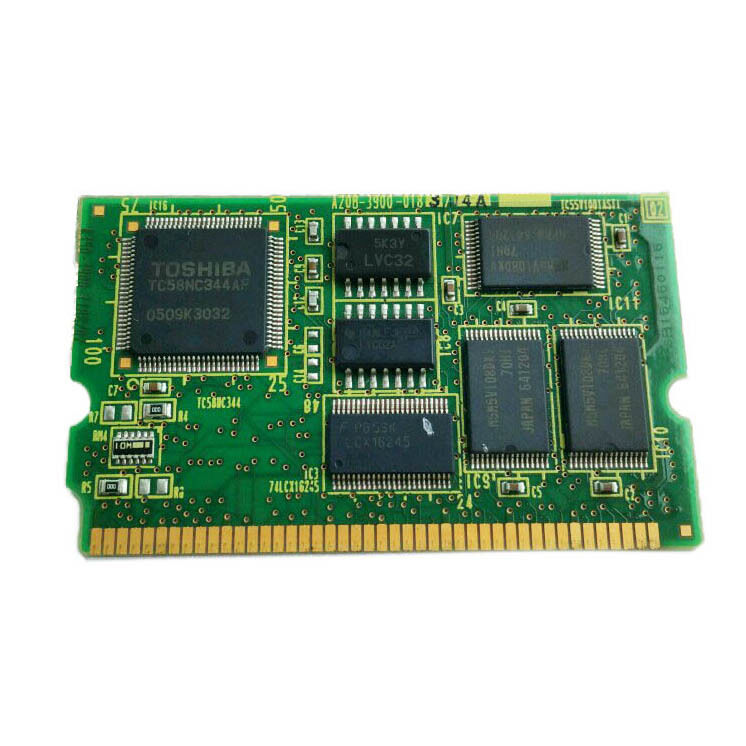
FANUC A20B-3900-0181 16MB FROM / 512KB SRAM Module
Product Description
The FANUC A20B-3900-0181 is best framed as a 16MB FROM / 512KB SRAM module within the A20B-3900 family. Multiple parts listings align on this memory description, while broader catalog pages also place the part in the PCB category.
For product-page writing, the strongest structure is to lead with the memory-module identity and use PCB as the board classification underneath it.
Compared with a generic “control board” label, this description is much more useful to maintenance buyers. Memory size and module type are often the quickest way to distinguish one board from another in the same family, especially when the installed part is being matched from a cabinet, spare stock shelf, or repair intake sheet.
That makes A20B-3900-0181 a good candidate for listings aimed at exact-number replacement and catalog search visibility.
This kind of page should stay disciplined.
The memory-module wording already gives the listing strong technical identity, so there is no need to overbuild the description with unsupported controller claims.
A cleaner page usually performs better for industrial buyers because it reads like real parts information rather than generic marketing copy.
Technical Parameter Table
| Item |
Value |
| Brand |
FANUC |
| Part Number |
A20B-3900-0181 |
| Model Number |
A20B39000181 |
| Product Type |
PCB |
| Module Class |
FROM / SRAM Module |
| FROM Capacity |
16MB |
| SRAM Capacity |
512KB |
| Product Series |
A20B-3900 |
| Typical Use |
Board-level replacement |
Application
The FANUC A20B-3900-0181 is commonly used in board-level maintenance and replacement scenarios where a 16MB FROM / 512KB SRAM memory module is required. It is suitable for FANUC CNC control system service, memory module replacement, repair stock preparation, and long-life equipment support. This module is often associated with FANUC i Series control environments and is typically selected by exact part number for maintenance-focused sourcing.
FAQ
1. What is the clearest way to describe A20B-3900-0181?
The clearest description is 16MB FROM / 512KB SRAM module. That wording gives the part a precise identity and is more useful than calling it only a generic PCB.
For industrial buyers, the memory configuration is often the most helpful line on the page.
2. Why should the memory capacities be shown in the title?
Because the capacities help distinguish this part from nearby models in the same family. In practice, buyers often compare part numbers alongside memory configuration when validating a replacement, so including both values improves the clarity of the listing.
3. Is it better to list this as a module or as a PCB?
Both can be used, but they should not carry the same weight. “Module” is the stronger functional description here, while “PCB” works as the board-level category.
This combination gives the page both technical clarity and catalog consistency.
4. Should the page add more controller-level detail?
Only when you have a precise source for that extra detail. As written here, the page already contains the most useful model-specific information: part number, board category, and memory-module configuration.
That is enough for a clean, reliable product listing.
5. What kind of buyer will find this page useful?
It is most useful for repair teams, parts resellers, and maintenance buyers who identify boards by exact number and module type.
The listing is strongest when it focuses on those search habits instead of trying to sound like a broad marketing page.


 Your message must be between 20-3,000 characters!