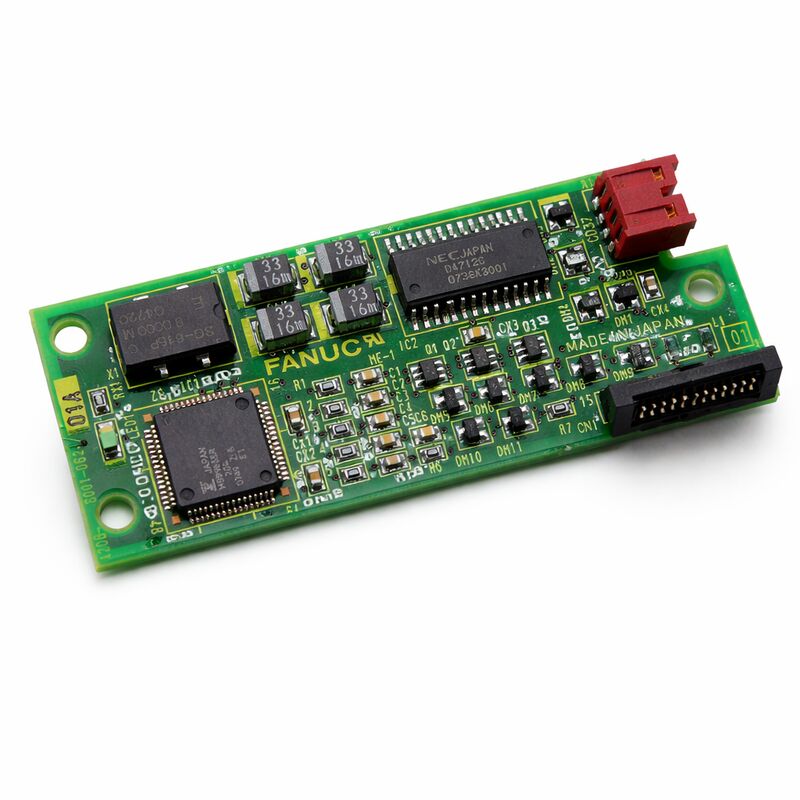
FANUC A20B-8001-0620 Touch Panel Control PCB
Product Description
The FANUC A20B-8001-0620 is a Touch Panel Control PCB developed for industrial electronic systems that require responsive operator interaction and dependable control at the board level.
In service and replacement scenarios, this type of board is typically selected when a control interface assembly must retain stable touch-related functionality without unnecessary changes to the existing system layout.
In industrial automation, touch panel control boards are more than simple interface components.
They sit close to the point where operator input meets machine response.
That means their condition can affect not only interface usability, but also the overall reliability of human-machine interaction within the equipment.
When a machine depends on consistent screen response, stable command input, and predictable control behavior, a correctly matched board becomes important.
The A20B-8001-0620 is therefore relevant to maintenance teams, repair specialists, and spare-parts buyers supporting FANUC-based equipment.
It is especially useful in service environments where restoring original control behavior is preferred over making broad hardware changes.
For older systems still in operation, an exact replacement part often helps reduce commissioning uncertainty and keeps maintenance work aligned with the original control architecture.
Application Perspective
This PCB is commonly considered for:
- Touch interface control repair
- FANUC operator panel service
- Industrial control board replacement
- CNC and automation maintenance support
- Spare stock planning for installed equipment
Technical Parameter Table
| Item |
Value |
| Brand |
FANUC |
| Part Number |
A20B-8001-0620 |
| Model Number |
A20B80010620 |
| Product Type |
Touch Panel Control PCB |
| Board Category |
Industrial Control PCB |
| Function Class |
Touch Interface Control |
| Application Field |
CNC / Automation / Industrial Electronics |
| Typical Use |
Replacement, Repair, Maintenance Spare |
| Service Role |
Board-Level Operator Interface Support |
FAQ
1. What is the main role of the A20B-8001-0620 in an industrial system?
The A20B-8001-0620 serves as a touch panel control PCB, meaning it is associated with the control path between operator touch input and the machine’s interface-level response.
In practical industrial use, boards of this type support stable interaction on equipment where the operator panel is an important part of everyday operation.
This makes the board relevant not only from an electronic standpoint, but also from an operational one, because interface reliability directly affects usability, fault handling, and service efficiency.
2. Is this board only important when the touch screen completely stops working?
No. In many industrial cases, interface boards show performance issues before complete failure occurs.
A machine may still run, but the operator can experience delayed response, inconsistent touch recognition, unstable navigation, or reduced usability under production conditions.
Those symptoms can slow down operations and complicate troubleshooting.
That is why maintenance teams often view interface control PCBs as important service parts even before a total shutdown happens.
3. Why is exact part-number matching important for a touch panel control PCB?
Because interface boards are typically integrated into a specific hardware structure and control environment.
Even when another PCB appears similar, the system relationship may not be the same.
Differences in board assignment, control logic, connector layout, or machine interface design can affect usability and service results.
In practice, using the exact A20B-8001-0620 reference helps reduce compatibility risk and supports a more predictable repair process.
4. Is this part suitable for legacy FANUC systems still in operation?
Yes. In many industrial facilities, older FANUC-controlled machines remain productive and continue to justify maintenance investment.
Replacing a failed or degraded interface control PCB with the correct board can be a practical alternative to broader retrofitting.
For operations that prioritize uptime and controlled maintenance cost, keeping the original board family in service is often a more efficient strategy than redesigning the operator interface section.
5. What should be checked before ordering this board for replacement?
A technician or buyer should confirm the exact board number on the installed unit, review the machine’s interface symptoms, and verify that the problem originates from the board rather than from the panel assembly, cabling, power conditions, or surrounding control hardware.
In industrial service work, accurate diagnosis matters because interface faults can sometimes be caused by related components. Good verification improves replacement accuracy and helps avoid repeat maintenance cycles.


 Your message must be between 20-3,000 characters!