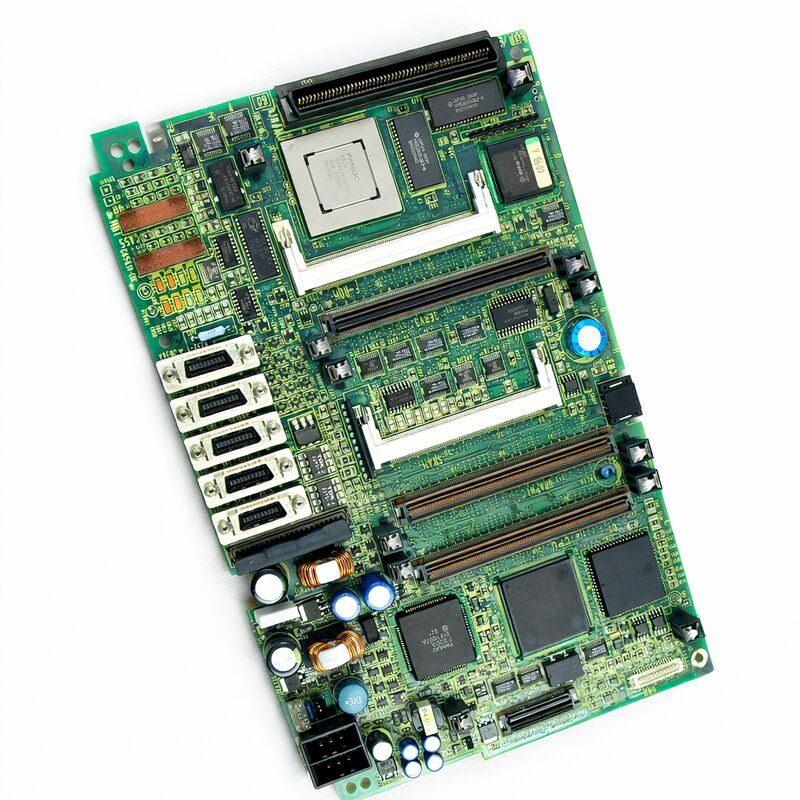
FANUC A20B-8100-0131 16i-A LCD Mounted Main PCB for FANUC Control Systems
Main Description
The FANUC A20B-8100-0131 is described as a 16i-A LCD mounted main PCB, a board intended for equipment applications where the display section and main PCB integration are part of the original control design.
As a product in the A20B-8100 series, it is associated with system compatibility, structured installation, and use within FANUC hardware environments that rely on dedicated mounted board assemblies.
This type of board is especially important in control systems where the LCD interface is not handled by a completely separate display unit, but by a more integrated mounted-board arrangement.
In these cases, the main PCB and display-side structure work together closely, and replacing the correct part becomes critical for restoring system usability, screen-related functionality, and reliable interface behavior.
From a service perspective, the A20B-8100-0131 is not simply a generic main board.
It is a model-specific replacement component used where the machine depends on the original LCD-mounted architecture.
That makes it valuable in repair work involving damaged screen assemblies, interface-side faults, or aging control hardware where the machine is still worth maintaining.
Parameter information
| Parameter |
Data to Show |
| Part Number |
A20B-8100-0131 |
| Product Name |
16i-A LCD Mounted Main PCB |
| Series |
A20B-8100 |
| Board Role |
Main PCB |
| Installation Style |
LCD-mounted type |
| Official Manual Data |
Public FANUC manual page not directly verified in this pass |
| Recommended Page Note |
Verify against machine BOM / FANUC parts list before publishing extra specs |
Functional Character
Board identity: LCD mounted main PCB
Series: A20B-8100
System relevance: 16i-A control-related applications
Typical purpose: Repair, replacement, maintenance support
A board in this category generally matters because it sits at the intersection of display mounting and main-board functionality.
That creates a more application-specific role than a basic support PCB, and it is one reason correct model selection is essential.
Service Value in the Field
In industrial environments, integrated LCD-mounted boards are often replaced when the system has suffered physical display-area damage, board aging, or control-side screen instability. A properly matched replacement helps preserve the original hardware layout and reduces the need for broader interface modification.
For maintenance teams, that means faster restoration and lower risk during installation.
FAQ
Q1: What does “LCD mounted main PCB” mean in practical terms?
It means the board is part of a design where the display section and main board structure are closely integrated.
In industrial terms, this kind of board does more than provide one isolated function; it supports the broader interface and control arrangement associated with the mounted LCD assembly.
That is why it is treated as a specific replacement part rather than a general board substitute.
Q2: Why is the A20B-8100-0131 considered important in equipment repair?
Because when an integrated LCD-mounted main board fails, the issue can affect not only display usability but also the broader control-side interface behavior.
In real service work, replacing the correct board often restores the original assembly more effectively than attempting to adapt unrelated parts or modify the screen structure.
Q3: What kinds of faults may lead technicians to inspect this board?
Possible triggers include persistent display-side malfunction, unstable interface behavior, screen-related startup issues, physical damage in the mounted display area, or unresolved problems after checking cables and surrounding display components.
The board becomes a likely service target when the fault appears tied to the integrated LCD/main-board structure itself.
Q4: What should be reviewed before replacing a mounted main PCB?
Technicians should confirm the exact part number, inspect connectors and display-area mounting points, check for visible damage or thermal stress, and verify that the problem is not caused by a simpler external issue such as cable failure or power irregularity.
In control-system service, proper diagnosis before replacement is essential because integrated boards can be affected by faults elsewhere in the assembly.
Q5: Why is compatibility especially important for this kind of board?
Compatibility is critical because integrated boards are closely tied to the original system layout, LCD structure, and control family.
A board that appears similar may still differ in mounting scheme, signal routing, or application scope.
Using the correct A20B-8100-0131 model helps protect installation fit, operational stability, and long-term service reliability.


 Your message must be between 20-3,000 characters!