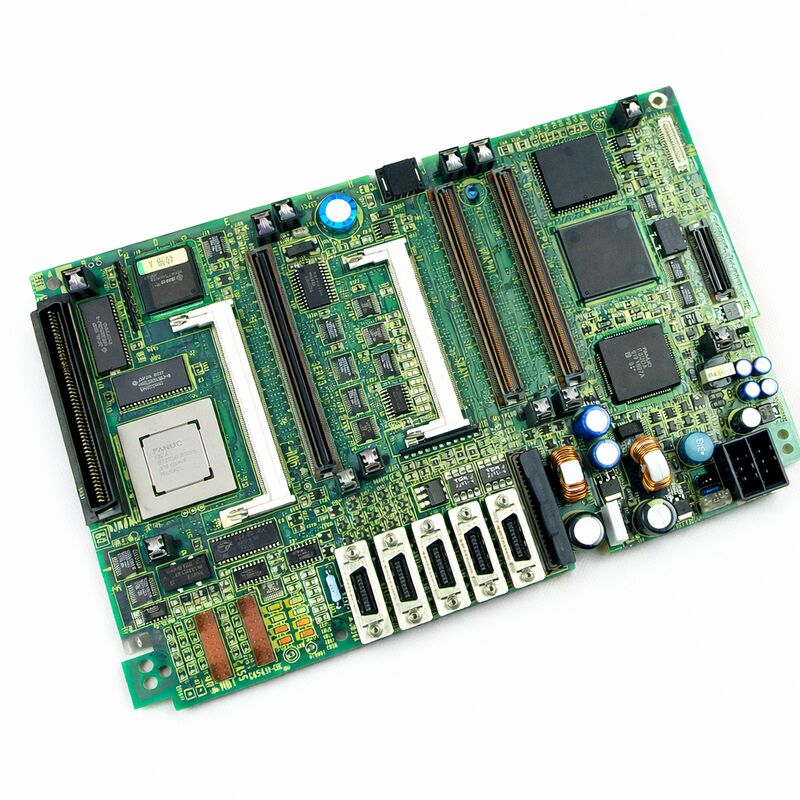
FANUC A20B-8100-0135 18i-A LCD Mounted Master Board for FANUC CNC Systems
Product Snapshot
The FANUC A20B-8100-0135 is an 18i-A LCD mounted master board used in FANUC CNC control architecture.
As a main-board level PCB, it sits at the center of system communication and board-level coordination, making it a critical replacement part when the original control hardware must be preserved rather than redesigned. Public listings consistently identify this model as a main PCB or master board for the 18i-A platform.
In service practice, a board like this is rarely treated as a generic electronic spare.
It is normally sourced for fault replacement, overhaul projects, or long-term maintenance support on installed machines that still depend on the original FANUC 18i-A structure.
For many workshops, the practical advantage is straightforward: replacing the correct master board is usually faster and less risky than attempting an adaptation around a mismatched PCB.
Parameter Table
| Parameter |
Value |
| Part Number |
A20B-8100-0135 |
| Manufacturer |
FANUC |
| Type |
PCB |
| Model Number |
A20B81000135 |
| Range |
PC Board |
| Category |
Main |
| Description |
181 / 181-A Master board |
| Board Role |
Master board / Main PCB |
| Mounting Style |
LCD mounted |
| Typical CNC Family |
18i-A |
Why This Board Matters
A master board has a broader responsibility than a narrow-function daughter card. It supports the main control framework, where data exchange, internal board communication, and system-level logic must remain stable under continuous machine operation.
That is why technicians usually treat failure at this level as a serious but highly specific repair event: the correct replacement board can restore the original control path without changing the rest of the system architecture.
FAQ
Q1: What is the practical function of the A20B-8100-0135 inside a CNC system?
The A20B-8100-0135 is used as a master board or main PCB in an 18i-A control configuration. In practical terms, that places it at the heart of the control assembly, where multiple internal functions depend on stable board-level communication.
When a board in this position becomes unreliable, the machine can show wide-ranging symptoms because the fault affects the central hardware layer rather than one isolated option.
Q2: Why is exact model matching especially important for a master board?
Because a master board is tied closely to the original control family, hardware structure, and installed system layout.
A board that looks physically similar may still differ in application, installed firmware environment, or supported configuration.
In industrial repair, exact matching helps reduce startup faults, communication problems, and avoidable commissioning delays.
Q3: Is this board mainly used in new machine projects or in maintenance work?
In most cases it is far more relevant to maintenance, retrofit support, and board-level replacement than to new machine construction.
Machines built around FANUC 18i-A controls often remain productive for many years, so the correct main board continues to have value long after the original installation.
Q4: What should technicians inspect before replacing this board?
They should confirm the exact part number, inspect connectors and mounting points, check cabinet cleanliness and cooling, and verify that the issue is not coming from a related power, cable, or option-board fault.
A master board replacement should be part of a controlled diagnostic process, because central-board failures can sometimes be accompanied by secondary symptoms elsewhere in the cabinet.
Q5: Why do industrial buyers keep boards like A20B-8100-0135 in spare inventory?
Because downtime linked to a failed main board can stop the machine completely.
Keeping the correct board on hand shortens recovery time and helps preserve the original control architecture.
For users operating legacy FANUC systems, that is often more economical than a broader control retrofit.


 Your message must be between 20-3,000 characters!