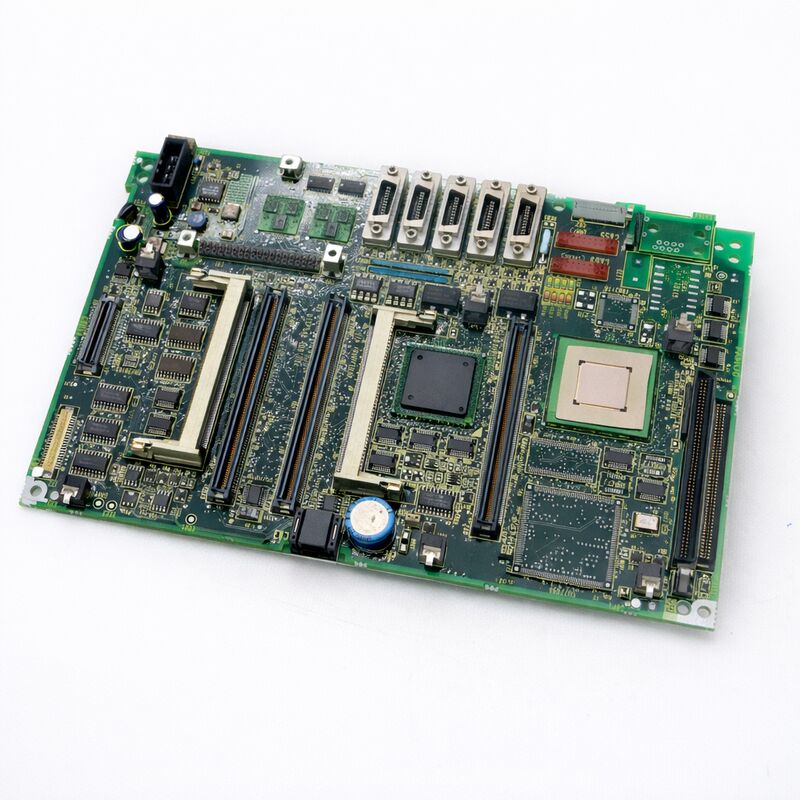
FANUC A20B-8101-0285 | Series 0i-C Mate Main PCB — A20B-8101 Integrated CNC Master Board, FSSB Servo Interface, Japan Origin
Overview
The FANUC A20B-8101-0285 is the main PCB for the FANUC Series 0i-C Mate — the first generation of the 0i-Mate platform to use FSSB (Fibre-optic Serial Servo Bus) communication as standard, bringing digital high-speed servo loop closure to a compact, value-oriented CNC package.
The "Mate" designation carried a specific meaning within FANUC's product hierarchy: it identified the entry-level configuration of a given CNC generation, delivered at a lower system cost than the full-featured variant, with limits on the maximum axis count and available option set that matched the needs of compact machine tools without over-specifying the controller.
The 0i-C generation — both the full 0i-C and the 0i-Mate-C — appeared around 2003 as FANUC's response to the need for improved servo performance and digital bus connectivity in the mid-range CNC market.
The 0i-B before it had established the platform; the 0i-C refined it with better FSSB implementation and updated servo software that improved following error performance and high-speed contour accuracy.
For machine tool builders of compact CNC lathes and 3-axis machining centres, the 0i-C Mate with the A20B-8101-0285 main board offered a compelling package: a proven FANUC control platform, FSSB-based servo drives, and a sufficiently capable PMC for typical machine function control — at a price point that kept the finished machine competitive.
The 7-inch monochrome screen is diagnostic of the 0i-Mate-C's era. This was the standard operator interface for the Mate version throughout the 0i-C generation — clear, functional, and familiar to the machinists who worked on 0i-series machines.
It wasn't until the 0i-D generation that colour LCD became available on the Mate platform, and the 7-inch monochrome display remains one of the recognisable identifiers of 0i-Mate-C-equipped machines in the field.
Key Specifications
| Parameter |
Value |
| CNC Series |
0i-C Mate (0i-Mate-C) |
| Max Axes (Machining/Milling) |
3 controlled axes (0i-Mate-MC) |
| Max Axes (Lathe) |
2 controlled axes (0i-Mate-TC) |
| Servo Interface |
FSSB (Fibre-optic Serial Servo Bus) |
| Standard Display |
7-inch monochrome LCD |
| Architecture |
High-integration single main board |
| Series |
A20B-8101 |
| Status |
Available — refurbished, tested |
| Origin |
Japan |
0i-Mate-C in the Machine Tool Ecosystem — Where It Was Used
The 0i-C Mate found its strongest adoption in the compact CNC lathe segment — machines producing turned components for automotive subassemblies, fasteners, hydraulic fittings, electrical connectors, and similar precision parts in high volumes.
For these machines, the 0i-Mate-TC's 2-axis (X and Z) configuration with spindle control was exactly what was needed.
The PMC had enough I/O capacity and ladder complexity to handle a normal CNC lathe's auxiliary functions — bar feeder interface, coolant control, tailstock, chuck pressure monitoring, and chip conveyor — without requiring the expanded capacity of the full 0i-TC.
The 0i-Mate-MC served 3-axis vertical machining centres at the lower end of the market — machines with a table travel in the 400–600mm range, suitable for prototype work, short-run production, and educational applications.
For these machines, 3-axis simultaneous interpolation with a FANUC-grade servo system was the primary requirement, and the Mate's limitation to 3 axes was not a constraint.
What the 0i-Mate-C did not offer that the full 0i-C provided: axis count beyond 3 (ruling out 4th-axis rotary table integration without creative workarounds), expanded PMC ladder capacity, high-speed skip and other advanced options, and the colour display.
For machines where these capabilities were needed, the full 0i-C was the appropriate choice.
Data Backup — Essential Before Any Board Replacement
The A20B-8101-0285 carries the machine's operational data in its integrated FROM and SRAM memory areas. Before removing the board for replacement, a complete backup of the following data is mandatory: all CNC parameters (over 1000 individual settings defining axis travel limits, servo gains, programme check limits, interpolation behaviour, and every other CNC function), all part programmes stored in CNC memory, the PMC ladder programme and PMC parameters, macro library if present, and tool offset and work coordinate data.
On the 0i-Mate-C, the I/O media for backup depends on what the machine has available: memory card (PCMCIA in this generation), RS-232C serial connection, or in some configurations an I/O link connection.
The 7-inch monochrome display's limited screen space makes the backup menus slightly more navigation-intensive than later colour-screen CNCs, but the procedure is well-documented in the 0i-Mate-C maintenance manual.
After installing the replacement board and loading all backup data, the machine must go through a home return cycle and the axis accuracy should be verified with a test cut or gauge measurement before the machine is returned to production.
LED Diagnostic Array — Reading the Board's Boot Status
The A20B-8101-0285 board, like most FANUC main boards, has a series of indicator LEDs on its face that display the boot progress and any fault that occurs during initialisation.
These LEDs cycle through a defined sequence as the CPU executes its self-test: power supply check, ROM checksum, SRAM test, servo system initialisation attempt, and so on.
A failure at any stage causes the LED sequence to stop at a specific pattern.
The LED patterns and their meanings are documented in the 0i-Mate-C maintenance manual. For maintenance engineers dealing with a machine that won't complete boot, reading the LED state at the moment of failure is the first diagnostic step — it narrows the fault to a specific subsystem and helps determine whether the main board has failed or whether an external problem (SRAM battery depletion, FSSB cable fault, servo amplifier failure) is preventing normal boot completion.
FAQ
Q1: After replacing the A20B-8101-0285 and loading all backup data, axes don't move and the CNC shows "SV-417 Analog output error". What is this?
SV-417 typically indicates an issue with the FSSB link or the servo amplifier initialisation. After main board replacement, the FSSB cable connection should be inspected — confirm the fibre-optic cable is properly seated in the main board's FSSB connector and at the servo amplifier end.
Also check that the FSSB axis assignment parameters were correctly restored from backup.
If the FSSB cannot establish communication, all servo axes will show readiness errors.
If the fibre cable and parameters are confirmed correct, power the servo amplifiers independently (if possible) to check their LED status.
Q2: The 0i-Mate-C display shows "B-64305EN" or similar manual text during a specific screen. Is this normal?
FANUC CNC displays occasionally show internal reference strings or software version text during diagnostic or setup screens. This is normal firmware behaviour and does not indicate a board fault.
The primary indicators of display or board issues are: the display not lighting at all, the display showing garbled characters across all screens (not just a diagnostic message), or the machine's normal operational screens being inaccessible.
If only one or a few screens show unexpected text while normal operation otherwise continues, this is typically a parameter configuration item rather than a hardware fault.
Q3: The machine's CNC serial number (machine ID) is stored on the main board. Is this recoverable after board replacement?
The CNC serial number and system software identification are stored in the board's FROM area and are part of the normal backup/restore procedure. If the original board's data was backed up before failure and the restore is complete, the CNC serial number as stored in the controller memory will be restored.
However, the physical serial number label on the original board cannot be transferred to the replacement board.
If the CNC serial number is used for option registration tracking or maintenance records, update those records to reflect the new board's physical serial number and note that the functional CNC serial number in software has been restored from backup.
Q4: The 0i-Mate-C machine has only 2 servo axes (lathe configuration). The replacement A20B-8101-0285 shows correct parameter settings but one axis doesn't respond. What should be checked?
On the 0i-Mate-TC, the two servo axes (X and Z) connect to the servo amplifiers through the FSSB chain. If one axis is unresponsive after board replacement with correct parameters, verify the FSSB axis assignment — the parameter that defines which FSSB position corresponds to which CNC axis.
If the FSSB assignment doesn't match the physical amplifier chain order, the CNC commands one axis but the other amplifier responds.
Also verify that the encoder cable for the unresponsive axis is correctly connected — a disconnected encoder cable prevents that axis from initialising even if the FSSB command link is working.
Q5: Is the A20B-8101-0285 cross-compatible with the full 0i-C main board (non-Mate), and can it extend a Mate machine to 4 axes?
No. The 0i-Mate-C and full 0i-C use different main boards with different software configurations.
The A20B-8101-0285 is the Mate-specific board and its integrated software supports the Mate's maximum axis count.
Adding a 4th axis to a 0i-Mate-C machine would require replacing the entire CNC system with a full 0i-C configuration — different main board, different software registration, and potentially different servo hardware.
This is not a simple board swap and represents a CNC system upgrade project rather than a maintenance replacement.


 Your message must be between 20-3,000 characters!