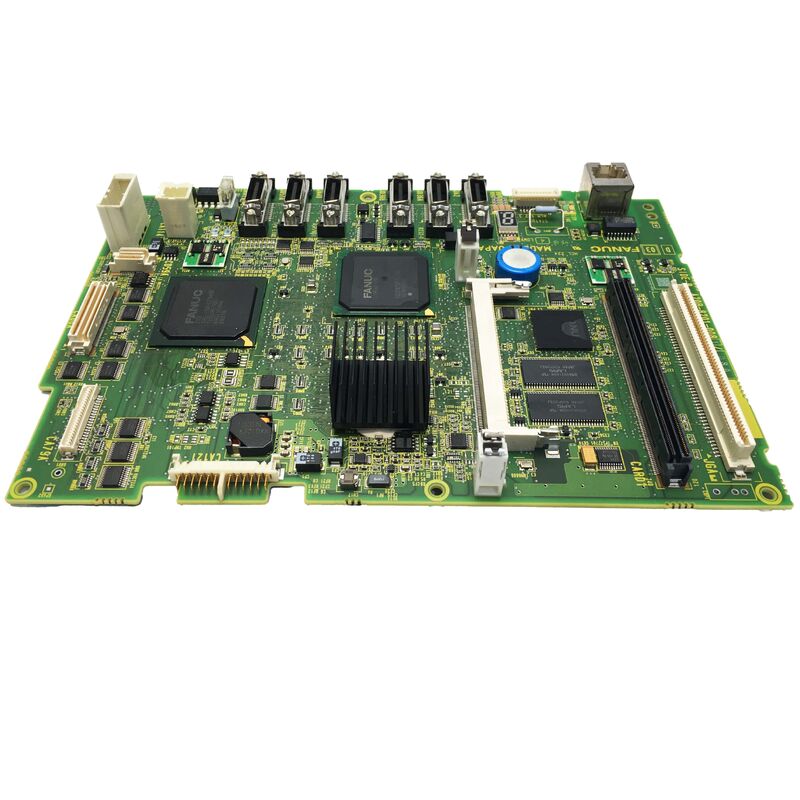
FANUC A20B-8201-0081 | Series 0i-D Main PCB — A20B-8201 High-Integration CNC Master Board, FSSB Servo Interface, Japan Origin
Overview
The FANUC A20B-8201-0081 is the main printed circuit board for the FANUC Series 0i-D — the CNC generation that FANUC introduced to bring digital servo control, high-speed block processing, and enhanced interpolation capabilities to the mid-range and compact machine tool market.
The 0i-D represented a generation step over the 0i-C, bringing improvements in FSSB servo communication bandwidth, faster block processing for high-speed die-and-mould cutting, better spindle synchronisation, and integrated safety functions into a controller still sized to fit the space constraints of compact CNC lathes and machining centres.
The A20B-8201 board family reflects FANUC's evolution from a modular plug-in architecture (used in Series 16/18 and earlier) toward high-integration design.
Where an earlier generation controller might distribute functions across four or five separate plug-in sub-boards, the A20B-8201-0081 integrates the core CPU, the FSSB servo bus interface, the spindle serial communication channel, the operator panel interface, and multiple I/O connections onto a single board — reducing the component count, the number of potential failure points, and the physical space the controller electronics occupy.
The Series 0i-D is widely recognised as the defining CNC of the 2010s for compact machine tool builders — its combination of capability, compactness, and cost-effectiveness made it the dominant choice for CNC lathes and 3-axis machining centres in Asia and increasingly in Europe and North America.
The installed base of 0i-D machines is correspondingly large, which drives sustained demand for A20B-8201-0081 boards as installed machines age and require maintenance.
Key Specifications
| Parameter |
Value |
| CNC Series |
0i-D (0i-TD, 0i-MD) |
| Architecture |
High-integration single-board |
| Servo Interface |
FSSB (Fibre-optic Serial Servo Bus) |
| Compatible Axis Card |
A20B-3300-0767 (and related) |
| Series |
A20B-8201 |
| Status |
Discontinued — spare available |
| Origin |
Japan |
The 0i-D Generation — What Makes It Distinct
The 0i-D's improvements over the 0i-C were concentrated in three areas that mattered most to machine tool builders: servo performance, programme processing speed, and safety.
FSSB servo performance: The FSSB servo bus in the 0i-D operates at a faster communication cycle than the 0i-C — the servo command refresh rate is higher, which allows tighter position loop closure and better following performance at high feed rates.
For machine tools cutting complex contours at high speeds, this means smoother surface finish and better accuracy at the corner transitions where the machine decelerates and reaccelerates between moves.
Programme processing: The 0i-D's CPU — accessed through the A20B-8201-0081 board — achieves higher block processing rates than its predecessor.
This is relevant for high-speed machining programmes with many short-segment moves (typical in 3D surface finishing), where the CNC must read, decode, and execute thousands of blocks per minute without the axis running out of programmed moves and momentarily dwelling.
A higher block processing rate allows higher feed rates on complex contours without this "starving" problem.
PMC and safety functions: The 0i-D's integrated PMC processor, executing the machine tool builder's ladder logic through the main CPU board, includes enhanced scan rate and more available PMC memory. Additionally, FANUC introduced safety function options in the 0i-D generation — speed and position monitoring functions that allow safe reduced-speed operation with the machine guarding open, without requiring a completely separate safety PLC.
Replacing the A20B-8201-0081 — Critical Preparation Steps
Main board replacement is the highest-risk maintenance procedure in any CNC system, and the 0i-D is no exception.
The consequences of an inadequate backup before proceeding can range from an afternoon of parameter re-entry to weeks of machine re-qualification — depending on what data was lost and whether backup copies existed.
Before powering down the machine for board replacement, the following data must be backed up to an external medium (memory card, USB, or RS-232C connection, depending on what the machine's MDI unit supports): all CNC parameters, all part programmes stored in CNC memory, the PMC ladder programme and PMC parameters, all tool offset and work coordinate data, and any custom macro programmes or user-defined cycles.
The 0i-D's maintenance manual provides the exact procedure for each data category.
The SRAM backup battery in the 0i-D system, which keeps CNC memory alive during power-off, should be checked for remaining charge before starting the procedure.
A battery that is near depletion may lose data even during the brief power-down required for board replacement.
After installing the A20B-8201-0081 replacement board, all backed-up data must be restored in the correct sequence — parameters first (before any axis movement), then PMC data, then programmes and offsets. The machine must then be returned to home position and verified for axis accuracy before returning to production.
FAQ
Q1: The CNC powers up but stops at a system alarm and won't proceed past the boot screen. Is this a main board fault?
A boot-time system alarm can originate from several sources — not necessarily the main board. Check the LED diagnostic display on the main board's face first: the LED array shows a code that identifies which subsystem's self-test failed during boot.
Common non-board causes at this stage include: the SRAM battery has depleted (causing memory corruption alarm), the FROM module has a checksum error, or the FSSB communication link to the servo amplifiers failed to establish.
Exhaust these checks before concluding the board itself has failed. If the LED array shows a processor or internal bus alarm, the main board is the correct replacement target.
Q2: Can the A20B-8201-0081 be used to upgrade a Series 0i-C controller?
No. The A20B-8201-0081 is designed specifically for 0i-D hardware platforms — the chassis, backplane connector pinout, and supporting hardware (power supply, axis cards, operator panel) are different from the 0i-C generation. The software architecture is also different.
These two generations are not cross-compatible at the main board level.
Q3: What data is stored in the replacement A20B-8201-0081 when it arrives new or refurbished?
A new or refurbished board arrives with either blank memory (requiring full parameter and programme load) or with a generic FANUC factory default configuration. Neither condition matches the specific machine's configuration.
All CNC parameters, option registrations, PMC ladder, and programme data must be loaded from the backup made before board removal.
This is expected and normal — the critical point is having a complete and current backup before the procedure begins.
Q4: The machine is a CNC lathe with C-axis and live tooling. Does the A20B-8201-0081 support this configuration?
Yes. The 0i-D supports multi-axis configurations including C-axis (spindle as a controlled CNC axis), Y-axis on lathes, and simultaneous multi-spindle configurations, depending on the software options registered on the system.
These options are defined in the FROM software installed on the main board and in the FANUC option registration for the system. Confirm that the replacement board's software version and option registration match the original system before proceeding.
Option registrations on FANUC systems are tied to the hardware configuration and must be re-registered after main board replacement.
Q5: What is the risk of handling the A20B-8201-0081 without proper ESD precautions?
The board contains multiple high-density CMOS integrated circuits that are vulnerable to electrostatic discharge.
ESD damage is particularly insidious because it often produces latent failures — the board appears to work after installation, but fails prematurely weeks or months later due to degraded junction breakdown voltage in components that were stressed but not immediately destroyed.
Always handle the board wearing an earthed wrist strap on an ESD-safe work surface, with the board remaining in its antistatic bag until the moment of installation. The replacement board should be stored in its antistatic packaging until needed.


 Your message must be between 20-3,000 characters!